Your cookie preferences
We use cookies to remember your preferences and understand how shoppers use our site, helping us improve your shopping experience.
Read our privacy policyUse this tool to guide you to the best heating and cooling solution for your home.
Step 3: Furnace Only - BTU, Tonnage and Orientation
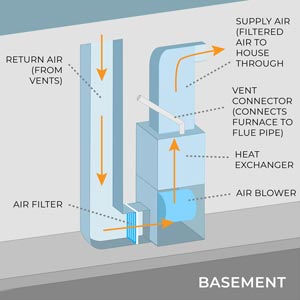
Upflow
Upflow Furnace
Takes in air from the bottom and pushes warm air upward (common in basements). Most commonly used with floor vents.
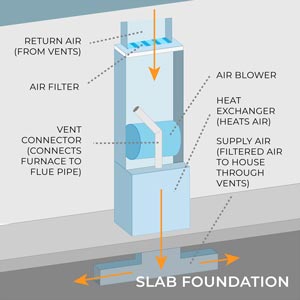
Downflow
Downflow Furnace
Pulls air from the top and pushes warm air downward (often used in attics). Most commonly used with ceiling vents.
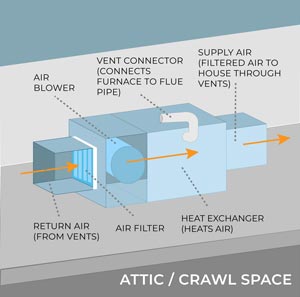
Horizontal
Horizontal Furnace
Moves air side to side, usually installed in crawl spaces or tight areas. Usually used sidewall or rooftop venting.
 TIPS
TIPS
Furnace Orientation
Furnace orientation matters because it determines how air moves through the system, ensuring proper performance, efficiency, and compatibility with your home’s ductwork.
Using the wrong orientation can cause poor airflow, inefficiency, or require costly duct modifications.
Tonnage & BTU
Air conditioners and heat pumps are rated in tons- this measures cooling capacity.
Furnaces are rated in BTU/hr - this measures heating capacity.
How to Determine the Right BTU or Tonnage for Your HVAC System
Use the guide and tools below to find the right system size for your space.
Step 1: Locate Your Current System’s Info
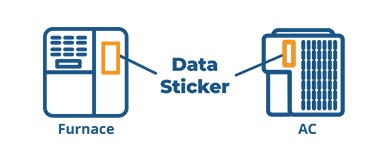
You can usually find the BTU listed on your furnace’s data sticker, often located inside the cabinet door or on the inner or outer wall of the cabinet. On an air conditioner, the data sticker is typically found on the outer panel of the outdoor condenser unit, often near the electrical disconnect box.
Look for terms like M/N, Prod, Mod No, or Model Number to identify your system. These numbers can also help you find a replacement if needed and the product manual (if you need to look up the BTU/Tonnage).
Step 2: Calculating BTU and Tonnage
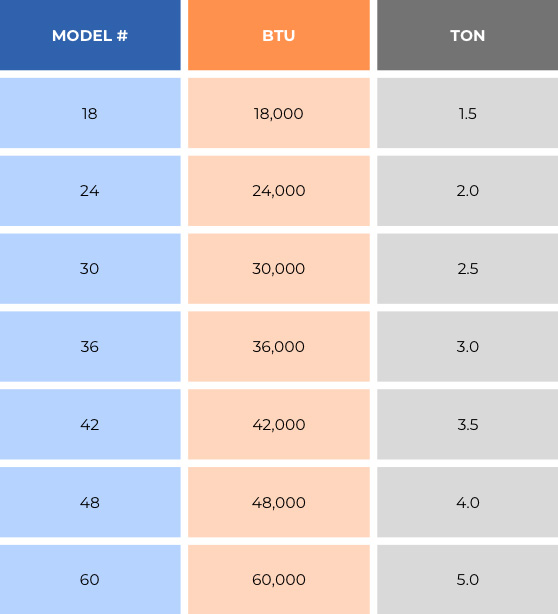
You can also use the model number to determine BTUs. You’ll find an even number within the model number string. Multiply this number by 10,000 to calculate the unit’s BTU.
From there, tonnage is typically calculated by dividing BTUs by 12,000 (since 1 ton = 12,000 BTUs).
If you don’t have product data available, you can also use our sizing calculator to use square feet to determine your needs.
Furnace Data Sticker
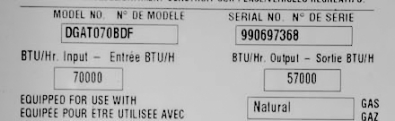
Model Number: DGAT070BDF
BTU: 70,000
AC (Heat Pump) Data Sticker
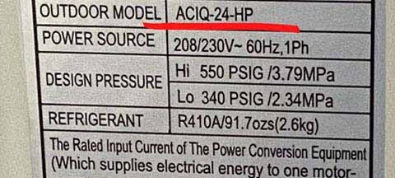
Model Number: ACIQ-24-HP
BTU: 24,000 TONNAGE: 2.0
The easiest way to find what you need to replace your current furnace is by locating your current unit’s model number. First, locate your data sticker. For furnaces, this is usually located on the inside of the cabinet door, located by removing the top service panel. It can also be found on the inside or outside wall of the cabinet.
Once located, you will see M/N, prod, mod no, or Model Number. Next to this is your model number that you can easily use to search for your new unit.
If you need to know your furnace’s BTU/hr, this is listed next to the labels input/output. You can use this number to calculate your efficiency by dividing your furnace input by furnace output.
For example, when looking at the graphic, Our input is 70,000 BTU/hr and output is 57,000.
70,000/57,000 = .814. Your furnace is 81% efficient.
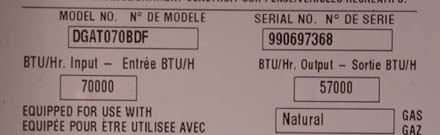
On this sticker you can also typically locate the year your unit was made, voltage, and serial number. Information included on this label varies by brand.
