Article Contents
Key Takeaways
- Accurate Pool Volume Calculation: Measure length, width, and average depth in feet, convert cubic feet to gallons (×7.5) to determine the precise water volume before selecting BTU capacity.
- Climate-Based BTU Rule of Thumb: Use 4 BTU/gal for typical summer conditions and 5 BTU/gal for cooler spring/fall climates to match heat pump output with ambient temperatures.
- Surface Area & Heat Loss Considerations: Larger surface area and wind exposure increase heat loss—using a pool cover and accounting for ceiling height (indoor pools) helps optimize sizing and run times.
When the summer heat hits hard, there’s nothing better than diving into a cool, refreshing pool. But what happens when the water feels more like bathwater than a retreat? That’s where a pool heat pump with cooling functionality comes in. Not only can it warm your pool during chilly mornings or cool nights, but it can also cool it down when the sun turns your swimming spot into a sauna.
Proper pool heat pump sizing is essential to achieve year-round comfort, minimize energy use and protect your equipment investment. In this guide, we’ll walk you through everything you need to know—plus, we’ve included a pool heater sizing chart to make it even easier!
How to Size Your Pool Heat Pump
Accurate pool heat pump sizing helps you avoid wasted energy, prevents short cycling, and ensures your system performs reliably. Follow these three simple steps:
Step 1: Calculate Your Pool Volume
Measure your pool’s dimensions in feet: length × width × average depth = cubic feet.
Average depth is calculated as (Shallow end depth + Deep end depth) ÷ 2.
Convert to gallons by multiplying cubic feet by 7.5.
Step 2: Determine Your BTU Requirement Based on Climate
Pool heat pumps are rated in BTU/h, indicating how many British Thermal Units they can add or remove per hour. Use this general rule of thumb based on your region and the time of year:
-
4 BTUs per gallon – Ideal for normal summer conditions
(average ambient temp ~70 °F over 24 hours).
Example: 10,000-gallon pool → 40,000 BTU unit. -
5 BTUs per gallon – Recommended for spring/fall (avg temp ~60 °F).
Example: 10,000-gallon pool → 50,000 BTU unit.
Step 3: Match Your Load with the Right Heat Pump
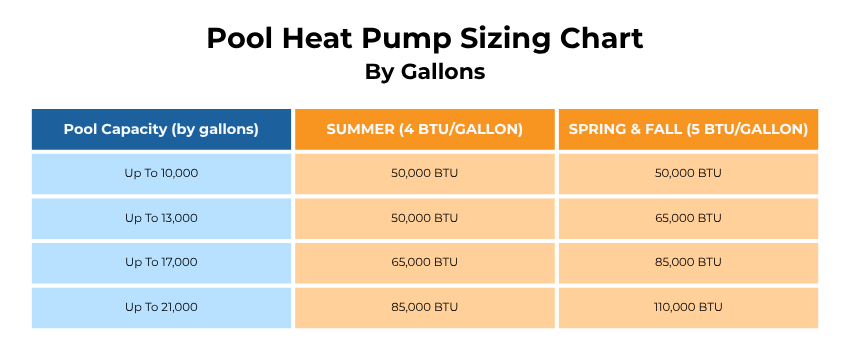
HVACDirect.com offers a helpful pool heat pump sizing guide that anyone can use. It includes step-by-step instructions for sizing by gallons or by pool shape—ideal for round and oval pools. The chart above outlines guidelines using gallons as the unit of measurement. For full details and additional sizing charts, visit our sizing page. Madimak, a brand well-known for their pool heat pumps, also has their own pool heat pump calculator as well. When comparing models, consider:
- Daily use time: longer swim sessions require more capacity
- Regional climate: hotter areas may need extra cooling power
- Pool cover use: covers dramatically reduce heat loss
Real-World Pool Heat Pump Sizing Example
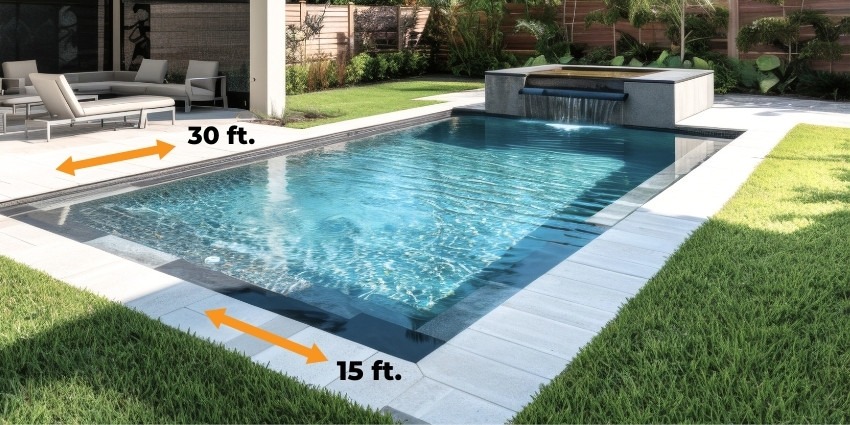
Let’s say we have a rectangular pool with these features:
- Length: 30 ft.
- Width: 15 ft.
- Shallow End Depth: 3 ft.
- Deep End Depth: 7 ft.
- Average Depth: (3 + 7) ÷ 2 = 5 ft.
Calculate cubic feet, then convert to gallons:
30 × 15 × 5 = 2,250 cu. ft.
2,250 × 7.5 = 16,875 gallons
Use our chart to determine the approximate number of BTUS you need. From our chart, under the “By gallons” section, this pool’s capacity falls under the “Up to 17,000” section. This means you would need a pool heat pump with a 65,000 BTU rating in the Summer and an 85,000 BTU rating in the Spring & Fall.
If this had been a 30 ft. by 15 ft. oval pool, you would use the “Oval Section.” Since this pool matches the 15’ x 30’ pool size category (50,000 BTU in Summer and 65,000 BTU in Spring/Fall), we would recommend sizing up one to 18’ x 33’, which has the same requirements as our rectangular pool.
Key Factors Affecting Pool Heat Pump Size
Pool Volume & Surface Area
A larger surface area accelerates heat loss (or heat gain). Using a pool cover when the pool is idle can cut energy demands by up to 50%.
Desired Temperature Adjustment (ΔT)
The greater the gap between ambient air and your target water temperature, the more BTU power you’ll need. In colder climates, size closer to the spring/fall rule; in hot climates, lean toward summer sizing.
Climate & Ambient Conditions
- • Hot & Humid Climates (FL, AZ): oversize by 10–15% and prioritize cooling benefit from oversizing by 10–15% and prioritize cooling.
- • Moderate Climates: balanced heating/cooling needs; inverter tech shines here
- • Cold Climates: focus on heating capacity; look for defrost cycles
Pool Usage Patterns
- High-use pools (fitness centers, active families) need more robust systems.
- Weekend-only pools can often get by with smaller units, especially if covered.
Other Environmental Factors
- Sunlight exposure reduces heating demand.
- Wind increases heat loss—windbreaks or fences help.
- Indoor pool installations generally need less capacity thanks to stable temperatures.
Climate-Specific Sizing Recommendations
Hot & Humid Climates
Cooling is critical when daily temperature highs exceed 80°F. For a standard 15×30 ft pool in Florida, you’re looking at 60,000–80,000 BTU capacity to maintain comfort and prevent algae growth.
Mild & Moderate Climates
Balanced seasonal heating and cooling needs make dual-function inverter models ideal. A quiet inverter pool heat pump for residential pools offers the flexibility to heat in spring/fall and cool in summer.
Why Proper Sizing Matters
If you do not size your pool heat pump correctly, it can cause some serious issues.
Undersized Pool Heat Pumps
When a pool heat pump is too small for your pool’s volume and climate, it simply can’t keep up. An undersized unit will struggle to reach and sustain your target temperature, running continuously at full blast just to claw back a few degrees. That constant high-power operation drives up your energy bills and wears out components faster, shortening the pump’s overall lifespan. And on the hottest days, an undersized system may never be able to cool the water adequately, leaving swimmers stewing in lukewarm—or even hot—pool water.
Oversized Pool Heat Pumps
On the other hand, going too big creates its own headaches. An oversized heat pump short cycles: it fires up, overshoots the set point, then shuts off again almost immediately. Those constant on/off cycles not only waste energy in every startup but also prevent the system from running long enough to properly circulate and filter the water. The result is uneven temperatures, excessive wear on the compressor, and higher upfront equipment costs that you never fully recover through performance gains.
Properly Sized Pool Heat Pumps
A properly sized heat pump, by comparison, runs steadily at moderate output. It maintains your desired temperature efficiently, quietly, and with minimal cycling - maximizing energy savings and extending the system’s lifespan.
When in doubt, always round up to the nearest available model size. Slightly oversizing your heat pump is typically better than undersizing, as it allows the unit to reach the desired temperature faster and operate more efficiently over time—without running at full capacity nonstop.
Shop Pool Heat Pumps at HVACDirect.com
Sizing your pool heat pump with cooling is the most important step in getting year-round comfort without breaking the bank. Whether you’re swimming daily or just on weekends, the right system will save you money, protect your equipment and enhance your pool experience.
Ready to find the perfect fit? Use our pool heat pump sizing guide or check out our full lineup of pool and spa heaters.
Pool Heat Pump Frequently Asked Questions
Look for models with high-BTU cooling capacity, reliable defrost cycles, and variable-speed modes—units like the Madimack InverECO excel in extreme heat.
If you live in a hot region and want consistent, comfortable water temperature all year, a pool heater with cooling is a worthwhile investment. But if you only need heating (or you don’t mind letting your pool warm up in peak summer), a traditional heat pump or gas heater—possibly paired with a separate chiller when needed—might be okay.
Inverter models offer lower operating costs by running more efficiently than fixed-speed units—especially when temperatures fluctuate. This cost is dependent on many variables including runtime, climate, and local energy rates.
While it’s possible for experienced DIYers, we recommend hiring a professional for proper sizing, electrical setup, and warranty compliance.