We use cookies to make your experience better. To comply with the new e-Privacy directive, we need to ask for your consent to set the cookies. Learn more.

1-800-397-1392
Today's Hours 8am - 11pm est

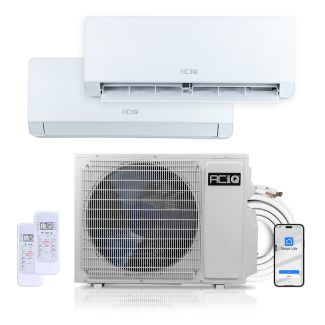

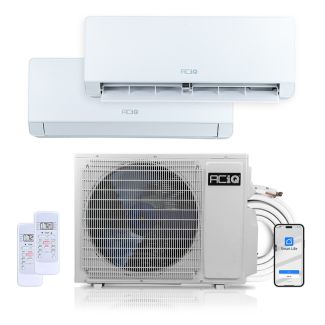
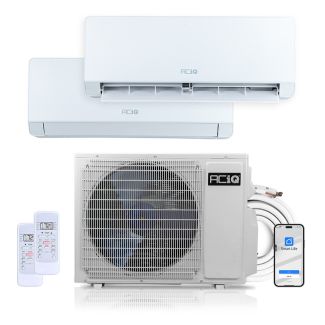
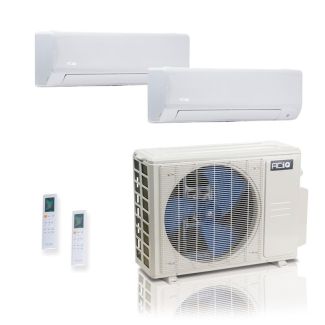

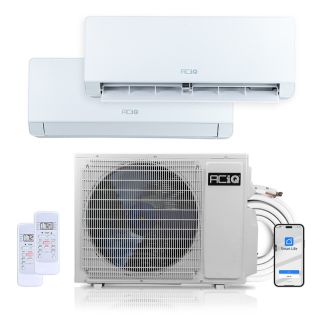
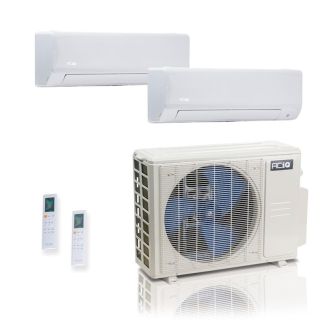
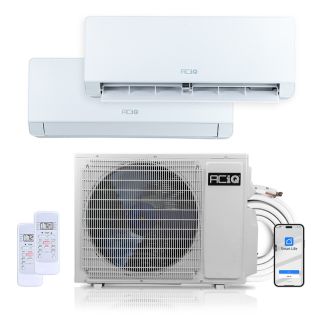
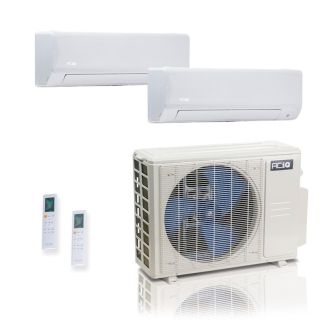
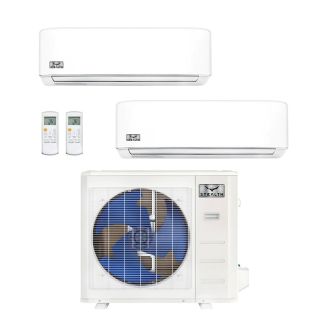

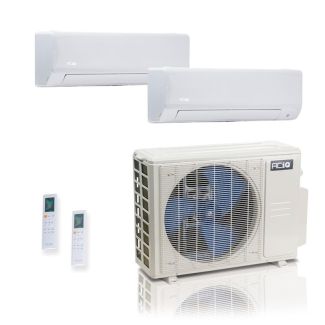
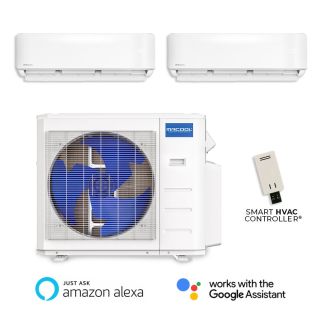
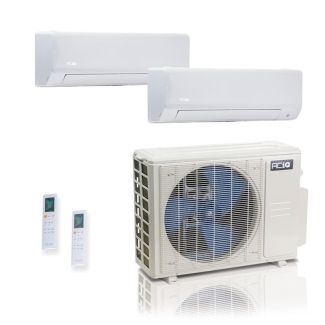
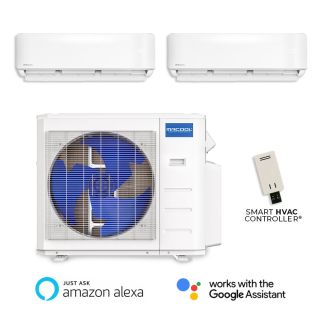
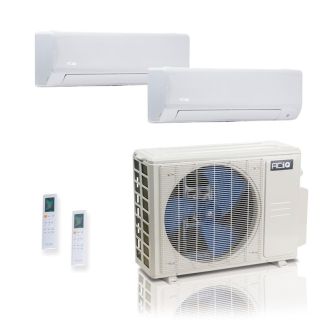
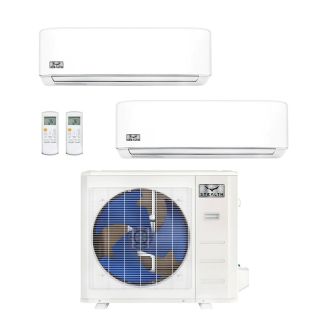
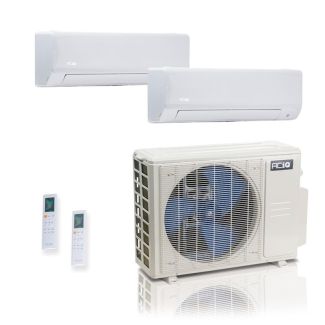
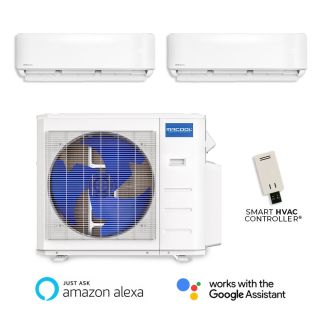
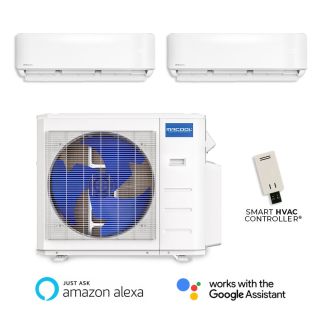
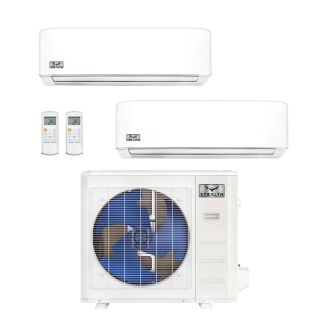
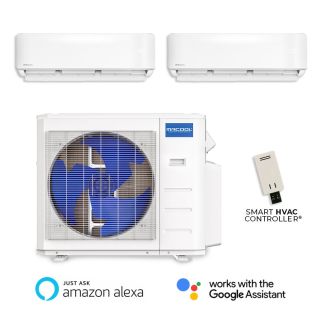
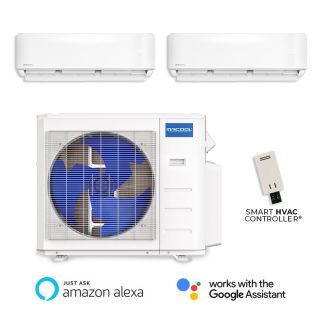
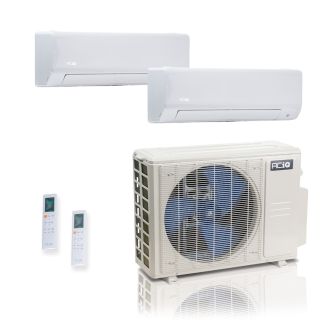
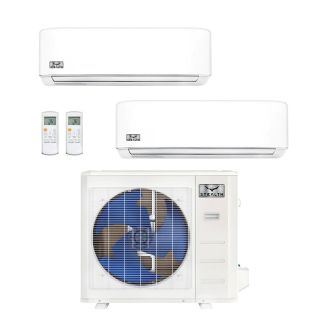

Two zone mini split systems, also known as dual zone mini splits, consist of one outdoor condenser with two air handlers designed to heat or cool two separate zones with each space having its own thermostat-controlled temperature. The outdoor condenser circulates refrigerant through connected lines to exchange heat directly at each indoor air handler. Because no ductwork is required, these 2 zone systems are a much cheaper alternative than running ductwork into new areas. They also avoid the energy losses common with ducted central air systems and can be up to 30% more efficient than ducted systems.
These systems perform most efficiently in rooms with 8-to-10-foot ceilings and 400 to 800 square feet of floor space, which usually include bedrooms, offices, and sitting rooms.
Primary Bedrooms and Living Rooms: Spaces like bedrooms and living rooms often need different temperatures at different times of day and night, based on space occupancy. A 2 zone mini split lets you control each room independently for better comfort and efficiency.
Home and Business Offices with Adjoining Rooms: Areas that share a wall, like a home office for work and a bedroom for rest, typically require entirely different climate settings. The same goes for business locations that might feature a small commercial office attached to a larger storefront area. A dual zone system allows each room to maintain its own temperature without affecting the other.
Primary Suites and Sitting Rooms or Nurseries: Attached spaces like nurseries or sitting rooms are often occupied differently than a main bedroom and may need different temperature settings. A 2 zone mini split gives each area independent control, helping keep everyone comfortable.
Detached Buildings and Mother-in-Law Suites: These mini splits are ideal for detached buildings which require individual air conditioning, like guest houses or cabins, mother-in-law suites, and even small commercial display structures. They also can be affected by their own independent environmental challenges (insulation, sun exposure, area dimensions).
Open-Concept Areas: When larger zones like open-concept living spaces and workshops measure more than 600 square feet, a single mini split head may not provide the best air coverage. Two zone units can provide stronger airflow and cover more ground with dual air handlers for better high-capacity efficiency and comfort.
Rooms with ceilings above 10 feet, poor insulation, or excessive sun exposure often need a higher BTU rating than the standard 400 to 800 sq. ft. guideline suggests. It is important to factor these conditions in before choosing a new dual zone system, so it can provide adequate heating and cooling.
A 2 zone AC unit can be installed as a DIY project or by a licensed professional, with tradeoffs including upfront cost and installation time. Professional installation is more common, and the difference between the two installations is often a matter of time and budget.
DIY Installation: Dual zone systems made for DIY installation come pre-charged with refrigerant, eliminating the need for a licensed professional to handle and vacuum refrigerant. However, the homeowner must have the time and energy to make DIY installation viable.
Professional Installation: Although it comes as a greater expense than DIY installation, professional installation of these mini splits is completed entirely by licensed professionals. Homeowners are not responsible for any part or stage of this install.
Whether you choose a self-installed route or a professional install, securing local municipal permits and ensuring a licensed electrician handles the final high-voltage connections are vital for safety and warranty preservation.
The starting range of these mini split units typically begins between $1,800 to $2,000 for equipment alone. Other items such as permits, installation, and labor fees can also raise the costs from $750 to $1,000, depending on the kind of mini split installation that takes place.
Equipment Cost: Brands like ACiQ have 2 zone systems that begin at $1,850, while other brands like Mitsubishi begin around $3,000. Features like installation type, BTU, and efficiency rating affect the equipment price.
Installation and Labor Cost: DIY setups eliminate professional installation fees entirely, requiring only an investment of personal labor and time. On the other hand, professional installation fees can begin in a range from $500 to $750 in installation fees, depending on the setup. The more complicated the installation (depending on the installation location and mini splits), the higher the costs.
Operation and Maintenance Cost: Operating a high-efficiency dual zone system year-round generally adds a modest $20 to $60 to your monthly electrical utility bill depending on your regional energy rates. Most often, mini split filters can be washed out and reinstalled, but if filter replacement is necessary, popular brands like ACiQ charge just under $10 for new filters. Professional annual unit cleaning may cost anywhere from $50 to $350.
Permits are required for most 2 zone unit installations, so homeowners should expect fees ranging from $100 to $300 to secure them. In some areas, however, permit costs can reach $500 or more depending on local regulations.
Two zone mini splits are available in five indoor unit styles that can be mixed and matched, depending on room measurement and homeowner preference, such as: wall mounted, floor mount, ceiling cassette, slim ceiling cassette (or slim duct), and concealed duct.
Wall Mount: Hung high on walls to provide strong airflow at no more than the sound of a whisper, wall mount air handlers are the most popular indoor unit option for 2 zone systems.
Floor Mount: Also known as low wall air handlers, dual zone floor mounted heads are affixed low on the wall near ground level. They are mounted both on and against walls, just above baseboards, and are popular for bedrooms and other sorts of living areas.
Ceiling Cassette: Standard-size ceiling cassettes deliver powerful, multidirectional airflow and are sometimes called 4-way ceiling cassettes. They are most valued for their low-profile appearance when mounted flush with the ceiling in open spaces and larger rooms.
Slim (or Slim Ceiling Cassette): For areas that feature drop ceilings or rooms that have low ceilings and minimal overhead space, slim mini splits can be installed directly flush into ceilings to provide discreet air conditioning in 2 zone setups. It may also be identified as a slim ceiling cassette or slim duct.
Concealed Duct: Constructed for installation behind walls or above ceilings, the concealed duct head is designed to be out of sight. Airflow from a dual zone concealed duct system can disperse through small vents, allowing for the unit to be virtually invisible.
Standard-size ceiling cassettes, slim ceiling cassettes, and concealed duct heads are sound choices for rooms where total-room air coverage is a priority, whereas wall mounted and floor mounted air handlers are well-valued for where concentrated airflow is desired.
Dual zone mini split systems span broadly across BTU sizes in air handlers. They commonly range from 6,000 BTU to 36,000 BTU with a general coverage area from as small as 150 square feet and up to 1,500 total square feet. Concerning the list of BTU ranges below, the matched combination of two indoor zones dictates the total capacity that a 2 zone mini split’s outdoor condenser must support.
6,000 to 9,000 BTU (150 to 400 sq. ft.): Great for small offices and bedrooms where room occupancy is consistent over long periods of time.
12,000 to 18,000 BTU (400 to 900 sq. ft.): Standard areas, medium-sized rooms, and living spaces that vary in room occupancy are well-aided by dual zone systems.
24,000 to 27,000 BTU (900 to 1,500 sq. ft.): Airy, open areas that exceed single-space measurements, and garages that fluctuate in temperature during seasonal conditions are good pairings for 2 zone units.
30,000 to 36,000 BTU (1,300 to 2,000 sq. ft.): Commonly used for small-to-medium houses for 2 rooms, such as a medium-sized bedroom, and either a living area, office, or bonus room.
42,000 to 48,000 BTU (2,000 to 2,600 sq. ft.): Great for larger homes with two distinct zones, such as a living room and a garage or basement.
55,000 to 60,000+ BTU (2,600 to 3,000+ sq. ft.): Used for extra-large homes, open floor plans, or spaces that have poor insulation, high ceilings, or extreme climates.
Room layout, insulation quality, sun exposure, and how often the room is occupied all affect the amount of heating and cooling power needed. These environmental factors play a major role in how high your air handlers’ BTU levels should be in each room. To avoid undersizing an installed 2 zone system, factoring in environmental loads by adding 10% to measured BTU baseline calculations for spaces featuring ceilings over 10 feet, sparse insulation, or high solar heat gain is key.
Most dual zone mini splits operate on dedicated 208/230V circuits. 230V units require dedicated electrical circuits to ensure proper performance.
Voltage & Amperage: A dedicated 208/230V circuit adequately powers the outdoor unit for medium to large 18K, 24K, and 36K BTU mini splits.
Dedicated Circuit Breaker: 20-amp to 25-amp breakers are recommended for mini splits rated at 18,000 BTU. 30A to 45A breakers are best for 24K to 36K BTU units.
Wire Gauge: High-voltage supply lines require 10-gauge copper wiring from the main panel to the condenser for power, while low-voltage multi-conductor 14/4 stranded wire connects the outdoor unit to each indoor head for communication.
Disconnect Box: For service ease and quick-access power shutoff, a 60A non-fused disconnect box serving 18K and 24K BTU mini splits operating on 230V is sufficient. Non-fused disconnect boxes are standard for most 18K to 24K BTU installations, while fused disconnect boxes provide additional internal fuse protection for larger or more sensitive electrical setups.
Inspecting the installation manual and outdoor unit nameplate are essential pre-installation steps to ensure a code-compliant and safe dual zone system install.

Yes, these systems are highly energy-efficient by comparison to conventional ducted air systems, especially units featuring inverter technology. Inverter technology involves the motor speed of the outdoor unit’s compressor determining how fast or slow refrigerant moves through the indoor zone air handlers. How fast or slow refrigerant moves within the lines connected to the indoor heads impacts the coolness or warmth of a room by thermostat. Ductless mini split systems can reduce energy consumption by up to 60% compared to traditional central air conditioning.
Two zone mini splits that are heat pumps can provide both heating and cooling, which they do by transferring heat into or outside of your home. Cooling-only mini splits act solely as air conditioners and are typically found in consistently warm climates where indoor heating is unnecessary.
A dual zone system is specifically designed to heat and cool two separate indoor rooms or areas. Two indoor air handlers are connected to a single outdoor unit and operate independently to provide customized comfort for those specific spaces.
Popular makers of dual zone systems like MRCOOL, Mitsubishi, and Daikin are well-known brands, but ACiQ stands out as the best option for matching all three brands in premium quality, efficiency, and performance ratings, but at a better cost to customers.
Choosing a DIY 2 zone system is fine, if the homeowner wants to reduce labor costs and facilitate DIY mini split installation on their own timeline. Choosing a standard professionally-installed dual zone system normally includes an installation and labor fee from a licensed pro and a longer manufacturer's warranty. DIY kits feature factory-sealed, pre-charged refrigerant line sets designed for quick coupling without specialized gear. Standard systems require a licensed technician to flare copper tubing, perform line vacuuming, and manually release the system's refrigerant charge.
Yes, these mini split systems have a lifespan that typically ranges between 15 to 20 years with regular maintenance and sometimes up to 25 years. Maximizing this lifespan requires rinsing the indoor mesh filters every four weeks and maintaining clear physical clearance around the outdoor condenser coil.
Two zone systems are exceptionally quiet, with indoor units operating as low as 19 decibels (dBA), which is quieter than a whisper.
Yes, many dual zone mini splits utilize heat pump technology, enabling the mini split systems to create heating and cooling through the indoor heads and eliminating the need for a gas or electric furnace to create heat.
Two zone mini split systems can dehumidify in cooling mode by condensing moisture from the air as it passes over the cold evaporator coils. Manufacturers like ACiQ feature a dedicated "Dry Mode," which enhances moisture removal without significantly lowering the room temperature.
No, homeowners do not need to add refrigerant to a new 2 zone system. During a professional installation, a licensed technician will verify charge levels of a mini split’s line set and proceed with assembly and startup appropriately, which includes adding refrigerant. For homeowners choosing a DIY-friendly model, all systems include pre-charged line sets and sealed connections that are designed to avoid the need to add refrigerant during installation.
No, homeowners do not need to vacuum dual zone mini splits, as standard 2 zone systems are vacuumed and pressure-set by licensed professionals. Skipping this step can contaminate the system, reduce efficiency, and void your manufacturer's warranty. Conversely, specialized mini splits are always pre-charged with refrigerant and therefore need no additional vacuuming.