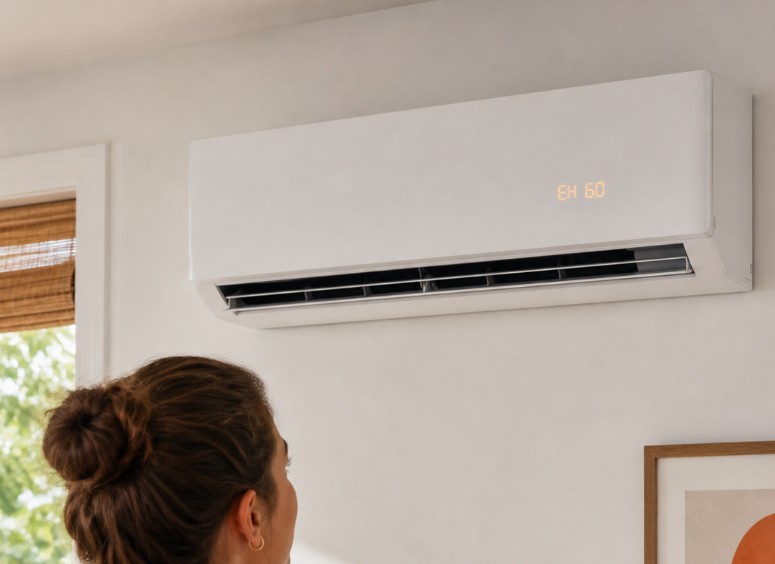
On Midea indoor units that use the EH-series diagnostic format, EH 60 means the T1 indoor room-temperature sensor circuit is open or short-circuited. The problem may be the sensor, its connector or wiring, or the indoor control board. It is not a refrigerant-pressure code, and changing the thermostat setting will not repair the circuit.
You can safely document the code, confirm the model numbers, clean an accessible filter, and perform one reset if the exact manual allows it. Sensor resistance testing, live-voltage measurements, wiring repair, and control-board replacement should be left to a qualified HVAC technician.
What Does the Midea EH 60 Error Code Mean?
The indoor unit uses the T1 thermistor to measure return-air temperature. That reading helps the controller compare room temperature with the setpoint. Midea's service documentation describes EH 60 as an open circuit or short circuit in the indoor room-temperature sensor T1 circuit.
“Open” means the control cannot see a complete electrical path. “Short” means the circuit resistance is abnormally low. Neither description proves the thermistor itself is bad. A loose plug, damaged lead, poor connection, moisture or contamination, or an indoor PCB fault can produce the same reported condition.
What You May Notice When EH 60 Appears
- The indoor display shows EH 60, EH60, or a controller-specific equivalent.
- The system stops heating or cooling or operates only in a protective state.
- The displayed room temperature may be implausible or may not update normally.
- The code returns after one controlled restart.
These symptoms are clues, not a parts diagnosis. The indoor board can display EH 60 when it cannot interpret the T1 circuit correctly, even if the sensor is not the only possible cause.
How to Troubleshoot Midea EH 60 Safely
- Photograph the complete display. Confirm that the code is EH 60 rather than EH 61, EH 00, or another similar-looking message.
- Record the equipment model numbers. Note the indoor-unit model, outdoor-unit model, and wired-controller model if present. Use the exact matching service literature.
- Check ordinary airflow items. With the unit off, clean the user-accessible filter according to the owner's manual and make sure curtains or furniture are not blocking return air. This may improve operation, but it does not repair an open or shorted sensor circuit.
- Check the room around the unit. Avoid directing a heater, strong sunlight, or another unusual heat source at the return-air inlet. Environmental heat can skew a healthy sensor reading, although it generally does not by itself create an electrical open/short code.
- Perform one controlled reset only if the model manual permits it. Turn the system off at the controller, shut off its dedicated disconnect or breaker, wait five minutes, restore power, and allow the normal startup delay. If you cannot positively identify the correct circuit, skip this step.
- Stop if EH 60 returns. Do not repeat breaker resets. Arrange model-specific diagnosis by a qualified HVAC technician.
Safety Note
Homeowner-safe: record the code and model numbers, clean an accessible filter, remove safe external airflow obstructions, and perform one manual-approved reset. Technician-only: remove the indoor-unit cover, access the electrical compartment, unplug or test the thermistor, probe a live board, repair wiring, or replace the PCB. Never bypass a sensor.
How a Technician Diagnoses EH 60
Midea's troubleshooting flow for temperature-sensor faults directs service personnel to verify the sensor connection, compare thermistor resistance with the temperature/resistance chart for the specific model, inspect wiring, and evaluate the indoor PCB when the sensor circuit checks correctly. The correct thermistor curve and test points must come from the matching manual.
| Check | What It Can Reveal | Who Should Do It |
|---|---|---|
| Confirm model-specific code table | Whether EH 60 has the expected T1 meaning on this unit | Homeowner or technician |
| Inspect T1 plug and harness | Loose connector, corrosion, pin damage, or broken lead | Qualified technician |
| Measure T1 resistance and compare with the manual's chart | Open, shorted, or out-of-range thermistor | Qualified technician |
| Test harness continuity with power isolated | Intermittent or broken wiring | Qualified technician |
| Evaluate indoor PCB input | Board fault when sensor and wiring test correctly | Qualified technician |
A technician should diagnose before ordering parts. Replacing the T1 thermistor without checking its harness and PCB input can leave the original fault unresolved.
Model-Specific Code Variations Matter
EH 60 is well documented across multiple Midea wall-mounted inverter service references, but it is not universal to every product sold under the Midea name. Portable, window, VRF, older split, and private-label equipment may use E1, E0, a flashing-lamp pattern, or another code for a room-temperature sensor problem. Some families use EH 61 for the T2 indoor-coil sensor, which is a different circuit and should not be treated as EH 60.
Use the indoor unit's full model number—not appearance alone—to select the service manual. On multi-zone systems, also document which head displays the code and the shared outdoor-unit model.
When to Call for Service
Schedule service when EH 60 returns after one controlled reset, the unit will not operate, the room-temperature display is clearly unreasonable, or there are signs of water intrusion, damaged wiring, burning odor, or electrical noise. Turn the system off and leave it off if you smell burning or see damaged electrical components.
Frequently Asked Questions
What does EH 60 mean on a Midea mini split?
On Midea families using this code set, EH 60 means the indoor room-temperature sensor T1 circuit is open or short-circuited. Confirm the exact model manual before replacing anything.
Can a dirty filter cause EH 60?
A dirty filter can restrict airflow and affect comfort, but EH 60 specifically points to an electrical problem detected in the T1 sensor circuit on the referenced models. Cleaning the filter is sensible maintenance, not a substitute for circuit diagnosis.
Is EH 60 the same as EH 61?
No. EH 60 identifies the T1 room-air sensor circuit; EH 61 identifies the T2 evaporator-coil sensor circuit in the referenced Midea service literature.
Should I keep resetting the breaker?
No. One controlled reset may clear a temporary state, but repeated resets cannot repair an open or shorted sensor circuit and can obscure a recurring fault.
Sources
- Midea EP/GA R32 3D Inverter Service Manual — indoor error table and temperature-sensor troubleshooting.
- Midea Celest Pro 2026 Catalogue — official EH 60 quick-troubleshooting definition.
- HVACDirect: Midea LP Error Code and Multi-Zone Mode Conflicts — related guidance on confirming model-specific Midea codes.