Key Takeaways
- Two Functions in One Unit: The NRCB produces hot water for showers, sinks, and appliances while also supplying heated water to a compatible hydronic heating system.
- Simultaneous Operation: The NRCB is designed to provide hot water for showers, faucets, and appliances while continuing to serve the home's hydronic heating system under compatible operating settings.
- Two Output Sizes: The NRCB180DV and NRCB199DV offer different hot water and space-heating capacities.
- Hydronic Heating Required: The NRCB works with water-based heating systems such as radiant floors, baseboards, radiators, and compatible hydronic air handlers.
Article Contents
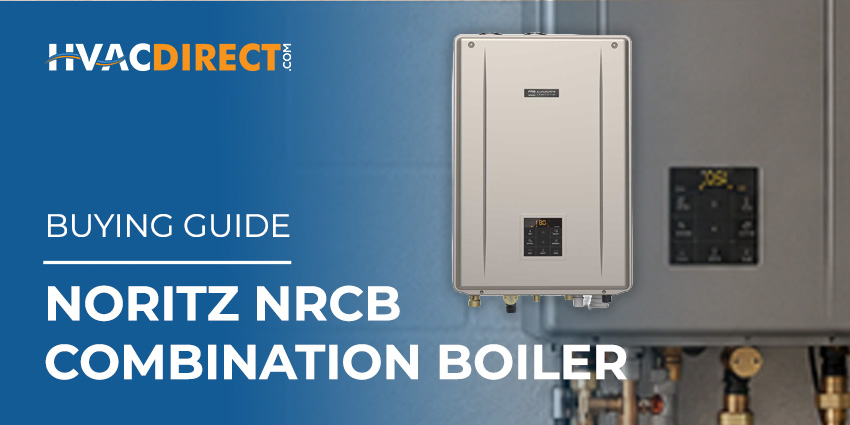
The Noritz NRCB does more than a standard tankless water heater. It combines two household systems into one compact, wall-mounted unit: hot water for showers, faucets, and appliances, plus hot water for a home's radiators, baseboards, or in-floor heating.
In many homes with water-based heating, a boiler heats the living space while a separate water heater supplies everyday hot water. The NRCB can handle both jobs, which may reduce the amount of equipment needed.
That is the main difference between the NRCB and the Noritz EZ Series. The EZ Series is designed for homeowners who only need hot water for fixtures and appliances, such as when replacing a traditional gas storage-tank water heater. The NRCB is intended for homes that also need a boiler for hydronic space heating. This guide explains how the NRCB works, its main features, and what to consider when choosing the right size for your home.
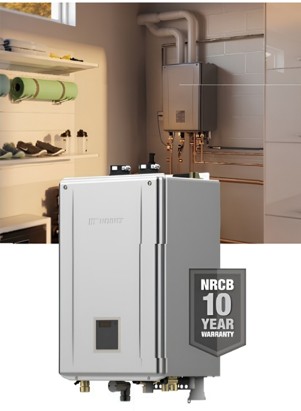
What Is the Noritz NRCB Combination Boiler?
The Noritz NRCB is a high-efficiency, condensing combination boiler that provides household hot water and hydronic space heating from one appliance.
On the household hot water side, the system heats water for showers, faucets, dishwashers, and washing machines. On the heating side, it sends heated water through a compatible hydronic system, which may include:
- Radiant Floor Heating: Heated water circulates through tubing beneath the floor.
- Hydronic Baseboards: Hot water moves through baseboard heating elements positioned around the home.
- Radiators: The system supplies heated water to traditional or modern hydronic radiators.
- Hydronic Air Handlers: A compatible water coil can transfer heat into air distributed through ductwork.
- Other Water-Based Applications: Properly designed panel radiators, fan coils, and similar hydronic equipment may also be used.
Because the NRCB serves both sides of the system, it should be viewed as part of the home's complete heating design rather than only as a water heater.
When Should You Use a Noritz NRCB?
The NRCB is best used when a home needs both hydronic space heating and household hot water. Common applications include:
- Replacing a Boiler and Water Heater: The NRCB may allow an installer to remove two aging appliances and replace them with one wall-mounted unit.
- Building a New Hydronic Home: It can support new construction designed around radiant floors, baseboard heat, radiators, or a hydronic air handler.
- Updating a Mechanical Room: Replacing floor-standing equipment with a wall-hung combi boiler can create additional usable floor space.
- Supporting Year-Round Hot Water Demand: The household hot water system operates separately from the home's heating schedule, so hot water remains available year-round, even when the heat is turned off.
- Using Natural Gas or Propane: Both NRCB capacities are offered in versions configured for natural gas or liquid propane.
The NRCB is not the right starting point for a home that only has a conventional forced-air furnace and no water-based heating system. In that situation, an EZ Series tankless water heater would generally make more sense because the home only needs household hot water equipment.
Why Choose an NRCB Instead of an EZ Series Water Heater?
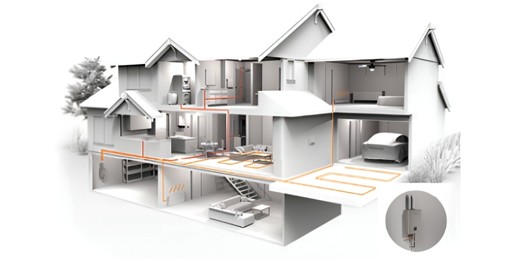
Choose the NRCB when you need a boiler and water heater. Choose the EZ Series when you only need a water heater. The difference is not simply capacity. It is the job the appliance is designed to perform.
The EZ Series is designed only to provide hot water for everyday household use, such as showers, faucets, dishwashers, and washing machines. It does not heat water for radiators, baseboards, or in-floor heating. The NRCB can do both jobs. It provides hot water for the home while also supplying a separate hot-water heating system. The NRCB provides separate temperature settings and controls for household hot water and hydronic space heating, allowing each function to be configured around the home's needs.
An NRCB may be the better option when:
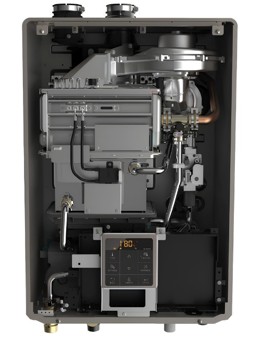
- Two Appliances Need Replacement: One properly sized combi boiler may take the place of a boiler and separate water heater.
- Mechanical-Room Space Is Limited: The wall-mounted cabinet can use less floor area than two individual appliances.
- The Home Already Uses Hydronic Heat: The NRCB is designed around water-based distribution rather than a conventional forced-air furnace.
- Heating Must Continue During Hot Water Use: Its simultaneous operating design helps avoid the heating interruption associated with domestic-hot-water-priority combi systems.
The EZ remains a better fit for tank-to-tankless water heater replacements. The NRCB is the more complete solution for a property that needs both services.
What Are the Main Features of the Noritz NRCB?
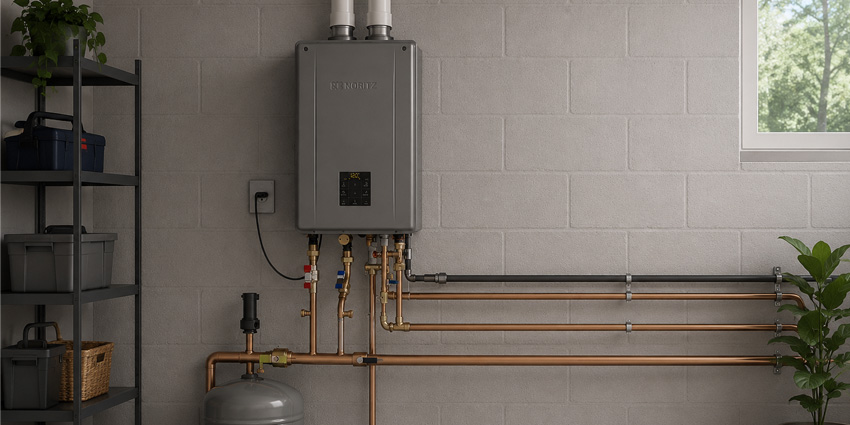
Noritz built the NRCB to handle two separate demands: heating the home and supplying hot water for showers, faucets, and appliances.
- Simultaneous Household Hot Water and Heating: Unlike many combi boilers that temporarily pause space heating when hot water is needed, the NRCB is designed to support both functions at the same time under compatible operating settings. This can help the home continue receiving heat while someone showers or uses another hot-water fixture.
- Separate Heating and Household Hot-Water Capacities: Because the NRCB performs two different jobs, each model has separate BTU ratings for space heating and household hot water. The NRCB180DV can use up to 100,000 BTU/h to heat the home and up to 180,000 BTU/h to produce household hot water. The NRCB199DV can use up to 120,000 BTU/h to heat the home and up to 199,900 BTU/h to produce household hot water.
- Stable and Quick Temperature Control: Built-in controls respond to changing domestic and heating demand to help limit sudden temperature increases or decreases.
- Three Stainless-Steel Heat Exchangers: The NRCB uses a primary exchanger, secondary exchanger, and plate-type exchanger. Stainless-steel construction provides resistance to corrosion and supports long-term operation.
- High Household Hot Water Capacity: The NRCB180DV has a maximum domestic input of 180,000 BTU/h, while the NRCB199DV reaches 199,900 BTU/h.
- Premix Burner: The premix design combines fuel and air before combustion to support efficient operation and reduced emissions.
- 95% AFUE: Both models are rated at 95% Annual Fuel Utilization Efficiency for the space-heating side.
- Separate Temperature Ranges: Household hot water and hydronic heating temperatures can be set independently based on system requirements.
Together, these features allow the NRCB to function as more than a tankless water heater with a heating connection added to it. It is designed as an integrated hot water and hydronic heating appliance.
Noritz NRCB Technical Specifications
The NRCB has separate BTU ratings for its two jobs. The space-heating rating applies to the heated water sent through radiant floors, baseboards, radiators, or a hydronic air handler. The household hot-water rating applies to showers, faucets, dishwashers, and other plumbing fixtures.
The NRCB180DV has a maximum space-heating input of 100,000 BTU/h and a maximum household hot-water input of 180,000 BTU/h. The NRCB199DV increases those ratings to 120,000 BTU/h for space heating and 199,900 BTU/h for household hot water.
| Feature | NRCB180DV | NRCB199DV |
|---|---|---|
| Household Hot Water Input | 18,000–180,000 BTU/h | 18,000–199,900 BTU/h |
| Household Hot Water Flow Range | 0.29–9.8 GPM | 0.29–11.1 GPM |
| Space-Heating Input | 18,000–100,000 BTU/h | 18,000–120,000 BTU/h |
| Maximum Heating Capacity | 95,000 BTU/h | 114,000 BTU/h |
| AFUE | 95% | 95% |
| Heating Temperature Range | 80°F–180°F | 80°F–180°F |
| Household Hot Water Temperature Range | 90°F–140°F | 90°F–140°F |
| Approved Elevation | Up to 10,000 feet | Up to 10,000 feet |
| Warranty | 10-year heat exchanger, 5-year parts, 1-year labor | 10-year heat exchanger, 5-year parts, 1-year labor |
Both models offer the same efficiency rating, temperature ranges, elevation approval, and warranty coverage. The NRCB199DV provides the higher maximum heating capacity and household hot-water flow rate.
What Additional Features Does the NRCB Include?
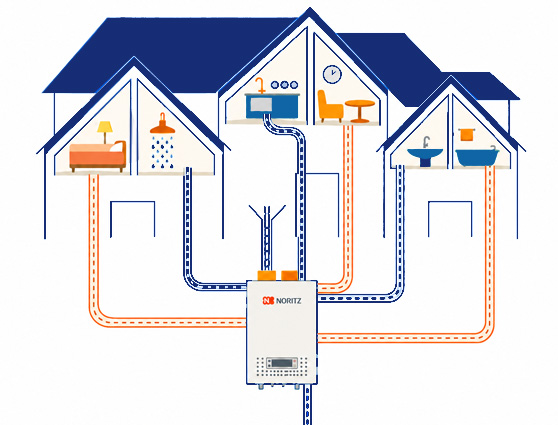
The NRCB includes several features that help it work with homes that have multiple heating zones, long plumbing runs, or more advanced water-based heating systems.
- Support for an Additional Heating Loop: The NRCB can control an external pump for a second heating loop. This is useful in homes with multiple zones, such as separate heating areas for different floors, an addition, or an in-floor heating system.
- Hot Water Flow and Bypass Control: Internal valves manage how water moves through the hot-water side of the system, helping the NRCB reach and maintain the selected outlet temperature as demand changes.
- Outdoor Temperature Sensor: The included sensor allows the boiler to adjust based on the weather outside. During milder weather, it can use lower-temperature water to heat the home. As outdoor temperatures fall, it can raise the heating-water temperature to provide more warmth. When properly set up, this can improve comfort and reduce unnecessary energy use.
- DHW Preheat Function: The NRCB includes a preheat function designed to help the system respond more quickly when a shower or faucet is turned on.
- Hot Water Recirculation Compatibility: The NRCB can be used with a compatible recirculation system that keeps hot water moving through the home's plumbing. This can reduce the time spent waiting for hot water at bathrooms or fixtures located far from the unit. Additional components may be required.
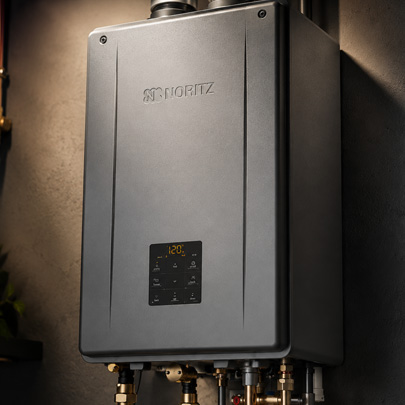
- Separate Hot Water and Home Heating Settings: The NRCB allows household hot water and space-heating temperatures to be controlled separately. Hot water for showers and faucets can be set from 90°F to 140°F, while water used to heat the home can be set from 80°F to 180°F.
- Approved for High-Elevation Homes: The NRCB can be installed at qualifying elevations of up to 10,000 feet when Noritz installation requirements are followed.
Together, these features allow the NRCB to adapt to the home's layout, heating zones, local weather, and hot water needs. A qualified installer can configure the system to provide more consistent comfort and dependable hot water throughout the home.
How Do You Size a Noritz NRCB Combination Boiler?
A Noritz NRCB must be sized for two separate needs: heating the home and supplying household hot water. Unlike the Noritz EZ Series, which is sized only around hot-water demand, the NRCB also must provide enough space-heating capacity for the property.
The Noritz Residential Sizing Calculator can help with preliminary hot-water sizing. However, the home's space-heating requirement must still be determined through a professional heat-loss calculation.
Step 1: Calculate the Home's Heating Load
Begin with a professional heat-loss calculation, such as Manual J. This determines how many BTUs per hour the home requires during the coldest expected weather. The calculation considers the home's size, insulation, windows, ceiling height, air leakage, and local winter temperatures. Compare the result with each model's maximum heating capacity:
| Model | Maximum Heating Input | Maximum Heating Capacity |
|---|---|---|
| NRCB180DV | 100,000 BTU/h | 95,000 BTU/h |
| NRCB199DV | 120,000 BTU/h | 114,000 BTU/h |
Maximum input describes how much fuel the boiler can use. Maximum heating capacity is the more relevant figure when comparing the unit with the home's calculated heating requirement.
For example, if the home requires more than 95,000 BTU/h, the NRCB180DV would not provide enough maximum heating capacity, so the NRCB199DV would need to be evaluated. If the calculated load exceeds 114,000 BTU/h, neither model may be large enough on its own.
The installer should also evaluate the smallest heating zone. Both models have an 18,000-BTU/h minimum heating input. If one small zone requires much less heat, the boiler may cycle on and off more frequently during mild weather. The installer can determine whether changes to the zoning, controls, piping, or system water volume are needed.
Step 2: Calculate Peak Household Hot-Water Demand
Next, determine how much hot water the household may use during its busiest realistic period.
Start by calculating temperature rise:
- Desired hot-water temperature − incoming cold-water temperature = temperature rise
For example:
- 120°F desired temperature − 40°F incoming water = 80°F temperature rise
The greater the temperature rise, the harder the NRCB must work to heat each gallon. As a result, it can provide fewer gallons per minute when the incoming water is cold.
Next, add the flow rates of fixtures that are likely to operate at the same time. Preliminary estimates may include:
- Shower: Approximately 2.0 GPM
- Bathroom faucet: Approximately 1.0 GPM
- Kitchen faucet: Approximately 1.5 GPM
- Dishwasher: Approximately 2.0 GPM while filling
- Washing machine: Approximately 2.0 GPM while filling
For example:
- Two showers at 2.0 GPM each = 4.0 GPM of peak demand
Use the actual fixture ratings whenever possible. Rain showerheads, body sprays, large soaking tubs, and other high-flow fixtures may require substantially more water.
Step 3: Compare the Demand with the NRCB Flow-Rate Chart
After calculating the required temperature rise and the flow rates of fixtures likely to operate together, compare those results with the NRCB flow-rate chart.
| Temperature Rise | NRCB180DV | NRCB199DV |
|---|---|---|
| 30°F | 9.8 GPM | 11.1 GPM |
| 40°F | 8.5 GPM | 9.5 GPM |
| 45°F | 7.5 GPM | 8.4 GPM |
| 50°F | 6.8 GPM | 7.6 GPM |
| 60°F | 5.7 GPM | 6.3 GPM |
| 70°F | 4.9 GPM | 5.4 GPM |
| 80°F | 4.3 GPM | 4.7 GPM |
| 90°F | 3.8 GPM | 4.2 GPM |
| 100°F | 3.4 GPM | 3.8 GPM |
Using the earlier example:
- Incoming water temperature: 40°F
- Desired hot-water temperature: 120°F
- Temperature rise: 80°F
- Two showers: Approximately 4.0 GPM
At an 80°F rise, the NRCB180 provides approximately 4.3 GPM and the NRCB199 approximately 4.7 GPM. Either may appear to cover two 2.0-GPM showers, although actual performance also depends on water pressure, plumbing conditions, fixture ratings, and heating demand.
Step 4: Confirm Heating and Hot-Water Operation Together
The NRCB is designed to support space heating and household hot water at the same time instead of automatically pausing the heating loop whenever someone opens a hot-water fixture. However, simultaneous operation is not available under every combination of settings.
The final model must therefore:
- Cover the home's calculated heating load.
- Meet the household's peak hot-water demand at the required temperature rise.
- Operate properly with the smallest heating zone.
- Support the intended heating and hot-water settings when both are needed.
A qualified boiler installer must make the final selection and confirm the gas supply, heating zones, piping, pumps, water pressure, controls, venting, and condensate drainage.
What Venting and Installation Options Are Available?
The NRCB supports several indoor and qualifying outdoor installation options.
- Indoor Direct Vent: Separate venting brings combustion air to the unit and carries exhaust gases outdoors.
- Indoor Single Vent: The boiler may draw combustion air from the installation space when the room meets all applicable requirements.
- Outdoor Installation: The NRCB may be installed outdoors with the separately sold VCK-NRCB kit where climate and local codes permit.
- Condensate Drainage: As a condensing boiler, the NRCB produces condensate that must be routed and treated according to the installation manual and local requirements.
- Natural Gas or Propane Models: Purchase the version that matches the property's available fuel rather than assuming the unit can be converted in the field.
Noritz lists sealed-combustion direct vent, single vent, and outdoor installation with the appropriate kit for both NRCB capacities.
Shop Noritz NRCB Combination Boilers at HVACDirect.com
HVACDirect.com's technical team can help review your heating and hot-water requirements, compare the NRCB180DV and NRCB199DV, and determine whether an NRCB combination boiler is the right type of system for your home. Final load calculations, installation design, and equipment selection should be confirmed by a qualified boiler professional.
Noritz NRCB Combination Boiler FAQ
What is the main advantage of the Noritz NRCB?
Its main advantage is that it provides household hot water and hydronic space heating from one wall-mounted appliance while supporting simultaneous operation under compatible system settings.
Can an NRCB replace both my boiler and water heater?
Yes, when the property has a compatible hydronic system and the selected NRCB meets both the calculated heating and hot water loads.
Is the NRCB better than the Noritz EZ Series?
It is better only when the property needs hydronic space heating. The EZ Series is the more appropriate choice for a household-water-only replacement.
Does the NRCB include a recirculation pump?
The NRCB is household-hot-water recirculation capable, but the recirculation system and required components must be designed and confirmed separately.
Which NRCB model should I choose?
Choose between the NRCB180DV and NRCB199DV by comparing each model with the building's calculated heating load, household hot water temperature rise, and peak simultaneous fixture demand.
Can the NRCB be installed outdoors?
Yes, qualifying outdoor installation is permitted with the correct VCK-NRCB kit and where climate, clearances, and local codes allow it.