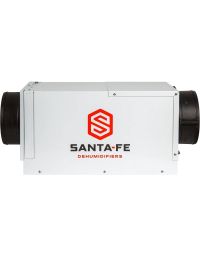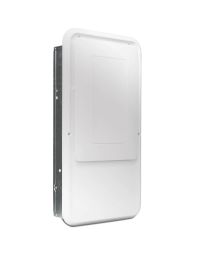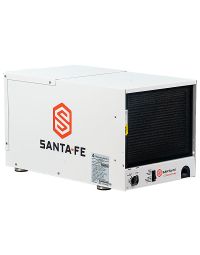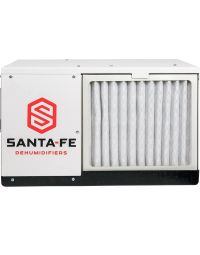
If you’ve ever walked into a damp basement or noticed a musty smell drifting through your home, you already know high humidity isn’t just uncomfortable — it can damage your property and impact your health. The big question for many homeowners isn’t whether to buy a dehumidifier, but which type is worth the money.
At HVACDirect.com, we’ve sold everything from small portable units to heavy-duty Santa Fe dehumidifiers. Over the years, we’ve noticed a clear trend:
A well-built commercial unit like Santa Fe often outperforms — and outlasts — cheaper portable models.
Here’s why.
1. Moisture Removal Capacity
Portable units
-
Usually rated for 20–70 pints/day (at 80°F, 60% RH).
-
Performance drops sharply in cool spaces like basements or crawl spaces.
-
Many can’t handle more than about 1,000–1,200 sq. ft. effectively.
Santa Fe commercial-grade units
-
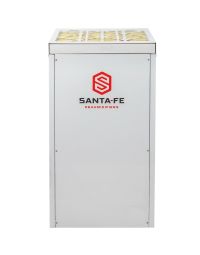
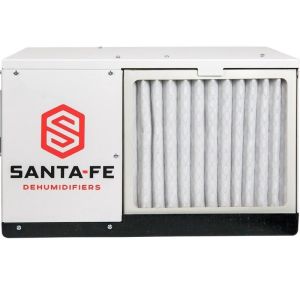
Santa Fe Classic: 110 pints/day, covers up to 2,500 sq. ft.
-
Santa Fe Oasis105: 105 pints/day, 7.6 pints/kWh efficiency, covers up to 2,600 sq. ft.
-
Santa Fe Ultra205: 205 pints/day, designed for whole-home or large commercial use up to 5,000 sq. ft.
-
Operates in temps as low as 49°F — a must for crawl spaces and basements.
Takeaway: If you have a large or cool space, Santa Fe’s higher pint-per-day ratings ensure you actually reach and maintain your target humidity.
2. Energy Efficiency
Portable units
-
Many fall short of ENERGY STAR® standards.
-
Example: A 50-pint portable may use 0.7–0.8 kWh per pint removed — meaning higher monthly bills.
Santa Fe units
-
ENERGY STAR® certified across multiple models.
-
Example: Oasis105 delivers 7.6 pints/kWh at 80°F/60% RH — among the most efficient in its class.
-
Lower run time due to higher capacity means less wear and tear.
3. Durability & Build Quality
Portable units
-
Plastic housing, lighter-duty compressors.
-
Lifespan: 3–5 years with regular use.
-
Often non-repairable — a major component failure usually means full replacement.
Santa Fe units
-
Heavy-gauge steel cabinet, corrosion-resistant finish.
-
Commercial-grade rotary or scroll compressors.
-
Designed for continuous duty, 24/7 operation.
-
Lifespan: 10–15 years with routine maintenance.
-
Backed by a 6-year limited warranty (5 years operational + 6 years parts).
4. Filtration & Air Quality
Portable units
-
Basic dust filter, often non-MERV rated.
-
Focused only on moisture removal.
Santa Fe units
-
Standard MERV-13 filter traps dust, pollen, mold spores, and other allergens down to 0.3 microns.
-
Improves overall indoor air quality — especially valuable in allergy-prone households.
5. Installation & Maintenance
Portable units
-
Plug-and-play, but bucket emptying can be daily.
-
Gravity drain option may be available but not always reliable.
Santa Fe units
-
Permanent installation with dedicated drain or condensate pump.
-
No buckets to empty.
-
Filter change intervals: typically every 3–6 months.
-
Easily accessible service panels for part replacement.
6. Long-Term ROI
Yes, a Santa Fe will cost more upfront — usually $1,500–$2,500 compared to $200–$500 for a portable. But when you factor in:
-
Lower operating costs due to higher efficiency.
-
Longer replacement cycles (10–15 years vs. 3–5).
-
Better humidity control preventing mold remediation bills ($1,500–$10,000+).
-
Healthier indoor air with advanced filtration.
…the numbers lean heavily toward Santa Fe.
Example:
Over 12 years, replacing a $350 portable every 4 years = $1,050 in equipment alone (plus higher power bills). A single Santa Fe could last that entire time — often paying for itself in energy savings alone.
Final Word
If you just need a quick solution for a single small room, a portable dehumidifier can be fine. But for whole-home coverage, basements, or crawl spaces, Santa Fe delivers more capacity, better efficiency, and longer service life — and that’s a combination that saves money and hassle over time.