We use cookies to make your experience better. To comply with the new e-Privacy directive, we need to ask for your consent to set the cookies. Learn more.

1-800-397-1392
Today's Hours 10am - 6pm estShop MRCOOL DIY Hyper Heat Single Zone Mini Split Systems for efficient year-round heating and cooling, even in colder conditions. Designed for easy DIY installation and dependable single-zone comfort, these ductless heat pump systems are ideal for bedrooms, offices, additions, garages, and other spaces that need powerful performance.
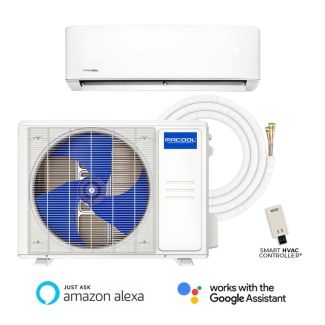

MRCOOL DIY single zone mini split systems are ductless systems that pair one outdoor condenser with one indoor air handler to provide independent cooling, and heating on heat pump models, for a single room or defined space.
These systems work by circulating refrigerant through factory-precharged Quick Connect line sets between the outdoor condenser and the indoor air handler, transferring heat into or out of the space, with no vacuum pump, manifold gauges, or refrigerant certification required.
These systems are ideal for well-insulated single rooms with 8-foot ceilings and 250 to 2,700 square feet of space. Here are some top places that homeowners choose to install them:
Bedrooms That Need Personalized Comfort: MRCOOL DIY 5th Gen, Easy Pro, and DIY Select systems bring a welcome boost to spaces craving personalized comfort. A single zone gives one bedroom its own temperature control, so if one person gets chilly or hot at night, it doesn't throw off the whole house. The air handler hums along at just 23 decibels on low, making it perfect for bedrooms.
Additions with No Ductwork: When adding a new room or section to your home, it usually doesn't have ductwork. Extending your central HVAC system can be pricey and might not even handle the extra load. A single zone MRCOOL DIY unit solves this by working independently. The DIY 5th Gen provides a more feature-rich option, while Easy Pro and DIY Select systems offer more budget-friendly choices for smaller additions.
Finished Basements: Finished basements often feel cool and damp. MRCOOL DIY 5th Gen, Easy Pro, and DIY Select systems can provide dedicated heating and cooling without relying on the rest of the home's HVAC system. This makes them useful for basements that have been converted into living rooms, bedrooms, or recreational spaces.
Garages and Other Workspaces: Detached and attached garages heat up fast and are almost never connected to central ductwork. MRCOOL DIY Hyper Heat models keep the space usable year-round, maintaining heating output down to -13°F even during cold winters.
Home or Commercial Offices: There is no reason to heat and cool an office around the clock if it is only used part of the day. A single zone MRCOOL DIY unit lets you cool or heat the space independently, while compatible models offer features such as app control, geofencing, or programmed schedules.
If your space has leaky windows, poor insulation, high ceilings (about 10 feet), or excessive sun exposure, you will need to adjust your system's capacity, as these factors can decrease its efficiency.
These systems typically range from 9,000 to 48,000 BTU and cover 250 to 2,700 square feet. Here are some examples of where to use each size.
9,000 to 12,000 BTU (250 to 600 sq. ft.): These sizes suit bedrooms, home offices, and smaller living areas where reliable comfort is needed. MRCOOL DIY 5th Gen, Easy Pro, and DIY Select systems are all available in these smaller capacities, giving homeowners options at different price and feature levels. A top pick is the MRCOOL DIY 5th Gen 12K, a popular single zone option widely chosen for its efficiency and performance.
18,000 to 24,000 BTU (600 to 1,500 sq. ft.): This range covers larger living spaces, open-concept rooms, master suites, sunrooms, and attached garages with moderate insulation. MRCOOL DIY 5th Gen, Easy Pro, and DIY Select systems are all available in 18K and 24K capacities. For colder climates, the MRCOOL DIY 5th Gen 18K Hyper Heat provides enhanced low-temperature heating performance, making it a strong option for year-round use in challenging conditions.
36,000 to 48,000 BTU (1,500 to 2,700 sq. ft.): For large open spaces like finished basements, expansive bonus rooms, detached workshops, and two-car garages with high ceilings or significant heat gain, the larger DIY 5th Gen lineup provides more heating and cooling capacity. The 36K single zone system is designed for large individual spaces, while higher-capacity 48K systems are used for multi zone applications that condition several areas from one outdoor condenser.
MRCOOL DIY systems rely on correct BTU sizing to deliver on their promises. If the unit is too small, it'll run nonstop without hitting the desired temperature; if it's too big, it'll cycle on and off too quickly, failing to remove humidity and compromising efficiency and comfort that make MRCOOL a top pick. Correct sizing ensures the system maintains the target temperature and effectively removes humidity.
MRCOOL DIY one room systems are budget-friendly alternatives to traditional central systems and mini splits, cutting out much of the installation cost and typically ranging from $1,200 to $8,000. Here’s a breakdown of the costs:
Equipment Cost: $1,200 to $6,000, depending on BTU capacity and model type with the DIY Select Series being the most affordable option.
Installation and Labor Cost: There are no labor costs for these DIY systems unless the homeowner chooses to have a professional install them. Installation costs are usually minimal, since the system usually comes with everything you need to install it. However, if you need to hire an electrician to run an outlet or breaker, or pay an HVAC technician to pull a vacuum and verify lines, you may incur professional fees.
Operation and Maintenance Cost: $15 to $50 a month for electricity, depending on local power rates and usage. Maintenance fees are minimal for occasional replacement filters and coil cleaner if done by the homeowner. An annual professional tune-up usually runs about $100.
While the systems come fully pre-charged, you should factor in additional costs for critical installation accessories and supplies, such as line set covers, disconnect boxes, or electrical wiring, which typically range from $50 to $500 depending on your home's setup.
MRCOOL DIY units designed for a single area are specifically engineered for homeowner installation, a defining feature that sets them apart from virtually every other mini split brand on the market. This doesn’t mean that you can’t have a professional install it, though. Here is what to know about each installation path.
DIY Installation: MRCOOL DIY single zone systems can be installed by most homeowners with basic tools, including a drill, hole saw, level, and standard wrenches. The Quick Connect pre-charged line sets eliminate vacuuming and refrigerant handling entirely. Most homeowners complete the mechanical installation themselves and hire an electrician only for the dedicated circuit connection, which typically takes a few hours.
Professional Installation: If you prefer not to do the work yourself, you can hire a licensed HVAC professional to install your system. This is also the required route if you choose a traditional, non-DIY MRCOOL series, such as the Advantage or Olympus.
Always check local building codes about permits, as they are usually required. Make sure you meet the specific electrical requirements. Keep in mind that even though you typically don’t need professional HVAC handling for a MRCOOL DIY system, an electrician is usually needed to safely complete the power connection.
MRCOOL 1 zone DIY mini splits are available with three indoor unit styles, including wall mount, ceiling cassette, and hybrid ducted, giving homeowners flexibility based on room layout, aesthetic preference, and whether existing ductwork is present. Here is what each option offers:
Wall Mounted Air Handler: Wall mounted air handlers are installed directly on an interior wall and are available in 9k, 12k, 18k, 24k, 36k, and 48k BTU. Every unit includes the DIYPRO cable that eliminates the need for electrical conduit, Follow Me temperature sensing that adjusts comfort based on where you are in the room, and full Smart HVAC app control with Amazon Alexa and Google Assistant support.
DIY OuttaSight Ceiling Cassettes: The OuttaSight ceiling cassette fits flush between ceiling joists, so the only thing visible in the room is a small vent panel in the ceiling. It is available in various capacities, including 6k, 9k, 12k, and 18k BTU, with select sizes compatible with 12k and 18k Hyper Heat condensers. This makes it suitable for homeowners in colder climates who need reliable winter heating.
While the wall mounted unit is the most popular and easiest choice for many spaces, the ceiling cassette and hybrid ducted options let you enjoy reliable climate control without compromising your home's layout or look.
MRCOOL DIY single room systems require a dedicated electrical circuit with the correct voltage, wire gauge, breaker size, and disconnect box for the selected BTU size. Electrical requirements will vary by model, but here are some general guidelines to follow:
Voltage: The 9K and 12K BTU models operate on standard 115V or 120V power, which is the same outlet type used by most household appliances. Units 18K BTU and larger, including 18K, 24K, and 36K models, require 208V or 230V single-phase power and a dedicated double-pole breaker.
Wiring Size: The 9K and 12K models typically use 12 AWG wire. For 18K and 24K units, 10 AWG wire is standard. The 36K models typically require 8 AWG, though 6 AWG is sometimes recommended depending on the run length. The included DIYPRO cable replaces standard electrical conduit in most installations, simplifying the wiring run between the indoor and outdoor units.
Amperage and Breaker Size: For 9k and 12k 115V units, a 15- to 25-amp breaker is required. For 18k and 24k models, use a 25- to 35-amp breaker. For larger 36k and 48k systems, a 30- to 50-amp breaker is necessary, depending on the Minimum Circuit Ampacity (MCA) and Maximum Overcurrent Protection (MOP) listed on the unit's nameplate.
Disconnect Box: A weatherproof electrical disconnect box is required by most local codes and must be installed within a visible line of sight of the outdoor condenser. The disconnect box should carry an amperage rating equal to or greater than the circuit breaker feeding it, typically rated at least 1.5 times the equipment's amperage draw.
You should reference the Minimum Circuit Ampacity and Maximum Overcurrent Protection values printed on your specific unit's nameplate before sizing anything, as electrical requirements can vary between model and BTU capacity. Most homeowners handle the installation themselves and hire a licensed electrician for any electrical work.
Yes, they deliver exceptional performance values, with advanced single zone setups achieving efficiency ratings up to 24.0 SEER2 and 11.5 HSPF2. Their inverter-driven variable-speed compressors continuously adjust motor output to match the direct thermal load, avoiding the expensive electrical spikes triggered by older fixed-speed units.
MRCOOL DIY single zone mini split systems are designed and branded by MRCOOL LLC. The company is based in Hickory, Kentucky. The brand designs and patents its technology in the US, while major HVAC manufacturers like Midea and Gree create the actual physical units.
Yes, in fact, MRCOOL DIY mini splits are among the brand’s most popular options for homeowners who want complete control over their system installation. HVACDirect.com carries several single zone options, including standard DIY 5th Generation wall-mounted systems, Hyper Heat models for colder climates, OuttaSight ceiling cassette units, Easy Pro systems, and the budget-friendly DIY Select series. Available capacities and features vary by model, providing options for everything from bedrooms and home offices to larger living areas, garages, and additions.
MRCOOL DIY mini split systems come with a 5-year parts warranty and a 7-year compressor warranty, provided the system is registered. A key benefit is that homeowners can install eligible DIY systems themselves without voiding the warranty, unlike most mini split brands, which require professional installation. Certain models qualify for a limited lifetime compressor warranty if registered within 60 days and enrolled in the MRCOOL Care Program within four months of installation. The warranty coverage applies only to the original purchaser and is non-transferable.
Yes, MRCOOL DIY single zone mini split systems with heat pump technology can provide both heating and cooling. In cooling mode, the system moves heat from inside your home to the outdoors. In heating mode, it reverses the process, drawing heat from the outdoor air and transferring it inside. Fifth Generation Hyper Heat models provide consistent heating output down to -13°F, making them suitable for year-round use in most U.S. climates, including colder northern regions.
These systems, when well-maintained, usually last 15 to 20 years. Keeping the filter clean, clearing debris from the outdoor condenser, and having the system inspected periodically are the primary factors that determine how close a unit gets to the upper end of that range.
These systems are known for being very quiet, with the indoor air handlers operating at whisper-soft levels, usually ranging from roughly 22.5 decibels on their lowest fan settings to 40 decibels on high, while the outdoor condensers typically operate between 50 dB and 55 dB. You’ll barely notice either unit.
MRCOOL DIY one zone mini splits include a dedicated “Dry Mode” that is designed to dehumidify and specifically pull moisture out of the air while running the fan at low speed, removing up to two to four pints of water per hour. That said, this system is not a replacement for a dedicated dehumidifier.
You should clean the indoor filters every 2 to 4 weeks and have the entire system professionally inspected and cleaned at least once a year. You can gently vacuum the filters or wash them with mild soap and water, while compatible MRCOOL DIY units also feature a Self-Clean Mode that can be activated with the remote control. The outdoor condenser should also be checked regularly and kept clear of leaves, grass, dirt, snow, and other debris that could restrict airflow.
A single zone MRCOOL DIY system is designed to heat and cool a single room or space. It can potentially cover a space that has two combined, open-layout areas that don’t have any doors or obstructions blocking the airflow, such as a combined dining room and living room. However, if you need to heat and cool multiple rooms that are enclosed off from each other, a MRCOOL multi zone DIY system is the way to go.