We use cookies to make your experience better. To comply with the new e-Privacy directive, we need to ask for your consent to set the cookies. Learn more.

1-800-397-1392
Closed Until MondayExperience superior heating and cooling capabilities with our 60,000 BTU/ 5 Ton mini split systems. Whether you require a single zone or dual zone setup, these systems provide exceptional comfort and energy efficiency. With the ability to cover up to 2,400 square feet, our 60,000 BTU/ 5 Ton mini splits offer the perfect solution for cooling one larger space or two smaller spaces while maintaining optimal climate control. Explore our collection and discover the ideal cooling solution for your needs.
Shop By Zone
Shop By Brand



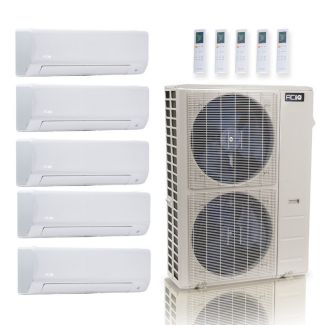


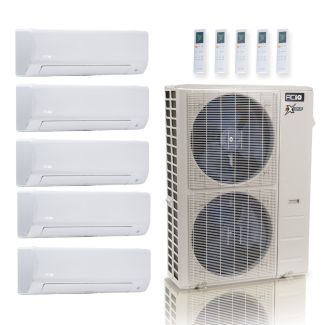




60,000 BTU mini splits, also referred to as 60K mini splits, are ductless heating and cooling systems designed for larger residential and light commercial spaces. These systems provide 5 tons of cooling capacity, since 12,000 BTU equals 1 ton, and are available in both single zone and multi zone configurations.
These systems work by connecting one outdoor condenser to either one indoor air handler or up to five indoor air handlers. Refrigerant transfers heat between the indoor and outdoor units, absorbing heat from inside the space and releasing it outdoors during cooling mode. If your system is a heat pump, it can reverse this process to bring warm air indoors.
A 60,000 BTU mini split may serve roughly 2,500 to 3,000 square feet in a well-insulated space with standard 8- to 10-foot ceilings, but actual coverage depends on climate, insulation, windows, ceiling height, and other heat-load factors. A single zone system can heat and cool spaces up to 3,000 square feet, while in a multi zone system, each indoor unit can range from 6,000 to 36,000 BTU and cover up to 2,000 square feet, provided the indoor unit combination is approved for the selected 60,000 BTU outdoor condenser.
Large Open-Concept Living or Dining Areas: Single zone open floor plans that combine a kitchen, living room, and dining area into one continuous space are exactly what a 60,000 BTU system is designed for. Also, if walls or obstructions divide your open-concept area into multiple zones, or if you want to maintain different temperatures in the living and dining areas, you can choose a multi zone configuration to control each space independently.
Whole-Home Applications for Smaller Homes: Smaller homes with a couple of bedrooms, a living area, a dining area, and a small office can be heated and cooled entirely with one of these systems. They are a practical alternative for smaller homes without existing ductwork or for homeowners who want to avoid the cost and disruption of adding ducts.
Light to Medium Commercial Space: Small retail shops, professional offices, breakrooms, and server rooms that need reliable year-round climate control and cannot easily accommodate traditional ducted commercial HVAC are a natural fit for a 5 ton multi zone system. They’re a great alternative to rooftop packaged units and can be turned off when nobody is occupying the space to save on energy costs.
Detached Buildings and Workshops: Large detached garages, commercial workshops, and agricultural outbuildings that generate significant heat from equipment or direct sun exposure need the capacity a 5 ton system provides. One of these systems can heat and cool the entire space without the need to add any ductwork.
Performance can be reduced in spaces with poor insulation, ceilings above 10 feet, large areas of unshaded glass, high internal heat loads from equipment, or outdoor temperatures below the rated low-ambient operating range of the selected model.
Many 60,000 BTU mini split systems can operate more efficiently than older or less efficient ducted systems because inverter compressors adjust output to match demand and ductless configurations avoid energy losses from ductwork, allowing them to achieve SEER2 ratings of up to 24 compared to 14 to 16 for traditional systems. SEER2 (Seasonal Energy Efficiency Ratio 2) measures cooling efficiency over an entire season, with higher ratings resulting in lower electricity costs. EER2 (Energy Efficiency Ratio 2) measures cooling efficiency under peak operating conditions, while HSPF2 (Heating Seasonal Performance Factor 2) measures heating efficiency over an entire season. Most 60,000 BTU mini splits achieve EER2 ratings between 10.0 and 12.0 and HSPF2 ratings between 9.5 and 10.5, helping reduce both summer cooling and winter heating costs.
At a $0.16 per kWh electricity rate, a system drawing 4,000 watts would cost about $0.64 per hour to operate, but actual costs vary because inverter-driven mini splits continuously adjust their power use. Most systems in this capacity range use 208/230V power, but the required breaker size and minimum circuit ampacity vary by model and must be confirmed on the equipment nameplate or specification sheet. In cooling mode, a system in this capacity range may consume 4,000 to 5,500 watts (17 to 24 amps) at full capacity before dropping to 1,200 to 2,500 watts as the inverter reduces output. Heating mode typically requires 4,500 to 6,500 watts (20 to 28 amps) at maximum output before settling between 1,500 and 3,000 watts to maintain the set temperature.
Most 60,000 BTU mini splits require a dedicated 208V or 230V circuit, but breaker size, wire size, and minimum circuit ampacity vary by model. Here’s a general breakdown of each requirement:
Voltage: Almost all 60,000 BTU mini split systems operate on 208V or 230V single-phase power. Single zone systems at this capacity connect one outdoor condenser to one large indoor unit, while multi zone configurations connect one outdoor condenser to up to five indoor air handlers, with electrical requirements determined by the specific system design and manufacturer instructions.
Amperage: The Minimum Circuit Ampacity (MCA) for most 5 ton systems falls between 35 and 45 amps, regardless of whether the system is single zone or multi zone, as the outdoor condenser determines the circuit sizing requirement. MCA varies by brand.
Wiring Size: Most of these units require 6 AWG copper wiring for the dedicated circuit run, though sizing will vary by model. Longer runs where voltage drop is a concern may require 4 AWG to maintain safe, consistent performance over the full length. The wire size will depend on the MCA.
Breaker Size: One of these systems usually requires a dedicated 40- to 50-amp double-pole breaker. Always reference the Maximum Overcurrent Protection (MOP) value on the unit's nameplate to confirm the correct breaker size for your specific model, as requirements vary by brand and configuration.
Disconnect Box: A weatherproof electrical disconnect box must be installed within visible line of sight of the outdoor condenser and rated at or above the amperage of the circuit breaker feeding it. The disconnect must be properly rated for the equipment and circuit according to the manufacturer’s requirements and applicable electrical code.
Again, these figures represent typical ranges for 60K systems, but actual electrical requirements will vary by brand, model, and configuration. Always reference the MCA and MOP values printed on your specific unit's nameplate and consult a licensed electrician before purchasing breakers or wiring.
Because of their large capacity, these systems are usually designed for professional installation rather than DIY installation. Here is what you should know:
DIY Installation: These systems are usually not available as DIY options, though you can find a few MRCOOL DIY options. DIY means a homeowner can complete the installation themselves, as the units come pre-charged with refrigerant and Quick Connect line sets. Unless the model is specifically designed for DIY installation, professional installation is generally recommended and may be required to maintain full warranty coverage. Since these systems have a higher capacity and usually involve multiple zones, the DIY path is uncommon.
Professional Installation: This is the most common choice for homeowners because a professional can ensure the refrigerant is flowing correctly and that all indoor units and the outdoor unit are installed correctly and in compliance with local codes and warranty requirements.
Permits are required in most jurisdictions to install one of these systems, and work that involves opening or servicing the refrigerant circuit may require an appropriately certified technician. A licensed electrician may be required to install the dedicated circuit, disconnect box, and other electrical components, depending on local codes and permit requirements.
Total installed costs for a 5 ton system, including the equipment and labor, typically range from $9,000 to $18,000, depending on local labor rates, the model, and the number of zones. Here is a typical breakdown of costs to expect.
Equipment Cost: $5,000 to $11,000+, depending on the model, brand, and number of zones. A single zone version of this system will be cheaper than a multi zone version.
Installation and Labor Cost: $3,500 to $6,000+, depending on the number and type of indoor units and local labor rates. Installation costs generally increase with each additional indoor unit, although the exact cost per zone varies by unit type, line-set length, and accessibility.
Operation and Maintenance Cost: Usually $20 to $100 a month for electricity, depending on usage and number of zones, along with a professional annual maintenance and cleaning fee of $150 to $500.
You should also budget for additional costs for accessories, such as line set covers, disconnect boxes, surge protectors, or branch boxes (if needed), which typically cost around $100 to $500 in total.
These systems are commonly available with five indoor air handler types: wall mount, ceiling cassette, slim ceiling cassette, concealed duct, and floor mount. Here’s a breakdown of when to use each in both residential and commercial spaces:
Wall Mounted Indoor Unit: Wall mounted units are among the most common indoor unit types and work well in large residential or light commercial spaces with few airflow obstructions. They can also be used in smaller spaces, such as bedrooms or offices, in multi zone setups.
Ceiling Cassette Indoor Unit: Distributing air in four different directions, ceiling cassette air handlers are commonly used in large, single zone residential and commercial spaces. They are great for spaces like living rooms and retail shops where you want the unit to be less visible, as they install within the ceiling and leave only the grille or panel visible, freeing up wall and floor space.
Slim Ceiling Cassette Indoor Unit: A slim ceiling cassette is a lower-profile version of the standard ceiling cassette, designed for installations where ceiling cavity depth is limited and a full-depth cassette will not fit. This makes it a practical choice for retrofits in existing homes or commercial spaces where ceiling space is restricted, but a recessed aesthetic is still preferred.
Concealed Duct Indoor Unit: Concealed duct air handlers install above the ceiling or inside a mechanical space and connect to short duct runs, delivering conditioned air through standard ceiling grilles with no visible indoor equipment. This style is popular in high-end residential applications and commercial spaces where a completely hidden installation is a priority.
Floor Mounted Indoor Unit: Floor mounted units install low on the wall and direct conditioned air upward into the room, making them a useful option in spaces with large windows, limited high-wall area, or architectural features that prevent a standard wall mount installation. They are also a practical choice in rooms where heating performance is a priority, since warm air is delivered from floor level rather than from above.
Many multi zone systems allow compatible indoor unit types to be mixed and matched, depending on the condenser and manufacturer-approved combinations. You can use HVACDirect.com’s “Design Your Own System” tool for 3, 4, and 5 zone 60K systems.
For 5 ton systems, you should look for a SEER2 rating of about 18 to 20, which will provide you with a balanced, high-efficiency system for moderate climates. You should choose a system with a SEER2 rating of 16 to 18 for heating and cooling in mild climates or if you have a tighter initial budget. If cooling efficiency and long-term energy savings are priorities, look for a higher SEER2 rating. In cold climates, also compare HSPF2 ratings and the system’s low-temperature heating performance. While SEER2 measures seasonal efficiency across varying weather conditions, EER2 measures how efficiently the system performs at peak outdoor temperatures. A higher EER2 rating can be especially valuable in hot climates where the system frequently operates during peak outdoor temperatures.
60K systems designed as heat pumps can heat and cool, pulling warm air out of the space during cooling and transferring it inside during heating. Not all systems are heat pumps, so not all of them can provide both heating and cooling. There are cooling-only models available.
For a 60,000 BTU mini split, look for an HSPF2 rating between 9.0 and 10.0 or higher. A higher HSPF2 rating indicates greater seasonal heating efficiency and can help reduce electricity use compared with a lower-rated system.
Choosing between a standard and a DIY 60,000 BTU (5 ton) system comes down to your budget, technical skills, system availability, and warranty preferences. Here’s what to expect with each:
Regardless of whether you choose a DIY or standard system, the electrical setup must meet local code requirements and may need to be completed by a licensed electrician.
Yes, a 60,000 BTU mini split is the same as a 5 ton mini split, since 12,000 BTU of cooling capacity equals 1 ton. Multiplying 12,000 BTU by 5 gives the system’s total 60,000 BTU capacity. The two terms describe the same overall cooling output, although actual performance and coverage can vary based on factors such as climate, insulation, ceiling height, and the number of rooms or zones being conditioned.
ACiQ, Mitsubishi, Daikin, and LG make some of the top 60K systems. ACiQ offers high-efficiency systems at affordable prices. Mitsubishi and Daikin are well-known for their cold-climate performance and durability, while LG is best known for its smart home integration. If you need a DIY system, MRCOOL has limited options available in this capacity.
These systems, like most other mini splits, typically last 15 to 20 years when well-maintained. Because their inverter technology helps prevent wear and tear on internal components, they can last up to 25 years.
Many 60,000 BTU mini split systems include heat pump capability, allowing them to provide both heating and cooling. Cooling-only models exist at this capacity but are increasingly rare as heat pump efficiency has improved. Confirm the system's operating mode on the spec sheet before purchasing.
Many mini split systems include a “Dry Mode” that prioritizes moisture removal while providing limited cooling. At 60,000 BTU, dehumidification capacity is substantial, with most systems capable of removing 15 or more pints of moisture per hour. This is particularly useful in humid climates, large open spaces, and commercial environments where humidity control is as important as temperature management.


