Key Takeaways
- Cooling Distribution Method: Central air uses a single air handler and ductwork to distribute air throughout the home, while mini splits use multiple air handlers for room-by-room control.
- Installation Requirements: Central air is more practical for homes with existing ductwork, whereas ductless mini splits are ideal for spaces without ducts or for targeted cooling zones.
- Cost and Efficiency Trade-Off: Central air typically has a lower upfront cost if ducts are already in place, but ductless systems offer higher energy efficiency and long-term savings through zoned cooling.
Ductless Mini Split vs. Central Air: Which Is Better for Your Home?
Modern air conditioning systems feel better, function better, and fit better than their predecessors. Today, homeowners have more choices than ever before. Two of the most popular options are central air conditioning with ductwork and ductless air conditioning, also known as a mini split system. Both systems answer specific cooling needs and come with their own pros and cons. So, between ductless mini split vs central air, which system is right for your home or business?
Central Heat and Air vs. Ductless: The Similarities
The Condenser
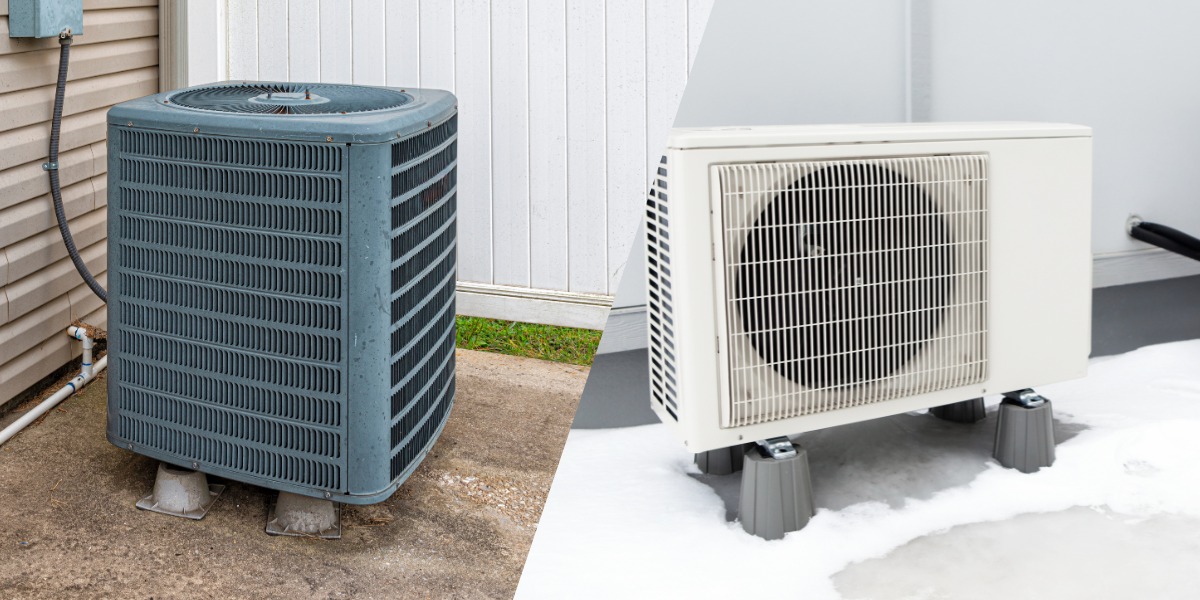
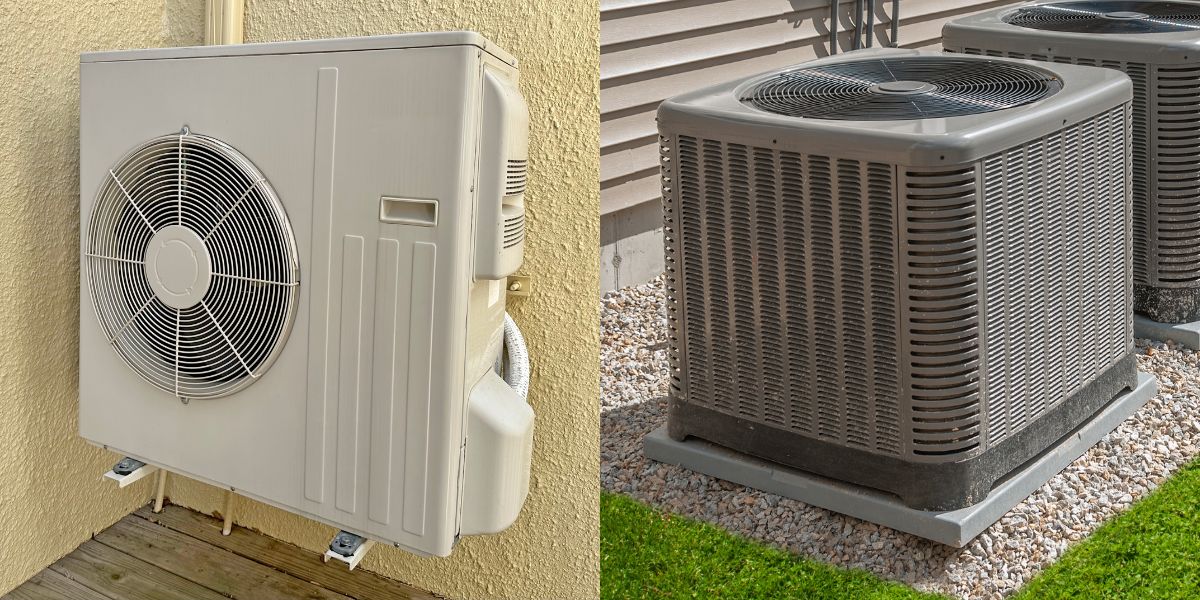
Virtually all AC systems, including ductless and central air, start with a condenser unit placed outside. This component includes coils, a fan motor, and a compressor. Refrigerant gas is compressed into a hot liquid and circulated through the condenser coils.
The Evaporator Coils
The hot liquid refrigerant travels inside the home via line sets to the evaporator coils. There, it evaporates back into a gas, absorbing heat from indoor air and cooling it. Contrary to common belief, an air conditioner doesn’t create cold air—it removes heat.
The Air Handler
This cooled air is pushed through an air handler, which distributes it into the living space. While both systems use air handlers, their configurations differ significantly.
Ductless Mini Split vs Central Air: The Key Differences
Ductwork vs. No Ductwork
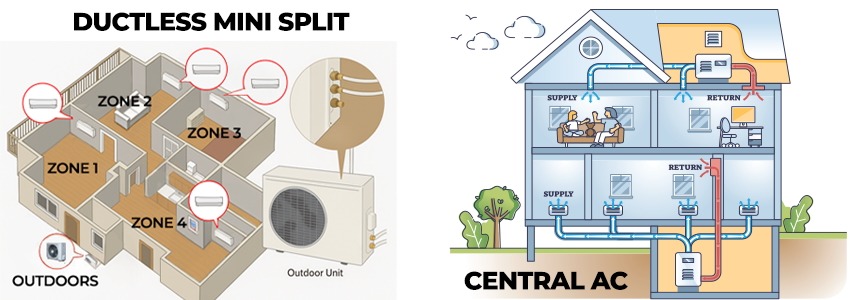
Central air systems use one air handler and a network of ductwork to circulate air throughout the house.
Ductless systems, on the other hand, don’t require ducts. Each room (or zone) has its own air handler, making ductless mini split systems ideal for:
- Single-room applications
- Home additions
- Garages and workshops
- Multi-room or whole-house zoning
One Air Handler vs. Multiple Air Handlers
A central AC system relies on a single air handler and thermostat.
Ductless mini split systems can have multiple air handlers—up to eight in some models—each with its own thermostat. This allows for:
- Independent temperature control by room
- Increased energy efficiency
- Personalized comfort in each zone
Comparing Costs: Ductless Mini Split vs. Central Air
Equipment Cost
Ductless systems generally cost more upfront due to compact design and multiple air handlers. The more zones you want to cool, the more equipment you'll need, which increases initial expenses. However, once installed, ductless mini splits begin to offer significant cost savings—especially when paired with a heat pump.
Central air systems may be more affordable for whole-house cooling if ductwork already exists. They use one air handler, so you don’t need to buy multiple units for each room.
Installation Cost
Ductless mini splits are often easier and faster to install. They do not require ductwork, which is one of the costly drawbacks to central heat and air systems.
DIY options are also available, featuring pre-charged refrigerant lines, so you don't need a license to handle refrigerants.
Central AC systems require ductwork, increasing both labor and material costs. They must be installed by a licensed HVAC professional and do not offer DIY options.
Long-Term Value
Ductless systems tend to be more energy-efficient and can lead to substantial utility savings over time. Avoiding ductwork simplifies remodeling and reduces air leakage, improving long-term performance.
Performance Comparison: Which System Works Better?
Temperature Control
Central systems use a single thermostat, which can lead to inconsistent comfort across rooms. Mini splits offer individual room control, allowing each space to be set at a different temperature.
Energy Efficiency
Ductless systems eliminate energy loss through ducts. Mini splits with inverter technology adjust output to meet demand, reducing energy usage and lowering your bills.
Versatility
Central air is great for homes with existing ductwork. Ductless systems are perfect for:
- Renovations
- Outbuildings
- Homes without existing ducts
Ductless Mini Split vs Central Air: Pros and Cons
Ductless Mini Split Pros:
- No ductwork required
- Zoned temperature control
- High energy efficiency
- Easier installation
Ductless Mini Split Cons:
- Higher upfront cost
- May require multiple indoor units
Central Air Pros:
- Lower equipment cost if ducts are in place
- Discreet, centralized air handler
Central Air Cons:
- Requires ductwork
- Less precise room control
- Potential energy loss through ducts
Frequently Asked Questions
It depends on the home. For homes with existing ductwork, central air may be more cost-effective. For homes without ducts or with room-specific needs, ductless systems offer better customization and efficiency.
Upfront, no. Mini splits often cost more initially, especially for whole-house installations. However, they can be cheaper in the long run due to energy savings and lower installation costs in new or renovated spaces.
Yes. Installing a new AC system, whether ductless or central, can increase home value by up to 12%, especially when it improves energy efficiency and comfort.
Final Thoughts: Which AC System Is Right for You?
Choosing between a ductless mini split vs central air system depends on your home's layout, whether or not it already has ductwork, your budget, and your comfort preferences. Ductless systems provide zoning and efficiency, while central air is ideal for traditional, whole-house cooling. Either way, upgrading your AC system is a smart investment that can increase your home’s value and comfort year-round.
Related Products

1.5 Ton 13.4 SEER2 Single Stage Air Conditioner Condenser - R32
Brand: ACiQ
Price: $ 1,454.00 (In Stock)

1.5 Ton 13.4 SEER2 80% AFUE 45,000 BTU ACiQ Gas Furnace and Air Conditioner System - Upflow/Downflow
Brand: ACiQ
Price: $ 3,149.00 (In Stock)

Perfect Aire DIY 9,000 BTU 19.5 SEER Quick Connect Ductless Mini Split Heat Pump w/ WiFi - 115V
Brand: Perfect Aire
Price: $ 1,199.00 (In Stock)

Central Heat and Air vs Ductless: The Similarities
The Condenser
Virtually all AC systems, including ductless and central air, start with a condenser that sits outside on a slab, platform or rooftop. The condenser includes coils, a fan motor and a compressor. Refrigerant, a gas that one would expect from its name to be naturally cold, is actually made extremely hot by compression, changed into a liquid and circulated through the condenser coils.The Evaporator Coils
The super-heated liquid moves to the interior via line sets and then circulates through the evaporator coils, where it cools and returns to a gaseous state. Following thermodynamic principles, interior air releases its heat to the evaporator coils and the aluminum fins adjacent to them. Therefore, an air conditioner does not create cold air. It removes heat, leaving cold air in its wake.The Air Handler
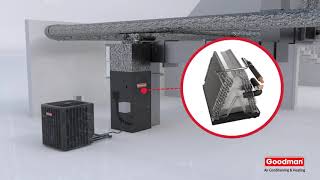
The evaporator coils reside inside the air handler, which blows the cold air into the living space. Both central air and ductless systems employ air handlers, but in much different ways. In a central air conditioning system, the air handler sits in a closet, basement, attic or utility room and is connected to the rest of the house by ductwork. In a ductless system the air handler is located in the room it is assigned to cover.Ductless vs Central Air: The Differences
Ductwork vs No Ductwork
A central air system uses one air handler to cover the whole house, and it forces the air through a ductwork network to all the rooms. It's not hard to guess that a ductless system doesn't use ducts. The in-room air handler does all the work for that particular room (sometimes called a zone). Ductless mini split systems are great for single room applications, add-ons, garages, workshops and family creation/entertainment rooms. They also can be used for multiple rooms, including an entire house. Remodeling projects, especially those that create separate living spaces like a duplex or an apartment, are best served by ductless AC systems.One Air Handler vs Multiple Air Handlers
The ductless system can have as many as eight separate air handlers, for eight separate rooms or zones. The air handlers in a multi zone mini split systems all feed off the same condenser, but they all perform independently of each other. They can be set to different temperatures, because they all have their own thermostats.Ductless vs Central Air: Advantages/Disadvantages of Each
Cost of Ductless Mini Split vs Central Air - Equipment
Ductless equipment is more expensive on the front end. The equipment is compact and must be built to tight tolerances for proper performance. Some mini split systems allow homeowners to perform their own installation, and therefore require special design considerations. The biggest reason for the additional front-end expense of ductless AC systems is the cost of multiple air handlers. The more zones (rooms) you air condition, the more expense you incur. Once installed, however, ductless mini split systems start working in your favor. They typically operate with much more efficiency, delivering more comfort while at the same time using less energy. The energy savings occur year-round, thanks to heat pumps, which reverse the cycle of air conditioning and send warm air into the affected rooms. If you're building new or adding on, ductless offers a cost advantage in that you don't have to install ductwork, which is probably the biggest drawback to central heat and air.Cost of Ductless Mini Split vs Central Air - Installation
One of the biggest benefits of ductless air conditioning is the ease with which it installs. Single-zone systems are often available as DIY projects, and even a few multi-zone systems are now coming out as DIY items. Regardless of whether the installation is performed by the homeowner or a licensed HVAC technician, installation of a ductless mini split system takes less time than a central air system.Performance
With traditional central air conditioning, you have one air handler and one thermostat for the whole house. Rooms that have climate control issues like big windows and high ceilings get the same temperature setting as the cozy sewing nook down the hall. Family members must accept the thermostat setting established by whoever is in charge of it (which is sometimes debatable). Ductless systems offer individual controls. Each zone has its own thermostat, so settings can be customized from zone to zone. Ductless mini split systems tend to be more energy efficient since energy is not wasted trying to make all rooms the same temperature. There is also less air loss through ductwork. Ductless vs Central Air Conditioners: Frequently Asked QuestionsIs central air better than ductless? When choosing between central heat and air and ductless, the question of whether the house already has ductwork is probably the biggest factor. A secondary factor is the size of the house. For a large house, already fitted with ductwork for a lot of rooms, central air might be your best option, for cost reasons. Does ductless air conditioning increase home value? The addition of any new AC system, whether ductless or central air, increases the value of a home by as much as 12 percent. Replacing the AC system could be the best investment you put in your home, even in an older home. Are mini splits cheaper than central air? For a whole-house system, the cost of ductless mini split vs central air is not cheaper than central air. The necessity of buying multiple air handlers drives the initial cost up. However, in new construction, the ability to forego the installation of ductwork becomes a bonus for ductless mini split systems. Plus, the energy savings over the life of the system cannot be overlooked. With the tightening of energy regulations and the volatile nature of energy costs in many areas of the country, this is a huge consideration.