Your cookie preferences
We use cookies to remember your preferences and understand how shoppers use our site, helping us improve your shopping experience.
Read our privacy policy

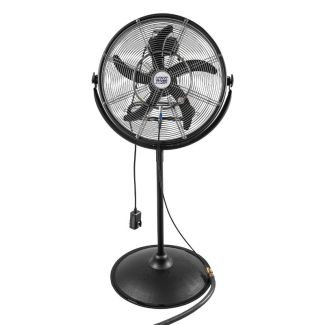

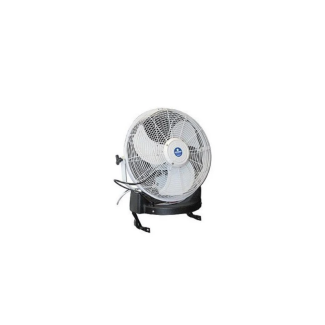
A misting fan combines airflow with a fine water mist to provide evaporative cooling in outdoor or open-air areas. Cooling performance depends on air temperature, relative humidity, airflow, water flow, and nozzle design. Misting pressure and nozzle design vary by model.
The fan moves air through a fine mist created by a hose connection, built-in reservoir, or dedicated misting system. As fine droplets evaporate, they absorb heat from the air and can make the area feel cooler. Misting fans work best in hot, dry outdoor or open-air spaces where moisture can evaporate.
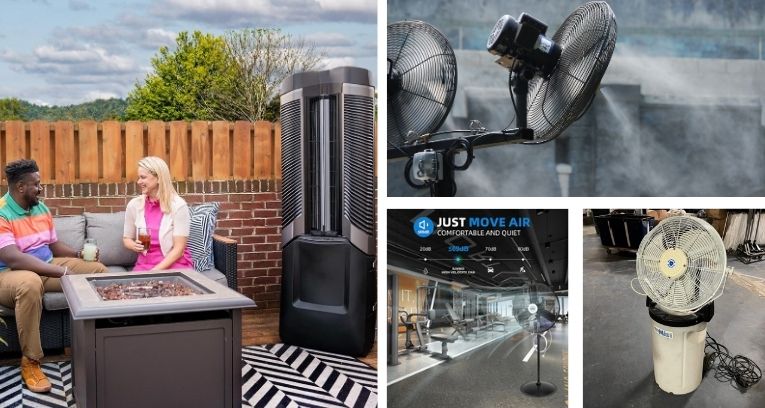
Misting fans cool air through evaporation, and their cooling effect depends on local relative humidity. Deploying these specialized air circulators expands usable space and helps reduce heat exposure and improve worker comfort across residential, commercial, and industrial settings.
Outdoor Patio and Hospitality Cooling: Misting fans can improve perceived comfort in outdoor dining areas, patios, and event spaces during hot, dry weather.
Commercial Warehouse Spot Cooling: Facilities managers place mobile misting units in high-heat loading docks and assembly areas. These fans can provide localized evaporative cooling as part of a complete workplace heat-safety plan.
Athletic and Event Safety Management: Sports teams and event organizers use portable misting units along sidelines and outdoor venues to provide targeted cooling in higher heat conditions.
Agricultural and Livestock Ventilation: Greenhouse growers and livestock operators may run misting circulators to reduce heat stress on plants and animals, but humidity must be monitored. Misting is most effective in dry environments and excessive humidity can create problems.
Depending on humidity and overall water consumption, operating a misting fan can deliver temperature drops at a fraction of the utility cost associated with standard compressor-based cooling systems. Misting fan operating cost depends on fan wattage, pump wattage, water flow, local electricity rates, local water rates, and runtime. Compare those figures with the cooling needs of the space before purchase. Low humidity conditions help misting fans create more effective evaporative cooling, so use them only where added moisture and wet-surface conditions are acceptable. Avoid creating slip hazards or exposing moisture-sensitive materials and equipment to mist as humidity rises.
Misting fans at HVACDirect.com display listings with airflow capacities ranging from 1,500 cubic feet per minute, or CFM, to over 9,000 CFM. They are available across an assortment of different configuration types, including portable, pedestal, wall mount, oscillating, and outdoor misting fans. Select the type based on required coverage, water source, electrical access, mounting options, portability, and operating conditions.
Portable Misting Fans: These mobile units can connect to a hose or external water supply in wheeled carts that allow fast deployment across sports sidelines, job sites, and patio areas without fixed plumbing.
Pedestal Misting Fans: Built on telescoping vertical poles, these pedestal models raise the fan above floor level and may allow height adjustment. They can project airflow to cool open-space areas like commercial venues and decks.
Wall Mounted Misting Fans: Permanently attached to structural studs or masonry walls, these space-saving designs keep floor spaces clear while providing elevated cooling for outdoor dining patios and loading docks.
Oscillating Misting Fans: Equipped with internal sweeping gearboxes, these oscillating models move airflow across a wider area to distribute evaporative cooling evenly.
Outdoor Misting Fans: Constructed with weather-resistant sealed motors and corrosion-protected hardware, these commercial-grade units are made to withstand humidity and UV exposure. Use a misting fan outdoors only when the manufacturer permits the planned environment.
Selecting the right mounting and mobility configuration depends on your floor space availability, electrical outlet placement, and water supply access. Runtime depends on water capacity, water supply, controls, and model design. Before buying, compare the selected model’s airflow, fan diameter, oscillation range, water-flow rate, water source, power requirements, and stated coverage guidance.
Selecting the right misting fan depends on matching airflow output, water volume specs, and motor durability ratings to your target cooling square footage. Misting fan airflow, water pressure, water flow, and cooling performance vary by model. Compare the manufacturer’s published CFM, fan size, water requirements, and coverage guidance for the selected unit.
Airflow Performance (CFM): Higher airflow may increase circulation and drive cool air across larger distances to manage heat loads in open outdoor zones, but evaporative cooling also depends on hotter, drier conditions to be effective. Compare CFM, fan diameter, speed settings, and stated throw or coverage guidance.
Misting Coverage and Cooling Performance: High-pressure nozzle systems can produce finer mist particles for evaporative cooling. Under favorable hot and dry conditions, that cooling may help reduce ambient temperatures by as much as 30 degrees Fahrenheit. For best results, review the selected model’s published cooling guidance rather than relying on a universal temperature-drop estimate.
Fan Size and Oscillation: For certain models, blade diameters ranging from 14 inches to 30 inches combined with 90-degree sweeping oscillation can broaden overall coverage angles across wide patio and event spaces. Check for the selected fan’s diameter, oscillation range, speed settings, mounting height, and stated coverage area.
Adjustable Fan Speeds: Multi-speed motor controls let users balance high-velocity cooling throw against lower, quieter airflow levels for intimate seating areas.
Water Supply Options (Tank or Hose Connection): Some models connect to a water hose, while others may use a self-contained water tank. Verify the selected unit’s water connection, tank capacity, water-flow rate, and refill requirements.
Outdoor-Rated Durability: Weather-resistant construction features like anti-drip nozzles and powder-coated steel housings help protect components from moisture and environmental exposure.
Portability and Mobility: Heavy-duty caster wheels, integrated push handles, and balanced reservoir bases allow operators to roll large commercial cooling units across uneven job site terrain.
Checking for these core specifications helps ensure your equipment delivers adequate evaporative cooling without creating excess standing water. Commercial-grade components may reduce long-term maintenance needs and help protect pump mechanisms against early wear. It is also important to inspect the fan’s housing, pump, nozzles, filter, wheels, cord, water connections, and maintenance instructions. Water quality, cleaning, storage, and operating conditions can all affect service needs.
Selecting a misting fan requires checking for electrical capacity, maintenance requirements, and ambient operating conditions alongside baseline fan performance. Evaluating these operational variables prevents equipment damage, reduces maintenance labor, and ensures reliable long-term cooling performance.
Indoor or Outdoor Application: Outdoor areas allow fine mist to evaporate completely in open air. Misting fans are generally best suited to outdoor or open-air areas where fine droplets can evaporate. Do not use a misting fan indoors unless the manufacturer specifically approves the application and the site can manage humidity, moisture, drainage, and slip risks.
Available Water Source (Tank or Garden Hose): Continuous hose hookups can provide uninterrupted operation for fixed installations, whereas those with self-contained 10- to 20-gallon reservoirs allow mobile deployment in areas without direct plumbing access. Confirm whether the selected fan requires a garden hose, uses a built-in tank, or supports another water-supply method. Check water pressure, water-flow rate, tank capacity, and refill requirements.
Coverage Area and Cooling Needs: Choosing a fan based on its published airflow, fan size, oscillation range, placement, local humidity, and the size of the open area to be cooled can improve performance. Misting fans can provide localized evaporative cooling in areas ranging from small seating patios to expansive industrial job sites.
Noise Level During Operation: Larger fan blades and lower operating RPMs can contribute to quieter operation through noise reduction, but noise depends on motor, blade design, speed, pump, and construction. Misting fans that produce less noise are commonly considered better suited for quiet commercial hospitality venues than noisier industrial blowers.
Ease of Cleaning and Maintenance: Fans with quick-disconnect water filters, removable brass nozzles, and drain plugs can simplify routine descaling and reduce mineral deposits that can clog fine orifice openings. Review the model’s filter, nozzle, pump, drain, and winter-storage instructions. Clean and descale parts only as directed by the manufacturer.
Weather and Corrosion Resistance: Those with powder-coated steel frames and stainless steel hardware are known to be able to withstand extended periods of humidity and UV exposure without rusting. However, continuous rain exposure is not recommended. Compare housing materials, weather ratings, water-exposure limits, and storage requirements. Protect the fan from weather conditions that the manufacturer does not permit.
Power Requirements and Cord Length: Standard grounded plugs can work with ordinary outdoor outlets, but commercial high-pressure units may require dedicated accessories to manage starting current and total electrical load. Verify the fan’s voltage, amperage, plug type, cord length, circuit requirements, and outdoor electrical protection. Use only extension cords approved for the fan’s electrical load and environment.
Accounting for these practical installation factors promotes a more seamless integration with your existing water and power infrastructure. Proper site preparation and routine mineral maintenance maximize equipment longevity across multiple summer cooling seasons. Before purchase, confirm the water source, drainage plan, electrical supply, placement, weather exposure, expected humidity, maintenance access, and manufacturer requirements.
iLIVING, Maxx Air, and Pinnacle are leading brands in the misting fan category on HVACDirect.com. These makers specialize in industrial-grade components, corrosion-resistant housings, and high-efficiency evaporative mist systems designed for commercial and outdoor environments. They also offer options that can be compared by airflow, fan size, water supply, portability, mounting style, electrical requirements, and published product features.
iLIVING: This brand is known to produce heavy-duty pedestal and wall mounted oscillating misting fans. Some may feature 30-inch aluminum blades, 8,400 CFM airflow output, UV-resistant powder-coated steel grilles, and 1/3 HP totally enclosed motors. Review HVACDirect.com for the desired iLIVING misting fan to confirm blade size, CFM, motor horsepower, oscillation, mounting method, water connection, and weather-exposure limits.
Maxx Air: Known for versatile portable mini-mister units, Maxx Air offers models that feature 14-inch steel cage fans with 20-gallon rotomolded water tanks that can deliver continuous misting. Look for current Maxx Air misting fan models by fan diameter, CFM, water source, tank capacity when included, runtime guidance, mobility features, and power requirements.
Pinnacle: Pinnacle manufactures the VersaMist series, with models that may feature up to 2,200 CFM ratings, 18-inch aluminum fan blades, 16,000 BTU cooling ratings, and portable wheeled tank assemblies for commercial sites. Verify the selected Pinnacle model’s published airflow, fan size, water-use requirements, coverage guidance, tank or hose configuration, wheels, and warranty before purchase.
Selecting among these top brands depends on whether your space requires high-volume wide-area oscillation or self-contained reservoir mobility. Misting fans with higher-grade motors and weather-rated enclosures may operate more reliably in harsh outdoor summer conditions, but check each brand and model for its permitted weather exposure. Choosing a model based on the required airflow, water supply, mobility, sound needs, electrical supply, and maintenance requirements is also advised.
Total acquisition costs for misting fans range from $100+ to $800+ at HVACDirect.com for equipment alone. Check current HVACDirect product listings for price and availability. Operating these fans can provide a high-efficiency alternative to traditional compressor cooling, so inspect for necessary fan size, airflow, misting system, water source, tank capacity, pump, mobility, mounting style, and weather-rated construction.
Prices shown here and below are planning estimates, not guaranteed costs. Equipment prices reflect current HVACDirect.com listings, where buying direct may save up to 70% on HVAC equipment versus local company pricing. Installation, labor, energy, maintenance, and service costs vary by system size, efficiency, installation complexity, local contractor and utility rates, climate, and location. For an accurate project estimate, consult a qualified local HVAC professional or an HVACDirect.com specialist to point you in the right direction.
Equipment Cost: Misting fan prices span from $100+ to $800+ for basic wall mounted fans through self-contained portable tank units on HVACDirect.com.
Energy Consumption Cost: Operating costs depend on the fan's electrical power consumption, local electricity rate, and hours of operation. For example, a 300-watt fan operating for 8 hours uses 2.4 kWh of electricity. At an electricity rate of $0.15 per kWh, that would cost approximately $0.36 per day or about $10.80 over 30 days of daily operation.
Water Consumption Cost: Water costs vary based on nozzle configuration, operating pressure, runtime, and local water rates. Some misting fans use relatively small amounts of water, while higher-output systems consume more. Check the manufacturer's published water-flow rate when estimating operating costs.
While initial equipment costs vary based on reservoir size and CFM capacity, overall utility consumption tends to be lower for commercial and residential users. Upgrading to high-pressure misting systems may have different water and maintenance requirements and can increase initial equipment investment, but may also maximize water evaporation efficiency. Look into the selected system’s pressure, nozzle design, water flow, filtration needs, and manufacturer guidance. Those features, as well as fan and pump wattage, runtime, local electricity rates, local water rates, and maintenance needs, also affect operating cost.
Purchasing your misting fan from HVACDirect.com provides access to commercial-grade cooling equipment backed by direct distributor pricing and expert technical support. Our inventory includes top ventilation brands like iLIVING and Maxx Air with full factory warranty protection and fast regional shipping.
Wholesale Distributor Pricing: Direct manufacturer partnerships allow HVACDirect.com to offer commercial misting fans at competitive wholesale prices that save customers up to 30% compared to retail stores.
Expert HVAC Technical Support: Trained HVACDirect.com ventilation specialists can help calculate required CFM output, evaluate water pressure specifications, and select the exact fan model for your specific outdoor or commercial layout.
Fast and Free Shipping: Many in-stock misting fans and cooling accessories ship directly from regional warehouses with free freight options on qualifying commercial orders. Check the selected product page and checkout information for stock status, shipping charges, delivery timing, freight requirements, and delivery-site details.
Authorized Factory Warranties: Misting fans sold at HVACDirect.com include manufacturer warranty backing and dedicated customer service to handle replacement parts, pumps, or technical claims quickly.
Partnering with an authorized distributor can secure access to replacement nozzles, water filter cartridges, and pump repair kits for your equipment. Our dedicated support team assists with commercial ordering and delivery logistics from initial selection through final installation. Before ordering, be sure to confirm whether replacement nozzles, filters, pumps, water tanks, and other service parts are available for the selected model.

Misting fans can be worthwhile for hot, dry outdoor or open-air areas when the site has a suitable water source, electrical supply, drainage plan, and safe placement. They provide localized evaporative cooling rather than compressor-based air conditioning. These fans are generally considered to be ideal for patios, job sites, loading docks, and outdoor events.
Pinnacle and Maxx Air are often considered among the best portable misting fans, offering high-capacity mobile units on HVACDirect.com that make for easier use and economy. Pinnacle is a leader in the commercial portable category at HVACDirect.com with its VersaMist series. Maxx Air is also a leading misting fan brand that produces compact portable varieties that can deliver continuous outdoor spot cooling. Use these fans only within their stated environmental limits and verify housing construction, weather rating, cord type, motor protection, and storage requirements for the selected model.
DeWalt does not currently offer an official standalone misting fan, though they offer standard jobsite dry fans like the 20V MAX Cordless Jobsite Fan. Selecting a fully integrated commercial misting unit can avoid warranty complications, but for any misting fan purchase, review the selected model’s warranty, intended application, weather-exposure limits, water requirements, cleaning instructions, and storage guidance.
Misting fans are less effective in high-humidity environments because the air has less capacity to absorb additional moisture. This reduces evaporation and can increase the risk of moisture accumulating on nearby surfaces. In humid conditions, fan-only airflow may still improve perceived comfort, but the misting effect is reduced. Misting fans perform best where the added moisture can evaporate quickly.
Misting fans can add moisture to enclosed spaces and may contribute to damp conditions that cause mold growth, if ventilation, drainage, and humidity control are inadequate. Continuous indoor misting creates standing moisture on walls, carpets, and porous surfaces, establishing the damp environment required for mold spores to propagate within 24 to 48 hours. Use misting fans only in approved settings, keep water from pooling, follow cleaning and drainage instructions, and avoid exposing moisture-sensitive surfaces to mist.
Misting fans are available online for you to shop through HVACDirect.com, which is an authorized HVAC distributor. Purchasing through an authorized distributor creates more access to wholesale pricing, full factory warranty backing, and technical support to match CFM airflow and water pressure to your specific application.
Selecting the right size misting fan depends on total square footage, airflow requirements measured in CFM (cubic feet per minute), and whether the space is enclosed or open. Small residential patios under 300 square feet tend to perform favorably with 14-inch to 18-inch fans delivering 1,000 to 2,500 CFM. Commercial outdoor dining areas, sports sidelines, and medium job sites ranging from 300 to 800 square feet pair well with 20-inch to 24-inch fans generating 3,000 to 5,500 CFM. For large industrial spaces, barns, or outdoor venues over 800 square feet, 30-inch heavy-duty oscillating fans capable of 7,000 to 8,400+ CFM can provide broad air circulation and coverage.
Yes, misting fans purchased through HVACDirect.com may include manufacturer warranties ranging from 1 to 3 years, covering structural parts, electric motors, and pump components against defects in materials and craftsmanship. Major brands like iLIVING and Maxx Air are known to offer 1-year limited warranties on portable and commercial units. Heavy-duty lines like Pinnacle have provided extended 2 to 3 year coverage on individual and specialty parts. Misting fan warranty coverage varies by manufacturer and model. Review the selected product’s warranty for coverage duration, included parts, maintenance conditions, weather-exposure limits, and claim requirements.
A commercial-grade misting fan typically lasts 5 to 10 years when properly maintained and stored during off-seasons. Lifespan is largely determined by motor quality, including the use of Totally Enclosed Air Over (TEAO) rated motors built to resist moisture, and by housing materials such as stainless steel or powder-coated aluminum that help prevent rust. Regular maintenance, including clearing mineral deposits from nozzles, flushing water lines, using filtered water, and draining reservoirs before winter storage, can significantly extend the operating life of both the pump and fan assembly.