Key Takeaways
- Accurate Sizing Maximizes Airflow Efficiency: HVLS fan performance depends on proper sizing. Calculating room volume and matching CFM output ensures balanced airflow, reduced energy use, and consistent comfort across large spaces.
- Ceiling Height and Activity Level Matter: Choosing the right fan diameter and airflow factor based on ceiling height and activity type prevents hot spots, improves ventilation, and keeps employees and customers comfortable year-round.
- Multiple Fans Improve Coverage in Large Facilities: For wide or irregular spaces, installing several HVLS fans instead of one oversized unit provides even air distribution, improved efficiency, and optimized climate control throughout the building.
Article Contents
It can be challenging to cool expansive spaces like factories and warehouses. Conventional HVAC systems frequently have trouble regulating the temperature, which results in hot spots, inconsistent airflow, and high energy costs. High-Volume Low-Speed (HVLS) fans can help with that.
The best choice for cooling large spaces, High Volume, Low Speed (HVLS) fans move massive amounts of air using very little energy. HVLS fans are considered the best fan for efficient air circulation and cooling in large industrial or commercial spaces.
In this HVLS fan sizing guide, we’re going to walk you through a simple five-step process so that you can accurately determine the right fan size for your application.
Size Your HVLS Fan in 5 Simple Steps
Step 1: Measure Your Space
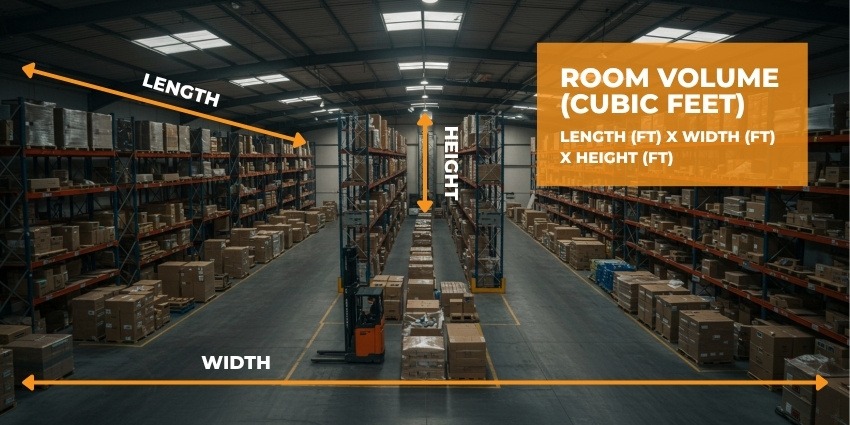
Step 1a: Measure L x W = Square Feet
In any HVLS fan sizing guide, the first step is figuring out how many square feet your space is. Simply measure the length and width of your room and multiple them together.
- Example: If the length of the room is 5 feet and the width is 6 feet, the total square footage is 50 ft. x 60 ft. = 3,000 sq. ft.
For irregular spaces, break the area down into sections, find the square feet of each section separately, and total them together.
Step 1b: Determine the Volume – Sq. Ft. x Ceiling Height = Cubic Feet
The next step is to calculate the volume of the room, taking into account the ceiling height. Ceiling height has a strong effect on airflow requirements and calculating the cubic volume of a space will be a more accurate measurement for airflow requirements than square footage.
- Example: If the square footage of the room is 30 sq. ft. and the ceiling height is 30 ft. then the cubic volume is 3,000 sq. ft. x 30 ft. = 90,000 cu. ft.
Again, if you have a space that is not a rectangular shape, break the space down into section, calculate the cubic feet individually, then add them all together.
Step 2: Calculate Cubic Feet per Minute (CFM)
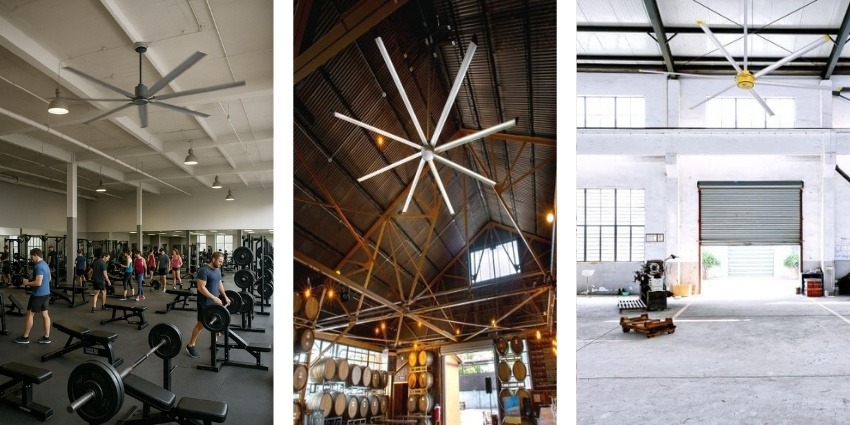
Now that you know the cubic volume of your space, you can determine the airflow you need, measured in Cubic Feet per Minute (CFM). CFM tells you how much air needs to be moved through the space to achieve effective circulation.
To calculate your target CFM, multiply your cubic footage by an air change multiplier:
- 0.75 – 1.25 for standard spaces (warehouses, gyms, retail, general manufacturing)
- 1.5 for high-heat areas (foundries, welding facilities, kitchens, or spaces with heavy machinery)
The multiplier you choose depends on how demanding your environment is. A lightly occupied space with moderate temperatures can use the lower end of the range, while a busier or warmer space will benefit from the higher end.
- Example (standard space): 90,000 cu. ft. x 1.0 = 90,000 CFM required
- Example (high-heat space): 90,000 cu. ft. x 1.5 = 135,000 CFM required
Once you have your target CFM, you'll use it in the next step to match your space to the right HVLS fan or combination of fans.
Step 3: Select the Right Sized HVLS Fan That Fits the CFM & Coverage
With your CFM requirement in hand, the next step is choosing an HVLS fan that can handle both the airflow demand and the physical coverage area of your space. HVLS fans are sized by blade diameter, and larger fans move significantly more air while covering more square footage.
Use the chart below as a starting point to match your space to the right fan size:
| HVLS Fan Diameter, Coverage Area, and Ceiling Height | |
|---|---|
| Area Covered | Fan Size |
| 400 - 2,500 sq. ft. | 4 - 10 ft. |
| 3,600 - 4,900 sq. ft. | 12 - 14 ft. |
| 6,400 - 8,100 sq. ft. | 16 - 18 ft. |
| 10,000 - 14,400 sq. ft. | 20 - 24 ft. |
Keep in mind that coverage area and CFM work together — a fan needs to be large enough to both cover your square footage and deliver the CFM your space requires. In some cases, a single large fan will do the job, but a fan's CFM is determined by fan size, blade diameter, and motor power. In some case you may need multiple fans to meet your CFM needs and more evenly distribute airflow throughout your space.
- Example: Our space is 3,000 sq. ft. with a CFM requirement of 90,000. Based on the chart, a 12 – 14 ft. fan would be the appropriate size to cover the area. However, always verify the fan's rated CFM output meets your calculated requirement before finalizing your selection.
When installing, make sure to leave two to three feet between the fan’s blades and any obstructions.
QUICK TIP: A fan can effectively cover an area approximately 5x its diameter.
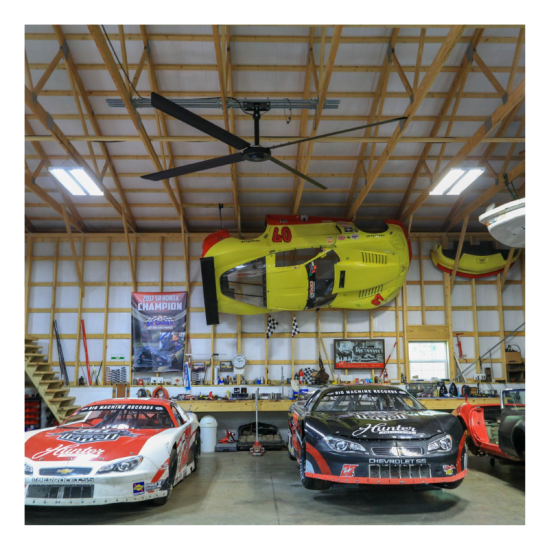
HVLS Fan Sizing Guide Quick Sizing Formula
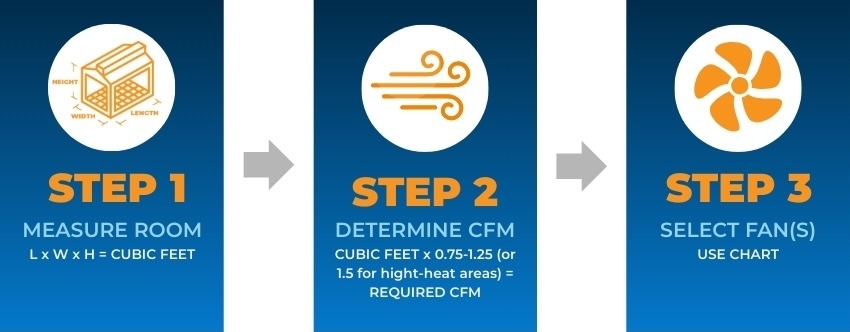
You’ve now walked through the full five-step process to size an HVLS fan. But if you just need a faster approach or want to double-check your work, here’s a quick sizing formula as well:
- Measure room: L x W x H = cubic feet
- Determine airflow: cubic feet x 0.75–1.25 (or 1.5 for high heat) = required CFM
- Select fan based on CFM rating and coverage area
Pro Tips:
- Don't size your fan purely by square footage, take into account ceiling height and activity type as well
- In some cases, multiple smaller fans are more effective than one large fan
Quick Sizing Formula HVLS Ceiling Fan Sizing Example
Let's look at a real-world example of a small-to-mid size distribution warehouse. We'll be using a space that is 150 ft. long and 100 ft. wide with a ceiling height of 24 ft.
- Calculate Room Volume:
- Measure the Square Footage: Length x Width = 150 ft. × 100 ft. = 15,000 sq. ft.
- Calculate Cubic Feet: Square Footage x Ceiling Height = 15,000 sq. ft. × 24 ft. = 360,000 cu. ft.
- Determine the Required CFM (Airflow):
- Use 1.0 CFM/ft³ for this standard warehouse example.
- Required CFM: 360,000 cu. ft. × 1.0 CFM/ft³ = 360,000 CFM
- Select Fan Based on CFM and Square Footage:
- Now that we know the space is 15,000 sq. ft. and requires 360,000 CFM, we can reference both the fan sizing chart and manufacturer CFM ratings.
- According to the chart, 15,000 sq. ft. falls into the "10,000–14,400+ sq. ft." range, which recommends a 20–24 ft. HVLS fan.
- Given the size of this warehouse, a single fan will not be sufficient — multiple fans will be needed to achieve even airflow distribution across the full 15,000 sq. ft.
- Our airflow target of 360,000 CFM should be divided by the rated CFM output of your chosen fan model to determine how many fans are needed.
- In this example, if a 24 ft. HVLS fan is rated at approximately 90,000–120,000 CFM, you would need roughly 3–4 fans to adequately circulate air throughout the warehouse.
Why Proper HVLS Fan Sizing Matters
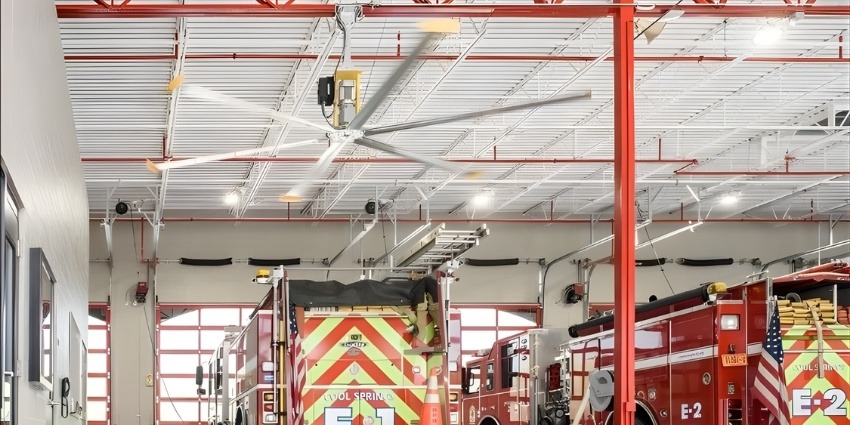
Large columns of air are forced downward by the wide, slow-rotating blades of your HVLS ceiling fan. If the fan is correctly sized for your room, that air displaces horizontally, covering thousands of square feet for a more comfortable, more energy-efficient air distribution. However, the benefits may be lost if an industrial or commercial HVLS fan is the wrong size.
If your fan is too small:
- You don’t meet airflow or CFM requirements
- Hot and cold spots remain in your facility
- Workers remain uncomfortable, leaving them less productive
- More fans or HVAC systems may need to be run, making your energy costs soar
If your fan is too large:
- You will overspend on equipment that is not needed
- Airflow that is too vigorous may make for uncomfortable drafts
- Too much energy wasted running a bigger motor than necessary
- May create safety issues in areas with loose materials or papers that will be blown about
When sized correctly:
- Achieve energy-efficient large space cooling that reduces HVAC costs
- Consistent temperatures; fewer if any, hot and cold spots
- Quiet, efficient operation that doesn't disrupt work
- Maximum ROI through optimized energy usage and comfort
- Supplies cooling in summer, destratification in winter
Why Buy HVLS Fans from HVACDirect.com
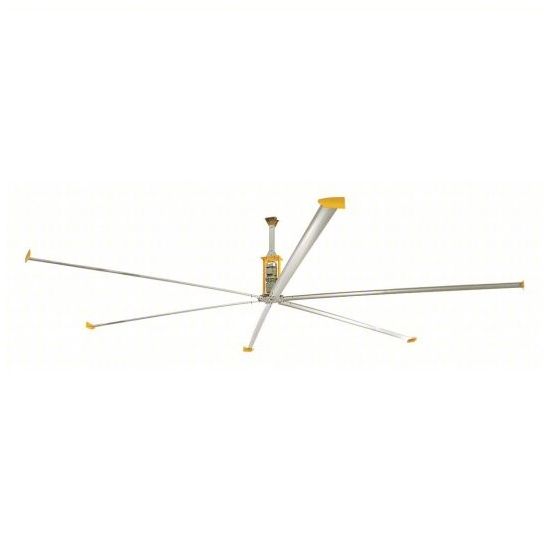
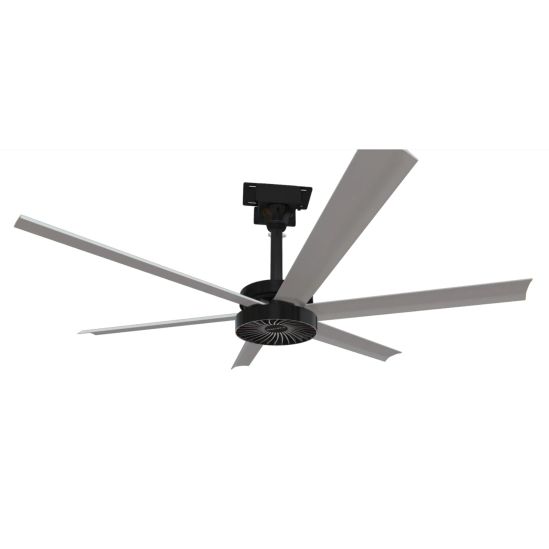
Selecting a reliable supplier is the next step after determining the ideal fan size for your area. That’s where HVACDirect.com comes in.
- We stock commercial and industrial HVLS fans from reputable manufacturers like Big Ass Fans, MacroAir, Hunter, and more
- Competitive pricing makes energy-efficient cooling accessible for any business
- Our team offers free sizing help to match the right fan to your space
- Fans range from 6 to 24 feet to fit everything from small shops to large warehouses
- Getting the fans you need fast is made simple with simple online ordering
- Our team of experts can help you choose the right size and answer any product questions you have
Shop HVLS Fans on HVACDirect.com
An HVLS fan doesn't have to be difficult to size. You can improve your facility's comfort and achieve energy-efficient large space cooling by using this 5-step HVLS fan sizing guide.
Buy HVLS fans at HVACDirect.com right now to add the ideal high-volume ceiling fan solution to your warehouse, manufacturing plant, gym, or commercial space!