Your cookie preferences
We use cookies to remember your preferences and understand how shoppers use our site, helping us improve your shopping experience.
Read our privacy policyACiQ 4 zone mini split systems are the perfect solution if you need to heat and cool four different zones in your home all at unique temperatures. All ACiQ systems are competitively priced and include free shipping.
For more information check out our FAQs at the bottom of the page!
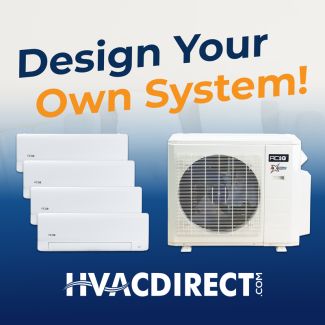




ACiQ 4 zone mini split systems are ductless heating and cooling systems that connect one outdoor heat pump condenser to four independent indoor air handlers, allowing four separate rooms or areas to be heated or cooled at the same time. Designed to cover four rooms totaling 1,000 to 3,000 sq. ft., these systems let you personalize the temperature in each room by giving each its own thermostat.
These systems work by moving refrigerant through a loop between the outdoor condenser and all four indoor air handlers, extracting heat from each zone and releasing it outside during cooling, then reversing that flow to pull warmth from the outdoor air and push it into each room during heating. ACiQ's inverter-driven compressor monitors real-time demand in all four zones, continuously adjusting its output. It speeds up when treating several occupied rooms and slows down when there are fewer.
ACiQ 4 room mini split systems are perfect for homes with four separate conditioned areas, covering about 800 to 4,000 square feet, considering 8-foot ceilings, average insulation, standard ceiling heights, and normal heating and cooling needs. They work best in homes where various rooms need individual temperature control without adding or changing the current ductwork.
Four Bedrooms: These ACiQ systems are an excellent choice when four family members have different comfort preferences or occupancy schedules. Each bedroom receives its own air handler, allowing personalized temperatures while avoiding the energy waste of conditioning unused rooms.
Main Living Area Plus Three Bedrooms: A common setup pairs an open living room with three bedrooms. Larger units can handle the main living space, while smaller handlers keep each bedroom at a comfortable temperature independently.
Homes with Multiple Additions: Homes with multiple additions, such as finished basements or sunrooms, often outgrow their central HVAC capacity. An ACiQ 4 zone system can condition each new area separately, without the need for new ductwork.
Split-Level or Multi-Story Homes: Homes with basements, main floors, upper levels, and finished bonus rooms frequently experience temperature differences between floors. Four independently controlled indoor units help eliminate many of the hot and cold spots common with a single central thermostat.
Homes with Dedicated Living Spaces: Households with home offices, exercise rooms, hobby rooms, guest suites, or media rooms benefit from heating and cooling only the rooms currently in use. Independent zoning reduces unnecessary energy consumption.
Even with four independently controlled zones, poor insulation, high ceilings, too much solar gain, large areas of glass, air leaks, and extreme outdoor temperatures can raise heating and cooling demands. To keep your system running at its best, choosing the right indoor unit capacity for each room is crucial.
ACiQ 4 zone mini split systems are available in outdoor capacities ranging from 24,000 BTU to 55,000 BTU, covering approximately 1,000 to 3,000 square feet across all four zones. Individual indoor air handlers range from 6,000 BTU to 24,000 BTU, allowing numerous equipment combinations for different room sizes and layouts.
24,000 BTU to 27,000 BTU (1,000 to 1,500 sq. ft.): The entry point for ACiQ's 4 zone lineup, available in both the Standard and Extreme series. Suited for four smaller rooms where each zone is compact, with common air handler BTU combinations including 6k+6k+6k+6k BTU, 6k+6k+6k+9k BTU, and 6k+6k+9k+9k BTU, typically serving groups of standard bedrooms or a mix of bedrooms and a home office.
36,000 BTU (1,500 to 2,100 sq. ft.): A versatile mid-range configuration covering four rooms where at least one zone is larger or carries a higher heat load. Available in both series, supporting configurations like 9k+9k+9k+9k BTU, 9k+9k+9k+12k BTU, and 9k+9k+12k+12k BTU, which suit combinations like a living area alongside three bedrooms.
48,000 BTU (2,000 to 2,700 sq. ft.): A step up for larger homes or configurations that include one or two high-load zones such as an open-plan living area, a sunroom, or a challenging converted space alongside three standard rooms. It’s also available in both series, supporting indoor unit BTU combinations including 9k+9k+9k+24k BTU and 12k+12k+12k+18k BTU.
55,000 BTU (2,500 to 3,000 sq. ft.): ACiQ's largest 4 zone outdoor unit is designed for homes with substantial heating and cooling demands. Popular combinations include 18k+18k+12k+6k BTU or 24k+12k+12k+6k BTU, making it ideal for large open living spaces combined with multiple bedrooms or finished additions.
Proper sizing is critical for every ACiQ 4 zone mini split, so be sure not to oversize or undersize your system. An undersized system may struggle to maintain comfort across all four zones during peak weather conditions, while an oversized system can short cycle, reducing humidity control and overall efficiency.
A four room ACiQ mini split system usually runs $5,000 to $12,000+, depending on the outdoor unit size, indoor air handler combination, installation complexity, and product series. Here is a breakdown of the costs:
Equipment Cost: $3,600 to $9,000+, depending on BTU capacity, indoor unit styles, and whether you choose the Standard or Extreme series.
Installation and Labor Cost: $2,000 to $3,500+, depending on the number of line set runs, electrical work, wall penetrations, mounting requirements, and local labor rates.
Operation and Maintenance Cost: Operating costs generally range from $60 to $120 per month during peak heating or cooling seasons, depending on local electricity rates and how many zones operate regularly. Annual professional maintenance typically costs $200 to $600.
You'll also need to factor in $250 to $1,000 for additional installation materials such as line sets, condensate pumps when required, mounting brackets, electrical disconnects, communication wire, and line set covers.
ACiQ does not offer any DIY systems, including those for 4 zones. These systems must be installed by a licensed professional.
DIY Installation: ACiQ four zone systems are not designed for self-installation, and attempting it risks voiding the manufacturer's warranty.
Professional Installation: ACiQ recommends having all 4 zone mini split systems installed by a licensed HVAC contractor, preferably one participating in the ACiQ Dealer Program. Professional installation ensures the refrigerant system is properly evacuated, electrical connections meet code, indoor units are correctly balanced, and the equipment qualifies for applicable warranty coverage.
Permits are typically required for both the mechanical and electrical portions of a 4 zone mini split installation, with specific requirements varying by local jurisdiction. Electrical work must be completed by a licensed electrician, and all refrigerant handling must be performed by an EPA Section 608-certified technician, even if the homeowner completes portions of the installation.
ACiQ systems for four rooms can be paired with wall mounted, ceiling cassette, slim ceiling cassette, concealed duct, and floor mounted indoor air handlers. Because each indoor unit can be selected independently, homeowners can combine different styles throughout the home to match each room's layout, available installation space, and appearance.
Wall Mount: The most common choice for ACiQ 4 zone systems, wall mounted air handlers are available across the Standard and Extreme series and are compatible with the widest selection of indoor BTU capacities. They mount on the wall and preserve valuable floor space.
Ceiling Cassette: Ceiling cassette air handlers are available in select BTU sizes compatible with ACiQ 4 room systems. They are installed flush within the ceiling and provide multi-directional airflow, keeping walls completely clear. This feature makes them a popular choice for living rooms, kitchens, and open-concept spaces where unobstructed walls are desired.
Slim Ceiling Cassette: Slim ceiling cassette units are a good option for any of the four rooms with limited ceiling space. They fit into tighter cavities than standard models, making them practical for finished basements, remodels, and bedrooms.
Concealed Duct: These units are tucked away completely out of sight in a ceiling void, attic, or floor space. They use hidden ductwork to deliver air into any of the four rooms via discreet, flush-mounted registers or grilles.
Floor Mount: ACiQ's universal floor mounted air handlers can be installed near the floor or suspended from the ceiling for any of the four areas. They're useful in rooms with knee walls, large windows, or sloped ceilings where standard wall mounted units won't fit and wall space is limited.
One advantage of ACiQ 4 room mini split systems is the flexibility to mix indoor unit styles throughout the home. For example, many homeowners choose wall mounted units for bedrooms, a ceiling cassette for the main living area, and a floor mounted or concealed duct unit where installation space is more limited. You can use HVACDirect.com’s “Design Your Own System” tool to mix and match air handler types as needed.
ACiQ 4 zone systems require a dedicated 208/230V circuit, with breaker sizing and wire gauge determined by the Maximum Overcurrent Protection (MOCP) and Minimum Circuit Ampacity (MCA) values on the outdoor unit's nameplate. General requirements include:
Voltage: Most ACiQ 4 zone outdoor condensers operate on 208/230V, single-phase, 60 Hz power. Standard 120V household circuits are not compatible.
Amperage and Breaker Size: Depending on the outdoor unit capacity, ACiQ 4 zone systems generally require 25- to 50-amp breakers. Smaller condensers typically use 25- to 35-amp protection, while larger 48k and 55k systems commonly require 40- to 50-amp breakers.
Wire Sizing: Copper conductors should be selected according to the condenser's MCA rating. Most installations use 12 AWG, 10 AWG, or 8 AWG copper wire, depending on the required circuit amperage and local electrical code. Wire size will also depend on which 4 zone ACiQ model you have.
Dedicated Circuit and Disconnect Box: The outdoor condenser in this system must be connected to its own dedicated branch circuit with a weatherproof disconnect installed within sight of the equipment. Sharing the circuit with other appliances is not permitted.
A licensed electrician should confirm all electrical components meet both manufacturer specifications and local code requirements.
Yes, they feature outstanding energy efficiency, with four zone setups achieving efficiency ratings anywhere from 18 to 25 SEER2. Some models from the Standard series achieve the highest rating of 25 SEER2, while the Extreme series is just behind at 24 SEER2.
ACiQ mini split systems are manufactured by Midea, one of the world's largest HVAC producers. Midea produces equipment for many major HVAC brands.
ACiQ does not offer DIY mini split systems. All ACiQ four zone systems require professional installation using traditional flared line sets that must be vacuumed, pressure-tested, and commissioned by a licensed HVAC technician. Self-installation may void the manufacturer's warranty.
When purchased through an authorized online retailer and registered within 90 days of installation according to the manufacturer's requirements, ACiQ 4 zone mini split systems include a 12-year compressor warranty and 7-year parts warranty. If the system is not registered, coverage typically defaults to a 5-year compressor warranty and 5-year parts warranty. Systems purchased through an ACiQ Dealer Program contractor may also qualify for an extended 12-year parts warranty. Always verify the warranty terms for your specific model before purchasing.
Most ACiQ mini splits are heat pumps, providing both heating and cooling to all four spaces, though some cooling-only models are also available. They do this by reversing the refrigerant cycle when the seasons change. Standard series models heat effectively down to -13°F outdoors, while Extreme series configurations extend that range to -22°F, which covers virtually all residential cold-climate heating conditions without a supplemental heat source.
These systems usually last 15 to 20 years as long as you routinely clean and maintain the outdoor unit and all four indoor units. They can potentially last up to 25 years if they use an inverter compressor, which helps decrease the wear and tear on the system by preventing it from constantly turning on and off. They have Gold Fin® anti-corrosion coating on the outdoor condenser coils as well.
Indoor units for 4 zone systems operate at whisper-quiet levels, often as low as 19.5 to 27 decibels on low speed, while the outdoor condenser typically ranges between 59 and 65 decibels at full capacity. They are both quiet enough not to disturb you or your neighbors.
Each one of the four indoor units removes humidity as a natural part of the cooling cycle, as room air passes over the cold coil, moisture condenses, and drains away automatically through the condensate line. All four air handlers also have a “Dry Mode” that targets humidity specifically by slowing down the fan to force humid air to linger longer over the cold coils.
ACiQ mini splits for four spaces usually have washable filters that you can easily clean every two to four weeks with water. The outdoor unit will need to be consistently kept clear of debris. We recommend that you have the entire system, the outdoor condenser and four indoor air handlers, professionally cleaned at least once a year to make sure you catch any maintenance issues.
ACiQ 4 room mini splits are designed to heat and cool four separate spaces or areas. They can potentially cover 5 spaces if one of them is an open-concept area where two rooms are connected without any doors, walls, or other obstructions blocking the airflow. However, do not try to force one of these systems to serve five separate zones because this will make the system wear out faster and run inefficiently.
