Your cookie preferences
We use cookies to remember your preferences and understand how shoppers use our site, helping us improve your shopping experience.
Read our privacy policy


Mitsubishi 3 zone mini-split systems provide heating and cooling for three rooms (zones) in your home. When you order a 3 zone ductless mini-split from us, you’ll get low wholesale pricing and Free Shipping!
Customize your Mitsubishi tri zone mini-split: Use the Shop-By filters at left to choose between wall or ceiling air handlers with the right combination of BTUs needed for each room.
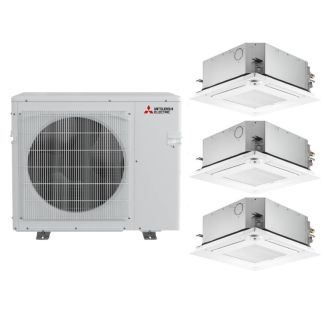
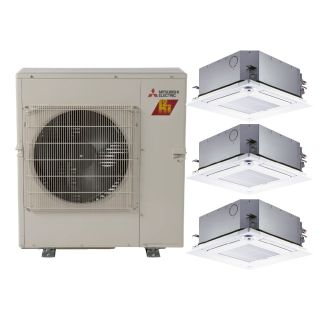
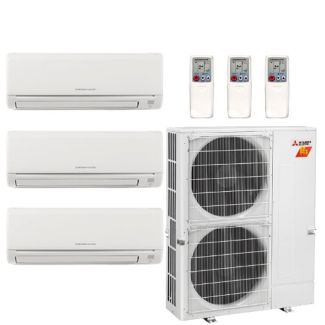
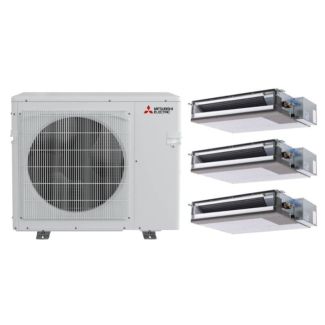
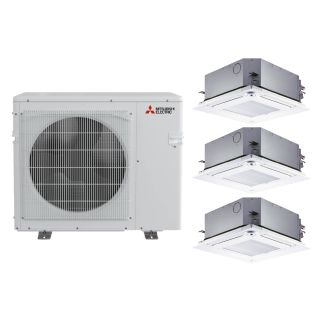
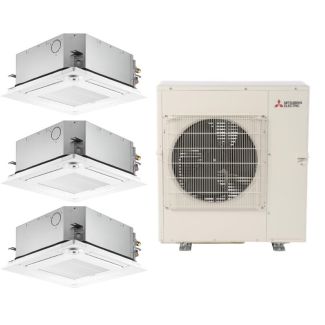
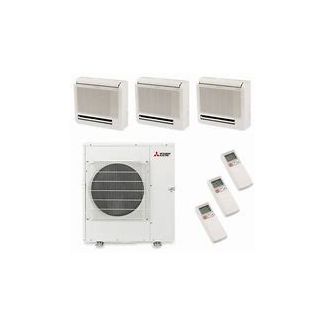
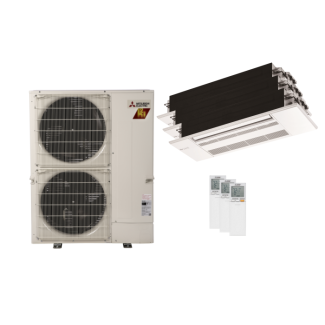

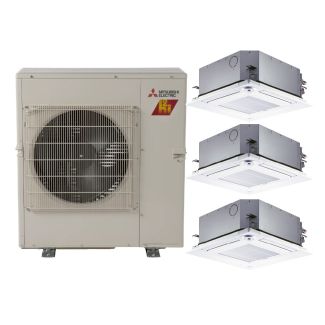

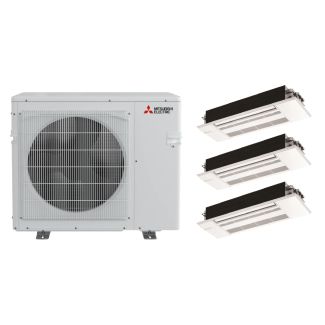
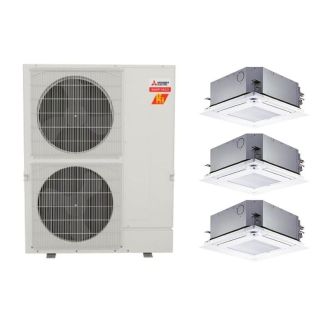
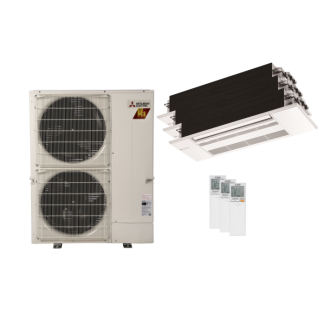
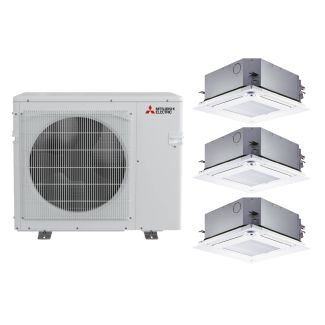
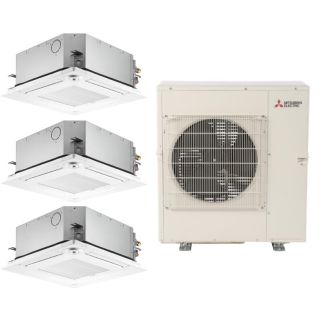
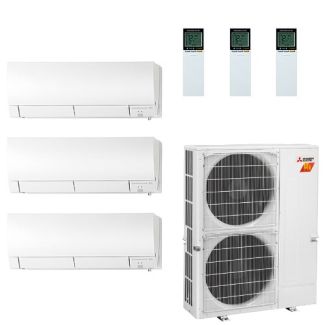
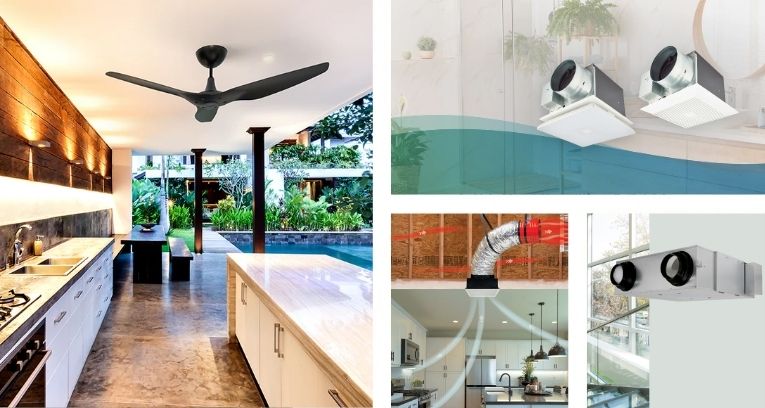

Mitsubishi 3 zone mini splits are ductless heating and cooling systems that connect one outdoor condenser unit to three indoor air handlers. Designed to cover an average of three distinct rooms, these systems maximize comfort by treating each area as an independent zone.
These systems work by circulating refrigerant between the outdoor unit and all three indoor units. Most Mitsubishi systems are heat pumps, absorbing heat from each zone and releasing it outside during cooling, then reversing this flow to deliver warmth indoors during heating. Most of these systems also feature variable-speed inverter technology that continuously adjusts the outdoor compressor speed in response to real-time indoor demand.
Mitsubishi tri zone mini split systems work best in well-insulated homes and light commercial spaces up to 3,000 sq. ft., with individual zones typically ranging from 0 to 1,750 square feet and ceiling heights around 8 feet. These systems are ideal when multiple rooms have different occupancy levels, heat loads, or temperature preferences that are difficult to manage with a single thermostat. Common applications include the following spaces:
Multi-Level Home Additions: Homes with additions on different floors, such as a first-floor family room addition, a second-story bonus room, and a finished attic, are excellent candidates for a 3 zone Mitsubishi mini split system. Instead of extending existing ductwork across multiple levels of the home, which can be costly and time-consuming, a ductless mini split lets you heat and cool each space independently.
Floors with Only Three Rooms: A home with an upper story that has three bedrooms is a common use case for this system. Since people have different comfort preferences in their own bedrooms, this type of mini split can help them maintain full control and end household temperature disputes.
Open-Concept Living Areas: A 3 zone Mitsubishi mini split system is ideal for open-concept homes where the kitchen, living room, and dining room share the same floor plan but have different heating and cooling needs. It allows each area to maintain its own temperature setting, helping manage heat generated by cooking in the kitchen, changing occupancy levels in the living room, and the occasional use of the dining area, all of which are difficult for a single thermostat to control effectively.
Add-on Home Offices, Guest Suites, and Sunrooms: Home additions and renovations are popular, especially when adding a guest suite for grandparents or a sunroom. However, your existing central AC and furnace system may not have the capacity to effectively heat and cool these new spaces. A three zone mini split system provides an affordable solution while avoiding the cost of extending ductwork, and because each zone operates independently, you can reduce energy consumption by conditioning only the rooms that are actively being used.
Light Commercial Spaces: Small commercial spaces can also benefit from a 3 zone Mitsubishi system, such as office suites where individual occupants want independent temperature control or facilities with multiple server rooms that require dedicated cooling for sensitive equipment.
Environmental factors such as poor insulation, excessive air leakage, large expanses of unshaded glass, ceiling heights above 12 feet, and frequent door openings can increase heating and cooling loads. For example, if one of the three zones is a sunroom with floor-to-ceiling windows while the other two are standard bedrooms, that zone may require significantly more capacity than the others to maintain comfort.
These AC units range from 18,000 to 48,000 BTU, typically covering 600 to 2,700 sq. ft. Individual indoor unit capacities typically range from 6,000 to 30,000 BTU, and different capacities can be paired together as long as they fall within Mitsubishi’s approved indoor-to-outdoor capacity combinations.
24,000 BTU (1,000 to 1,500 sq. ft.): These systems are commonly used in small homes and apartments, typically consisting of three smaller zones such as a bedroom, office, and small living area.
30,000 BTU (1,250 to 1,750 sq. ft.): These are commonly used in mid-size homes and townhouses for a living space and two separate bedrooms.
36,000 BTU (1,500 to 2,000 sq. ft.): These triple zone systems work well for open-concept living areas connected to kitchens and dining rooms or for three larger rooms that require additional heating and cooling capacity. You can also use them if you have three separate added-on spaces, such as a sunroom, garage, or guest room.
42,000 BTU (1,800 to 2,400 sq. ft.): These higher-capacity systems are often used in larger homes with spacious living areas, primary suites, and additions that require independent temperature control.
48,000 BTU (2,000 to 2,700 sq. ft.): Mitsubishi's largest common 3 zone configurations are often used in larger homes with multiple living areas, larger primary suites, or spaces with higher heating and cooling demands.
Proper sizing is critical for Mitsubishi 3 zone mini split systems because the outdoor unit must handle the combined heating and cooling demands of all three indoor units. For example, an undersized 24,000 BTU system may struggle to keep a living room and two large bedrooms comfortable during extreme temperatures, while an oversized 48,000 BTU system serving three small bedrooms may cycle more frequently than necessary and provide less effective humidity control.
A 3 zone Mitsubishi mini split will have a total investment cost of about $6,500 to $12,000+ for the equipment and installation. Here’s a breakdown of what this cost includes:
Equipment Cost: $5,000 to $10,000+, depending on air handler type and total capacity. Mitsubishi is considered a premium, reliable brand, so their equipment tends to be more expensive.
Installation and Labor Cost: $2,000 to $4,000+, depending on local rates. Installation and labor costs will vary significantly based on your space's needs and local costs. If your main electrical panel needs an upgrade to support this system, it will add on at least another $1,000, and you will need to hire a licensed electrician to complete the work. Add-in permit costs typically range from $100 to $300+, although some jurisdictions charge significantly more.
Operation and Maintenance Cost: $40 to $100 per month for electricity, depending on the season, usage amount, and local power rates. Maintenance costs are usually minimal because these systems usually come with washable, reusable filters, and the indoor units sometimes include a self-cleaning mode. If you get a professional cleaning, expect to pay about $100 per indoor unit, totaling about $450 for all indoor units plus the outdoor unit.
If you need any extra accessories, such as line-hide covers, wall brackets, and electrical disconnects, you’ll have to pay an additional $200 to $600.
Mitsubishi does not make any DIY tri zone systems, so you’ll need to have a licensed HVAC installer, preferably a Mitsubishi Electric Diamond Contractor, install the system for you. Here are some specific details on each path
DIY Installation: Mitsubishi does not offer any DIY-friendly three zone systems. If you try to install one of these systems yourself, your warranty will be voided. You must have a licensed HVAC contractor install the system.
Professional Installation: Professional installation helps ensure the system is properly sized, configured, and commissioned for optimal performance across all three zones. Homeowners who choose a Mitsubishi Electric Diamond Contractor may qualify for Mitsubishi's extended 12-year parts and 12-year compressor warranty on qualifying residential installations when the system is registered within 90 days of installation.
These systems require local permits, which your installer usually includes in the installation cost and obtains for you, and electrical work must be completed by a licensed electrician. Mitsubishi 3 zone mini split systems require professional installation because they involve refrigerant line connections, electrical wiring, system evacuation, and startup procedures that must be performed correctly to maintain warranty coverage.
The majority of air handler types are compatible with Mitsubishi systems that are designed for three areas, including wall mount, ceiling cassette, slim ceiling cassette, concealed duct, and floor mount. Here’s a breakdown of each type:
Wall Mounted Indoor Unit: Mitsubishi's most popular option, commonly used in 3 zone systems serving bedrooms, home offices, living rooms, and other everyday living spaces.
Ceiling Cassette Indoor Unit: Installed flush within the ceiling and designed to distribute conditioned air in multiple directions, making it a popular choice for open-concept living rooms, kitchens, and larger gathering areas. In a typical three zone configuration, homeowners might install one cassette in a large great room, a second in a primary suite, and a third in a home office to maintain a clean appearance throughout the home.
Slim Ceiling Cassette Indoor Unit: A lower-profile cassette designed for applications with limited ceiling space, often used in bedrooms, offices, and finished basements where a traditional cassette may not fit.
Concealed Duct Indoor Unit: Hidden above ceilings, inside soffits, or within closets and connected to short duct runs, allowing a single indoor unit to discreetly condition multiple nearby spaces. A popular configuration is one concealed unit for a primary suite, one for a living area, and one for a separate wing of bedrooms.
Floor Mounted Indoor Unit: Floor mounted units are often used when wall space is limited or ceiling installation is impractical. Homeowners frequently pair them with wall mounted or cassette units in mixed-layout homes where each of the three spaces has different installation requirements.
These systems allow homeowners to mix and match compatible indoor unit styles and capacities, but all indoor and outdoor components must be Mitsubishi units that use the same refrigerant and communication platform. Each indoor unit requires its own dedicated refrigerant line set, and the combined indoor capacity can typically be up to 130% of the outdoor unit's rated capacity because all three zones rarely operate at maximum demand simultaneously.
Most Mitsubishi 3 zone mini split systems require a dedicated 208/230V electrical circuit, a 20- to 50-amp double-pole breaker, 14/4 or 16/4 communication wiring, and a weatherproof disconnect box installed within sight of the condenser. Here are some typical requirements, though be sure to check your specific model, as exact requirements will vary:
Voltage: Mitsubishi 3 zone mini split systems require a dedicated 208/230V, single-phase, 60 Hz electrical supply and are designed to operate within a voltage range of approximately 198V to 253V, though some have an absolute minimum of 187V.
Amperage and Breaker Requirements: Depending on the model and whether it includes Hyper-Heating technology, these systems typically have a Minimum Circuit Ampacity (MCA) of 15.0 to 31.5 amps and require a 20- to 50-amp double-pole breaker based on the manufacturer's Maximum Overcurrent Protection (MOP) rating. You must strictly follow the MOP and MCA listed on your model’s outdoor unit’s data plate.
Typical Wiring Size: Most three zone installations use 10/2 or 10/3 AWG copper wire from the electrical panel to the disconnect box and 10/2 AWG wire from the disconnect to the outdoor unit. Communication and power between the outdoor condenser and indoor air handlers typically use 14/4 or 16/4 AWG communication wire, which carries both operating power and control signals, and many contractors rely on approved Diamondback Mini Split Wire or stranded 14/4 THHN. Exact wire sizes vary based on the Mitsubishi model, electrical requirements, local code, and your home's existing electrical system.
Separate Disconnect Box: A weatherproof disconnect box rated between 30 and 60 amps is typically installed within sight of the outdoor unit to meet electrical code requirements and allow safe servicing.
Failing to follow your tri zone Mitsubishi model's specific electrical requirements can lead to nuisance breaker trips, communication errors between indoor and outdoor units, poor system performance, equipment damage, code violations, and, in some cases, may void portions of the manufacturer's warranty.
Mitsubishi 3 zone mini split systems are highly efficient inverter-driven heat pumps, with most models achieving SEER2 ratings between 19 and 23. Entry-level MXZ Series systems typically deliver around 19 SEER2, while premium H2i, FX, and GX Series models can reach up to 23 SEER2. Mitsubishi's inverter technology continuously adjusts compressor speed to match demand, reducing energy consumption and improving temperature consistency. Many H2i Hyper-Heating systems also maintain strong heating performance in temperatures as low as -13°F, making them suitable for cold climates.
These systems are manufactured by Mitsubishi Electric, a division of Mitsubishi Electric Corporation, a Japanese company that has been producing ductless mini split systems since the 1970s. In the United States, Mitsubishi Electric heating and cooling products are sold and supported through a joint venture with Trane Technologies, called Mitsubishi Electric Trane HVAC US (METUS).
No, Mitsubishi does not make DIY 3 zone mini split systems, and if you try to install one yourself, your warranty will be voided regardless of whether you installed it correctly. All Mitsubishi multi-zone equipment requires professional installation by a licensed HVAC contractor for refrigerant work and system startup, and professional installation is required to keep the manufacturer's warranty valid.
Warranties for these systems depend on who installs the system. Installations completed by a licensed HVAC contractor typically include a 5-year parts warranty and a 7-year compressor warranty, while qualifying systems installed by a Mitsubishi Diamond Contractor can receive up to a 12-year parts and 12-year compressor warranty when registered within 90 days. Proof of professional installation is required for all warranty claims, and DIY or unlicensed installations generally void the manufacturer's warranty.
The majority of Mitsubishi 3 zone systems are heat pumps, meaning the same system cools in summer and heats in winter by reversing the refrigerant cycle to pull warmth from the outdoor air and deliver it into each zone. Each zone can have its own temperature and fan speed settings, but all indoor units must operate in the same heating or cooling mode at the same time.
These systems usually last 15 to 20 years, with higher-efficiency, frequently cleaned systems lasting up to 25 years. Longevity is most influenced by the quality of the original installation, how consistently filters are cleaned across all three indoor units, and whether the outdoor unit is kept clear of debris and vegetation year-round. Keeping up with those basics across all three zones gives the system the best chance of reaching the upper end of its expected lifespan.
Yes, Mitsubishi multi zone systems, including the 3 zone ones, are exceptionally quiet with indoor units operating in a sound range of 19 to 49 dB, similar to a whisper up to the sound of a quiet library. Outdoor units typically range from 48 to 58 dB, similar to moderate rainfall or a quiet residential street. Mitsubishi's quietest indoor units, including the MSZ-FS Designer Series and newer FX/GX models, can operate at sound levels as low as 18 to 19 dB on their lowest fan settings.
Most Mitsubishi indoor units also include a dedicated dry mode that reduces humidity without overcooling the room, which is useful on mild but muggy days in all three zones. Each zone runs in dry mode independently, so you can address humidity in one room without affecting the others' temperature or humidity. Dehumidification also occurs naturally during cooling in mini splits: as warm, humid air passes over the cold indoor coil, moisture condenses and drains out through the condensate line.
All three indoor units should have their washable filters cleaned every two to four weeks during periods of regular use, and more frequently in dusty or high-traffic spaces. All you have to do is remove the panel covering the filter, take the filter out, rinse it with water, let it dry, and reinstall it. A professional cleaning that includes inspecting refrigerant levels, electrical connections, and coil condition for all three indoor units and the outdoor unit is recommended yearly.
A 3 zone Mitsubishi system is designed to heat and cool three separate rooms or areas. Each of these rooms will be independently controlled with its own thermostat. If you need to add a fourth or fifth room later, upgrading to a 4 zone or 5 zone system is a better option than trying to stretch the 3 zone system past what it is designed for.
