Key Takeaways
- Measure & Size Accurately: Always verify your mobile home’s true square footage and use the 25–30 BTU/ft² rule (up to 45 BTU/ft² in colder climates) to ensure optimal heating and cooling performance.
- Choose the Right System Type: Central forced‑air delivers whole‑home comfort when ductwork exists, while ductless mini splits provide zoned, efficient heating and cooling without ducts—and even DIY installation kits.
- Prioritize Proper Installation: Professional airflow calibration, correct condenser placement, and matching tons per 600–700 ft² (about 3 tons for a 1,800 ft² home) prevent short‑cycling, hot spots, and high energy bills.
Below is a concise list of FAQs designed to help you keep your mobile home comfortable, energy‑efficient, and safe—all without breaking the bank.
Before you size your system, measure your actual living area with a tape—don’t just trust the manufacturer’s stated dimensions. For single‑wide mobile homes, budget on 25–30 BTU per square foot in warm to temperate zones, and up to 45 BTU per square foot in colder northern climates.
Mobile Home Frequently Asked Questions
How does mobile home HVAC work?
A mobile home HVAC system works the same way as a traditional system, but with airflow modifications designed for small spaces with less insulation. In the summer, heat is removed from the living area using refrigerant. The heat is then expelled to the atmosphere. If the system includes a heat pump, the process is reversed, with heat absorbed from the atmosphere and released indoors.
What is the most efficient way to heat/cool a mobile home?
Mobile‑home HVAC systems follow the same basic refrigeration cycle as standard homes but are engineered for lighter construction and tight floor plans. In cooling mode, the compressor pushes cold refrigerant through an indoor coil, where it absorbs heat from the air your blower circulates; that heat is then expelled outdoors by the condenser. Heat‑pump models simply reverse the cycle in winter, drawing warmth from outside air and releasing it indoors, so they can replace or supplement a furnace without burning fuel.
Because mobile homes have thinner walls and shorter, sometimes pre‑sealed duct runs, manufacturers often package everything into compact rooftop or closet units with high‑output blowers. Getting the BTU capacity and airflow balance right is crucial—undersized or oversized systems can short‑cycle, create hot or cold spots, and drive up energy bills.
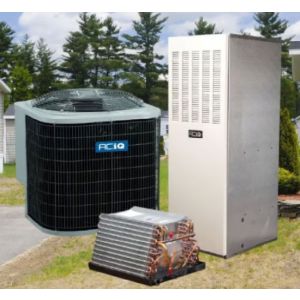
Central forced‑air HVAC is the most efficient way to heat and cool a mobile home. An outdoor condenser sits on a slab to reject or absorb heat, while an indoor air handler houses the evaporator coil and blower, pushing conditioned air through under‑floor ducts to every room. You can choose a heat‑pump model—reversing in winter to draw warmth from outside—or add a furnace or electric coil for supplemental heat.
One standout option that puts these advantages into practice is the Revolv System. It offers the right capacity for single‑ and double‑wide homes, meets or exceeds regional SEER requirements, and employs variable‑speed technology for quieter operation and lower energy bills—delivering outstanding year‑round comfort and value.


Can you add central air to a mobile home?
You can add central air to a mobile home if it has ductwork installed. Even if a mobile home originally lacks an AC for summer use, if it has a forced-air furnace, a central air conditioning system can easily be installed. The best air conditioner for a mobile home handily out-performs window units in both comfort and efficiency.
If your mobile home does not have ductwork installed, consider a ductless mini split system for your heating and cooling needs.
Can a mini split cool a whole mobile home?
Yes—when properly sized, a multi‑zone mini split can cool (and heat) an entire mobile home just like a central system. An outdoor condenser feeds multiple indoor air handlers, each creating its own “zone,” so you get even comfort and independent temperature control without duct losses.
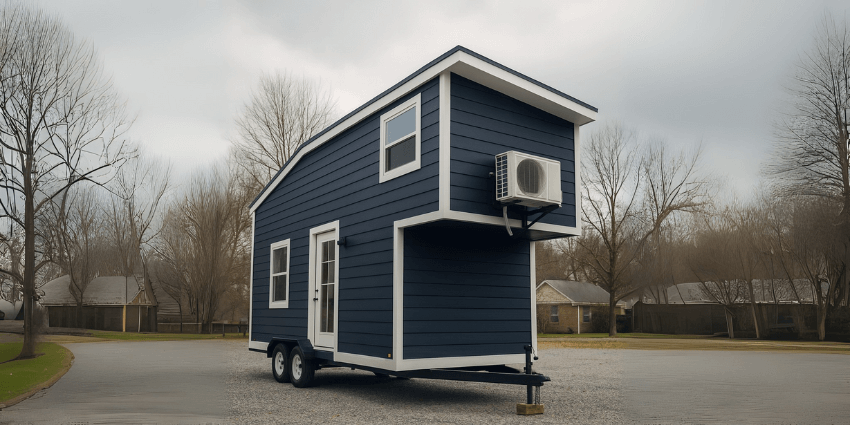
Mini splits are ideal for mobile homes because they need only a small wall opening for the refrigerant lines. Wall‑mounted units are the most popular—slim, easy to install, and great for airflow—though floor‑ or ceiling‑cassette models are available if space is tight. Just pick the right total BTUs and number of heads to match your square footage, and you’ll have reliable, whole‑home cooling.
Can I install a mini split myself?
Absolutely—if you’re handy with basic plumbing and electrical work, you can install a DIY mini‑split yourself. Modern kits come factory‑charged with quick‑connect refrigerant lines, straightforward mounting brackets, and step‑by‑step guides. All you need is a drill, level, hole saw for the wall pass‑through, and ideally a vacuum pump to purge the lines before start‑up. For peace of mind (and warranty requirements), you can always tackle the install yourself and call in a licensed pro for the final vacuum check and charge.
Ready to dive in? Browse our full list of DIY‑friendly mini‑split options.
How many BTUs do I need to heat a mobile home?
You’ll need about 25–30 BTU per square foot to heat a mobile home comfortably in most U.S. climate zones. It’s actually both. You need extra BTUs in colder regions because the bigger temperature difference drives more heat loss, and mobile homes’ thinner walls (plus their compact layouts) make that loss even greater—so you size up to meet the combined challenge of cold weather and lighter construction.
Always measure your actual living area—don’t rely solely on the manufacturer’s stated dimensions. Be sure to factor in ceiling height, insulation quality, and window placement when calculating your total BTU requirement. This approach ensures reliable warmth without wasting energy.
How many tons do I need to cool my mobile home?
Most mobile homes need around three tons of cooling capacity—roughly one ton per 600–700 sq ft—to stay comfortable on average summer days. For a typical 1,200–1,800 sq ft single‑ or double‑wide, a 3‑ton system will usually suffice. In hotter southern and western climates—or in units with large south‑ or west‑facing windows and minimal insulation—you might bump up to 3.5 tons to handle those peak‑heat days without running nonstop. Just beware that significantly oversizing can cause short‑cycling and poor dehumidification, so whenever possible get a proper load calculation or stick to the one‑ton‑per‑600 sq ft guideline as your starting point.
Why are mobile homes so hot?
Mobile homes are hot, primarily because they don’t have as much insulation on the exterior walls as a full-size home would. Air leaks around doors and windows, portals for utilities and joints between mobile home sections can add to the problem.
Can you put a house furnace in a mobile home?
You can not put a house furnace in a mobile home without creating a fire hazard. Traditional furnaces are too hot for the smaller ductwork of a mobile home, and the heat cannot easily be dispersed.
How do I keep my mobile home warm in the winter?
You can help keep a mobile home warm in the winter by sealing all air leaks around doors and windows, especially those that face north. Caulking and weather stripping can make a big difference in comfort levels and heating bills. In short, any place where gaps are noticeable needs attention – even under the unit - and it is well worth the effort. This will add to your efficiency.
Shop Mini Splits for Mobile Homes at HVACDirect.com
Choosing the right HVAC solution for your mobile home boils down to understanding your space, climate, and installation options. Whether you opt for a central forced‑air system or a ductless mini split, proper sizing, efficient airflow, and professional setup will ensure year‑round comfort and energy savings. For homes without existing ductwork—or for those who want individualized temperature control in every room—mini splits offer unmatched flexibility and performance.
Shop mini splits for mobile homes at HVACDirect.com and find the perfect system to keep your home comfortable, efficient, and budget‑friendly.


Mobile Home Heating and Cooling FAQs
A short list of frequently asked questions follows, providing you a guide to making your mobile home comfortable, energy efficient and safe, all within a tidy budget.
Carefully determine your square footage with a tape measure. Don’t simply rely on the manufacturer’s stated size. For single-wide mobile homes, plan on 25-30 BTUs per square foot in warm and temperate climate zones and up to 45 BTUs per square foot for northern climate zones.
FAQs
How does mobile home HVAC work?
A mobile home HVAC system works the same way as a traditional system, but with airflow modifications designed for small spaces with less insulation. In the summer, heat is removed from the living area using refrigerant. The heat is then expelled to the atmosphere. If the system includes a heat pump, the process is reversed, with heat absorbed from the atmosphere and released indoors.
What is the most efficient way to heat/cool a mobile home?
The most efficient way to heat or cool a mobile home is through a central HVAC system. A central HVAC system includes a condenser, which sits outside on a slab or platform; evaporator coils, which are typically housed in the same cabinet with the air handler, which distributes air to the living area via ductwork that is installed under the floor. The system may include a heat pump (an ability to run in reverse, not a separate component) or a furnace/heating coil.
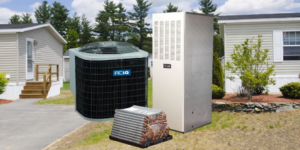
This Revolv System that has superb capacity for most mobile homes. It meets SEER requirements for the states that have them (mostly southern and western states) and represents outstanding value for the consumer:

Can you add central air to a mobile home?
You can add central air to a mobile home if it has ductwork installed. Even if a mobile home originally lacks an AC for summer use, if it has a forced-air furnace, a central air conditioning system can easily be installed. The best air conditioner for a mobile home handily out-performs window units in both comfort and efficiency.
If your mobile home does not have ductwork installed, consider a ductless mini split system for your heating and cooling needs.
Can a mini split cool a whole mobile home?
A mini split can cool a whole mobile home. These are a good option for those without preinstalled ductwork. Mini split systems have a condenser outside, just like a regular mobile home central system, but the condenser feeds one or more air handlers inside, each responsible for a zone (usually a room and its adjacent area). The air handlers in these systems do not need ductwork, distributing cool and heated air directly into the room.
For mobile homes, some options for air handler mounting are limited. Wall mount units are quite popular for use in mobile homes.
Can I install a mini split myself?
You can install a mini split yourself with a basic level of handyman skills. Many manufacturers produce DIY packages, with easily accessed bolts and screws, refrigerant lines that are charged with refrigerant at the factory and complete installation and mounting instructions. DIY mini splits gain in popularity every year, and many consider them to be the best HVAC for mobile homes.
See our full list of mini split options.
How many BTUs do I need to heat a mobile home?
You need 25 to 30 BTUs per square foot for a mobile more in most climate zones in the US. For more northern climates, additional BTUs may be required for the greatest comfort level.
How many tons do I need to cool my mobile home?
You need three or slightly more tons of AC capacity to cool a mobile home.
Most mobile homes can be kept comfortable in the summer with a 3-ton AC system, but mobile homes in the south and west may have days where the system could need a bit more power.
Why are mobile homes so hot?
Mobile homes are hot, primarily because they don’t have as much insulation on the exterior walls as a full-size home would. Air leaks around doors and windows, portals for utilities and joints between mobile home sections can add to the problem.
Can you put a house furnace in a mobile home?
You can not put a house furnace in a mobile home without creating a fire hazard. Traditional furnaces are too hot for the smaller ductwork of a mobile home, and the heat cannot easily be dispersed.
How do I keep my mobile home warm in the winter?
You can help keep a mobile home warm in the winter by sealing all air leaks around doors and windows, especially those that face north. Caulking and weather stripping can make a big difference in comfort levels and heating bills. In short, any place where gaps are noticeable needs attention – even under the unit - and it is well worth the effort. This will add to your efficiency.