We use cookies to make your experience better. To comply with the new e-Privacy directive, we need to ask for your consent to set the cookies. Learn more.

1-800-397-1392
Today's Hours 8am - 11pm est


Mitsubishi’s 5 zone air conditioner and heat pump systems provide combined heating and cooling for five areas of your home.
Customize your system: Use the Shop-By filters at left to choose between wall, ceiling air handlers, or concealed duct as well as the right combination of BTUs needed for each room.
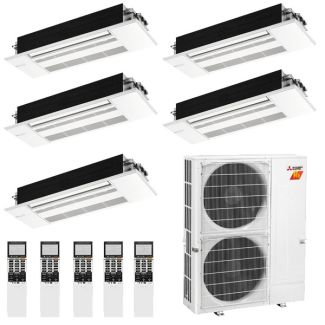

Mitsubishi 5 zone mini split systems are multi-room, ductless heating and cooling configurations that connect up to five individual indoor air handlers, often called heads, to a single outdoor compressor unit. They are designed to manage multiple independent living spaces, allowing homeowners to customize the temperature in each zone without installing the bulky ductwork common with traditional systems.
These systems work by sending refrigerant through a continuous circuit connecting the outdoor unit to all five indoor air handlers, transferring heat between the indoor and outdoor environments to provide cooling and, in heat pump systems, heating. Many systems use inverter-driven compressors that continuously adjust output based on the system's heating and cooling demand. As more zones call for heating or cooling, the compressor increases capacity; as demand decreases, it reduces output to save energy.
These systems are best suited for homes and light commercial spaces between approximately 1,500 and 2,700 sq. ft. with average ceiling heights of 8 feet, good insulation, and five distinct areas that would benefit from independent temperature control. While exact sizing depends on climate, layout, and construction quality, these systems perform best when the heating and cooling load is reasonably balanced across multiple rooms or occupied spaces. Here are some specific use cases:
Whole-Home Coverage for Single Family Homes: These systems are designed to provide independent temperature control throughout an entire home, making them ideal for layouts with multiple bedrooms, living areas, home offices, sunrooms, or finished basements. Instead of relying on a single thermostat to manage the entire house, each major living space can maintain its own comfort setting.
Homes without Existing Ductwork: Older homes, major renovations, and properties where installing ductwork would be difficult or expensive are excellent candidates for Mitsubishi 5 zone mini splits, as they provide whole-building comfort without requiring extensive structural modifications.
Homes with Multiple Additions or Converted Spaces: A main home that has grown over the years with a garage conversion, in-law suite, sunroom, bonus room, or finished basement can quickly outgrow what a regular central HVAC system can handle. These spaces often have different insulation levels, occupancy patterns, and heating and cooling needs. This makes it hard for a single thermostat and duct system to manage them effectively. These systems let each area operate independently. It provides comfort where it’s needed without overheating or overcooling the rest of the house.
Vacation Homes and Short-Term Rentals: Properties rented by different people at different times benefit from a five area mini split’s ability to heat and cool spaces only when occupied. Guests, or family members, will be able to customize the temperatures in every room while they are there. The building owner can turn off the system completely during periods when the building isn’t in use, saving a significant amount of money on energy bills.
Mixed-Use Light Commercial Buildings: Small offices, medical practices, law offices, and similar commercial spaces can use five zones to independently control temperatures in private offices, conference rooms, reception areas, and employee workspaces while reducing energy consumption in unoccupied areas.
Environmental factors such as poor insulation, excessive air leakage, ceiling heights above 10 feet, large expanses of unshaded glass, and extreme outdoor temperatures can place uneven loads across all five zones, reducing efficiency and making proper system sizing even more important.
These systems are sold with an outdoor unit sized to the combined load of all five indoor heads, usually with a total capacity ranging from 36,000 BTU to 48,000 BTU, and indoor air handlers ranging from 6,000 BTU to 24,000 BTU. Depending on the model, a branch box may be required to connect all five indoor units to the outdoor condenser, as some Mitsubishi outdoor units do not have enough direct refrigerant ports for each air handler, necessitating a branch box to split and distribute refrigerant to additional zones. Here are the most popular capacities for these systems:
36,000 BTU (1,500 to 2,000 sq. ft.): Mitsubishi's entry point for 5 room systems is built around the MXZ-5D36NL outdoor unit. It is best suited for homes with five smaller rooms, such as a group of standard bedrooms and a home office, where each zone is compact, and the average indoor head falls in the 6,000 to 9,000 BTU range. Common air handler BTU configurations that combine to equal 36,000 BTU include 6k+6k+6k+9k+9k and 6k+6k+9k+9k+9k.
42,000 BTU (1,800 to 2,400 sq. ft.): A step up for homes where one or two zones are larger or carry a higher heat load, such as an open-plan living area paired with four bedrooms or a primary suite alongside four secondary rooms. The MXZ-5D42NL supports configurations like 6k+6k+9k+9k+12k and 9k+9k+9k+9k+9k.
48,000 BTU (2,000 to 2,700 sq. ft.): Homes with five substantial rooms or configurations that include one high-capacity zone, such as a great room, and four standard zones are a good fit for this total capacity configuration. The MXZ-SM48NL with a branch box supports air handler BTU configurations like 6k+12k+12k+12k+15k and 12k+12k+12k+12k+12k, making it suitable for larger homes with unique layouts.
Getting the sizing right across each zone matters more at five zones than at any lower zone count because if the outdoor unit is too small, it will struggle to keep all rooms comfortable when multiple zones are running hard at the same time. In addition, an oversized system serving five smaller rooms will short-cycle frequently and provide poor humidity control throughout.
One of these systems will typically cost between $10,000 and $20,000+, with the final price depending on the unit series, BTU capacity, and the complexity of the installation. Here’s a breakdown of the costs you should expect:
Equipment Cost: $8,000 to $15,000+, depending on the BTU capacity and efficiency rating. The exact cost also depends heavily on the indoor units selected, with GX-Series configurations generally offering a more affordable entry point, while FX-Series systems command a premium due to their advanced cold-climate capabilities.
Installation and Labor Cost: $3,000 to $8,000+, depending on the complexity of running line sets across five rooms, ceiling height accessibility, and what air handler types you use.
Operation and Maintenance Cost: Electricity averages about $30 to $80 per month per zone, but is heavily tied to local utility rates and winter and summer extreme temperatures. For maintenance, expect to pay $150 to $350 per annual professional tune-up visit.
Remember to budget for additional costs for necessary accessories, such as drain pumps, line set covers, and electrical disconnects. These usually cost between $300 and $1,500+, depending on what you need.
You cannot install a 5 room Mitsubishi system yourself because none of their multi zone systems are DIY-friendly. Instead, you should have a licensed professional, specifically a Mitsubishi Diamond Contractor, install it for you. Here are more specifics on why this is the case:
DIY Installation: Mitsubishi does not offer a DIY version of any five head mini split, as these systems require refrigerant line vacuuming, pressure testing, and startup charging, all of which federal law restricts to certified technicians. You may be able to handle the installation preparations, such as drilling wall penetrations and securing mounting brackets, but the refrigerant connections, electrical work, and system setup must be completed by a licensed professional. If you try to do these things yourself as an unlicensed installer, your warranty will be voided.
Professional Installation: Mitsubishi five area systems are complex installations that often involve multiple indoor units, long refrigerant runs, branch boxes, electrical work, and precise system commissioning, making professional installation strongly recommended. Having the system installed by a Mitsubishi Diamond Contractor can qualify homeowners for an extended 12-year parts and 12-year compressor warranty on eligible systems. Installations performed by non-Diamond Contractors typically receive Mitsubishi's standard warranty coverage.
Completing one of these system installations safely requires local municipal mechanical permits and adherence to regional building codes. A dedicated high-voltage electrical sub-panel must be installed, and certified HVAC technicians must handle the system's refrigerant.
These systems are available with four different indoor air handler types, including wall mount, ceiling cassette, slim ceiling cassette, and concealed duct. Here are some details on when to choose each and what models are available:
Wall Mounted Air Handler: For a five room Mitsubishi system, the wall mount style is the most widely available and the most common choice. These units are installed high on an interior wall, are available in the full BTU range for 5 zone use from 6,000 to 24,000 BTU, and offer the widest selection of GX and FX series options Mitsubishi offers.
Ceiling Cassette Air Handler: Mitsubishi ceiling cassettes send air out in four directions when mounted flush with the ceiling, making them a good choice for open-plan areas or commercial spaces, especially with a 5 space setup and limited wall space, or when a cleaner aesthetic is the priority. A popular option is the SLZ four-way EZ FIT model.
Slim Ceiling Cassette Air Handler: For rooms with limited cavity depth above the finished ceiling surface, a lower-profile ceiling mounted option is available. This works well in finished basements, offices, and bedrooms where a standard cassette won't fit. It comes in select BTU sizes compatible with Mitsubishi 5 zone outdoor units, and one of the most popular models is the MLZ one-way cassette.
Concealed Duct Air Handler: Tucked away in a ceiling cavity, attic space, or closet to seem invisible, this unit type connects to short duct runs that end at standard ceiling registers. Mitsubishi's SEZ-Series is the most common concealed duct option used in five zone residential setups. It is especially popular for primary suites and formal areas where appearance matters.
With HVACDirect.com’s “Design Your Own” tool, you can customize your system and select the air handler type and size for each space, mixing styles as needed. Combined indoor capacity can typically reach up to 130% of the outdoor unit's rated BTU, since all five zones rarely run at maximum load simultaneously.
Mitsubishi 5 zone systems typically require a dedicated 208/230V electrical circuit, properly sized wiring, communication cables, and a disconnect box, although exact requirements vary by model, capacity, branch box configuration, wire run length, and local electrical codes. Here are the general electrical specifications most homeowners can expect.
Voltage: Every Mitsubishi 5 zone outdoor unit requires a dedicated 208/230V, single-phase, 60 Hz electrical circuit. Standard 120V household outlets are usually unable to power these systems.
Amperage and Breaker Size: Most Mitsubishi 5 zone systems require a dedicated 25- to 60-amp breaker, depending on the outdoor unit, whether it is a standard or Hyper-Heat model, and the overall system configuration. Always follow the Minimum Circuit Ampacity (MCA) and Maximum Overcurrent Protection (MOP) ratings listed on the unit's nameplate, as these are the only values approved by Mitsubishi and required for code-compliant installation.
Wiring: Most installations use copper wire sized according to the system's electrical requirements, run length, and local code requirements. While 10 AWG wire is common, longer wire runs may require larger conductors to prevent voltage drop, so final wire sizing should always be determined by a licensed electrician.
Communication Wiring: Communication between the outdoor unit and indoor air handlers is typically handled with 14 AWG, 4-conductor stranded control wire that carries control signals and low-voltage power between components. Following the manufacturer's wiring specifications is critical for reliable communication across all five zones.
Dedicated Circuit and Disconnect: The outdoor unit must be connected to its own dedicated circuit with no shared electrical loads. A weatherproof disconnect box located within sight of the outdoor unit is also required by electrical code to allow safe servicing.
Most Mitsubishi 5 area systems run on a single dedicated circuit connected to the outdoor unit; however, some indoor air handlers with electric auxiliary heat may require a separate 240V power supply. Additionally, some systems use branch boxes to distribute refrigerant from the outdoor unit to all five indoor units. This setup can impact the overall electrical design and installation requirements.
Mitsubishi mini splits for 5 spaces are highly energy efficient, with typical systems, such as a 42,000 BTU system, achieving SEER2 ratings of 18 to 23, depending on the outdoor and indoor units you choose. The Mitsubishi GX-Series is the brand’s premium five zone option, offering up to 21.5 SEER2 efficiency and Hyper-Heat technology for reliable heating in cold climates. The Mitsubishi FX-Series provides up to 19.2 SEER2 efficiency, quiet operation, and flexible room-by-room comfort for moderately sized homes. The Mitsubishi M-Series Ceiling Cassette system uses ceiling-recessed indoor units, delivers up to 23.0 SEER2 efficiency, and features 3D i-See Sensor technology that automatically adjusts airflow based on room conditions.
Mitsubishi Electric Corporation, a Japanese company that played a big role in developing residential ductless technology back in the 1970s, makes these systems. In the US, their heating and cooling business is run through Mitsubishi Electric Trane HVAC US, which is a joint venture with Trane Technologies. This joint venture handles getting its products to customers and providing support nationwide.
There is no DIY option in Mitsubishi's 5 zone lineup. Every system in this zone requires a licensed HVAC contractor for refrigerant work, evacuation, and startup, and skipping that step voids the warranty completely.
Standard coverage through any licensed HVAC contractor installation is typically 5 years on parts and 7 years on the compressor for these systems, though this can vary by model. If you have a Mitsubishi Diamond Contractor install it and register the system within 90 days, coverage extends to 12 years on both parts and the compressor. No warranty claim at any tier will be honored without documented proof of professional installation.
Most 5 room Mitsubishi systems are heat pumps, so, yes, they can provide both heating and cooling to the spaces they serve. A heat pump works by moving heat between the indoors and outdoors, pulling heat out of your home during cooling and bringing it in during heating. If you choose a model built with Mitsubishi's proprietary Hyper-Heating INVERTER (H2i) technology, the system will continue to extract thermal energy from outdoor air even when external temperatures plummet down to -13°F.
A well-installed and consistently maintained Mitsubishi 5 zone system can reasonably be expected to run for 15 to 20 years, and some units push past that with good care. What most often shortens that lifespan is not the equipment itself but neglected filters, a poorly executed original installation, or an outdoor unit that sits buried in debris for years without being cleared. Stay on top of those three things across all five zones, and the system will take care of itself.
The indoor units for a five head mini split system operate anywhere between 19 and 26 decibels, about as quiet as a whisper, while the outdoor unit usually ranges from 46 to 58 decibels, similar to the hum of a refrigerator. The lower the fan speed you set for the indoor unit, the quieter it will be. People usually become accustomed to the outdoor unit’s sound because it is outside, and the walls of your house will block most of the noise.
Each of the five indoor units removes humidity when cooling, as moisture in the air condenses on the cold coil and drains automatically through the condensate line. Beyond this process, each indoor unit also offers a dedicated dry mode that runs to reduce indoor humidity on days when it is muggy but not hot enough to warrant full cooling. Since all five units operate independently, you can run dry mode in one zone without touching the settings in any of the others.
Clean the washable filters in all five indoor units every two to four weeks while the system is running regularly. If the rooms have pets, heavy foot traffic, or visible dust, increase the cleaning frequency to weekly. In addition to that routine, an annual professional service visit covering all five units and the outdoor condenser should be conducted to check for any issues and prolong the system’s lifespan.
A five area Mitsubishi system is built to heat and cool five rooms, with one indoor air handler and its own thermostat in each room. If you want to add a sixth space, you should upgrade to a larger, compatible outdoor unit with a sixth indoor head, instead of trying to use this system beyond what it’s designed for. The one exception is an open-concept layout where two spaces flow into each other; in that case, a single indoor head might reasonably serve both areas, freeing up one of the five zones for a separate enclosed room elsewhere in the home.