Key Takeaways
- Choose equipment approved for the home's application. A furnace that physically fits is not automatically suitable for a manufactured home.
- Check the complete installation. Airflow direction, duct connector, return air, fuel or electrical supply, and cooling compatibility all matter.
- Gas and electric replacements have different requirements. Gas equipment needs an approved combustion-air and venting arrangement; electric equipment needs adequate electrical capacity.
- Size for the home, not just the old label. Have a qualified installer verify heating load, airflow, and the replacement model's instructions before ordering.
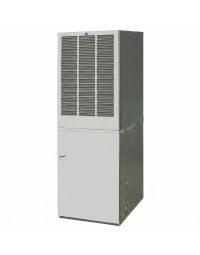
Mobile-home furnace replacement starts with confirming that the new equipment is approved for the home's installation, not simply finding a furnace with similar dimensions or BTU output. Cabinet fit, downflow connections, return air, fuel supply, and cooling compatibility can all change which model is suitable.
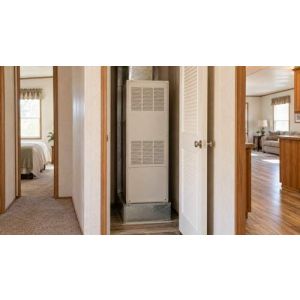
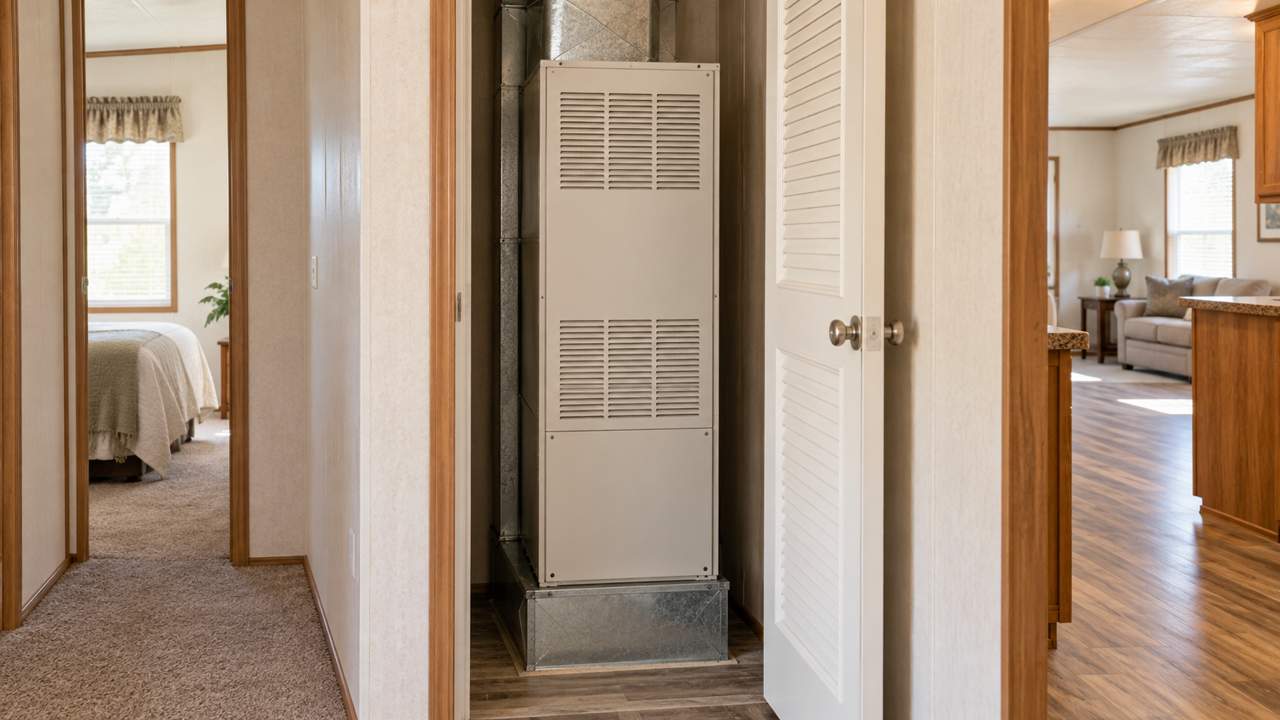
A manufactured home's heating system may use a compact furnace closet and ducts below the floor. Replacing that furnace calls for a system-level assessment rather than assuming a conventional residential furnace is interchangeable. This guide focuses on replacement planning; installation, fuel conversions, electrical work, and commissioning belong with qualified professionals.
Why Does Manufactured-Home Approval Matter?
Start with the exact model's installation instructions and listing. Look for explicit approval for the type of home and proposed installation. A product described as a downflow furnace is not necessarily approved for manufactured housing, and an efficiency rating does not establish that approval.
Mobile homes, manufactured homes, modular homes, and site-built homes are not interchangeable installation categories. Tell the installer what type of structure you have and provide available home and equipment identification. The installer should verify the applicable requirements with the local authority rather than relying on a retailer's category name alone.
Existing equipment is useful evidence, but it is not proof that the old installation was correct. Have prior modifications, replacement bases, combustion-air openings, and duct connections evaluated before repeating them.
Cabinet Dimensions Are Only Part of the Fit
Measure the closet and access opening, then compare the replacement's required service clearances, orientation, base, and accessory dimensions. Include any coil cabinet or filter assembly. A cabinet that can be squeezed through the door may still lack proper maintenance access.
Check Downflow and the Floor Connection
Many manufactured-home systems deliver air downward into a floor duct system. The furnace, listed base or duct connector, floor opening, and duct must work together. Do not assume a connector from the old furnace is compatible with a different model.
The installer should check for damaged ducts, disconnected sections, restrictions, and leakage. A new furnace will not correct a poor distribution system. If rooms remain uncomfortable, see our guide to duct leakage that can make new HVAC equipment feel undersized.
Keep Return Air and Filters in the Plan
Return-air openings and filter locations vary by furnace and installation. Closet doors, grilles, and nearby obstructions can affect airflow. Follow the exact installation instructions; do not cover louvers, add restrictive filters, or alter a door just to make the replacement look cleaner.
Gas vs Electric Mobile-Home Furnaces
The existing energy source is an important starting point, but changing fuel type is a separate project that needs its own assessment. Do not compare equipment prices without accounting for the supply, venting, controls, and installation changes.
| Replacement type | What needs verification? | Do not assume |
|---|---|---|
| Natural-gas furnace | Approved application, gas supply, venting, combustion air, electrical connection, and airflow | The old roof jack or vent fits every new furnace |
| Propane furnace | Exact model approval, any listed conversion kit, fuel pressure and supply, venting, and commissioning | A natural-gas furnace is ready for propane out of the box |
| Electric furnace | Approved application, heater capacity, voltage, circuits, conductors, service capacity, and airflow | The existing wiring supports any replacement kW rating |
Gas Furnaces: Venting and Combustion Air
Manufactured-home gas furnaces can have model-specific sealed-combustion, vent, and roof-jack requirements. Have the exact approved components and their condition checked. Reusing an old roof jack is not a blanket recommendation, even when the new furnace looks similar.
A condensing model can require a different vent arrangement and condensate drainage. Plan the approved route, termination, and drainage before buying. Do not improvise vent connections or fuel conversions. If you smell gas, leave the area and contact the gas supplier or emergency services from a safe location.
Electric Furnaces: kW and Electrical Capacity
Electric furnace heat output is commonly described in kilowatts. That rating does not tell you whether the home's panel, service, circuits, and wiring can support it. The replacement's exact electrical requirements must be checked by a qualified professional.
Changing from gas to electric can involve substantial electrical work. Likewise, a higher-kW electric furnace is not a safe shortcut for solving cold rooms. Size the heat output and verify airflow before selecting the electrical equipment.
Can You Keep the Existing Air Conditioner or Heat Pump?
Possibly, but the furnace blower, indoor coil, outdoor unit, controls, and installation arrangement need a compatibility review. Physical fit alone does not establish an approved combination or an efficiency rating.
Check the coil cabinet and service access, refrigerant compatibility, required airflow, condensate management, and the exact model documentation. If the outdoor equipment is also being replaced, compare a properly matched complete system with a furnace-only project.
A furnace or air handler advertised as compatible with a refrigerant does not mean every old coil or outdoor unit can be retained. A qualified installer should verify the complete combination and applicable refrigerant-safety requirements. Do not attempt refrigerant work yourself.
Choose Capacity and Efficiency Together
Ask for a heating-load assessment that reflects the home's climate, insulation, windows, air leakage, and other relevant conditions. Square footage and the old furnace's input number are not enough by themselves.
For gas equipment, distinguish input from output and compare AFUE separately from capacity. A replacement with a different efficiency can deliver a different amount of heat at the same input rating. Blower airflow also needs to suit the heating equipment, cooling system, and ducts.
Higher efficiency may reduce fuel use for the same useful heat, but installed savings depend on usage, fuel prices, the prior equipment, and installation quality. Compare the whole project rather than treating a rating as a guaranteed utility-bill reduction.
What Can Change Mobile-Home Furnace Replacement Cost?
The furnace is one part of the total. A quote may also need a duct connector or base, coil cabinet, vent or roof-jack components, condensate work, electrical changes, fuel-supply work, thermostat changes, permits, and commissioning.
Access and the condition of existing ducts can affect labor. Ask which accessories are included and which existing components the installer has verified for reuse. Compare itemized quotes with equivalent work rather than choosing solely by equipment price.
Before You Buy: Replacement Checklist
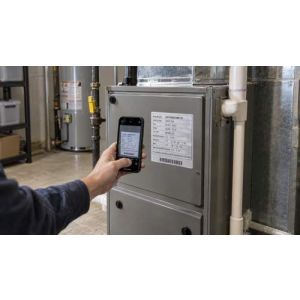
- Record the home's type and the complete existing furnace, coil, outdoor-unit, and thermostat model numbers.
- Confirm natural gas, propane, or electric heat and any conversion labels.
- Photograph the closet, access opening, floor connection, return openings, and existing vent arrangement without opening electrical compartments.
- Have the heating load, duct condition, airflow, and service clearances assessed.
- Verify manufactured-home approval for the exact replacement and installation.
- Confirm every required base, connector, vent component, coil cabinet, control, and conversion accessory.
- Include permits, startup testing, warranty requirements, and maintenance access in the installation plan.
Browse mobile-home electric furnaces, then have the exact model and accessories checked against your installation before ordering.
Frequently Asked Questions
Can I put a regular house furnace in a mobile home?
Do not assume so. The exact furnace must be approved for the home's application and installed according to its listing, instructions, and applicable requirements. Downflow orientation or a matching cabinet width is not sufficient proof.
Can I replace only the furnace?
Sometimes. The existing cooling equipment, coil cabinet, ducts, controls, and connections must be compatible with the replacement. Have the complete system checked before deciding what can stay.
Can an old roof jack be reused?
Only if the exact replacement instructions permit the arrangement and a qualified installer verifies compatibility and condition. Do not reuse it simply because it connects to the old furnace.
Should I buy a larger furnace if the far rooms are cold?
Not without diagnosis. Duct leakage, restrictions, return-air problems, insulation, and equipment faults can cause uneven comfort. Increasing capacity does not necessarily solve those issues.
Choose a mobile-home furnace replacement by verified approval, capacity, airflow, and installation compatibility so the equipment you order fits the home as a complete system.