We use cookies to make your experience better. To comply with the new e-Privacy directive, we need to ask for your consent to set the cookies. Learn more.

1-800-397-1392
Today's Hours 8am - 11pm est


Mitsubishi’s 4 zone air conditioner and heat pump systems provide combined heating and cooling for 4 areas of your home.
Customize your system: Use the Shop-By filters at left to choose between wall or ceiling air handlers with the right combination of BTUs needed for each room.

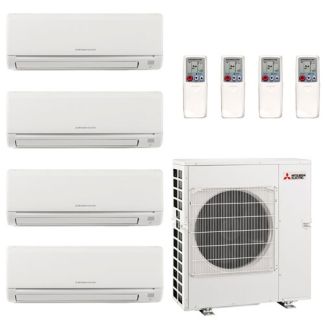
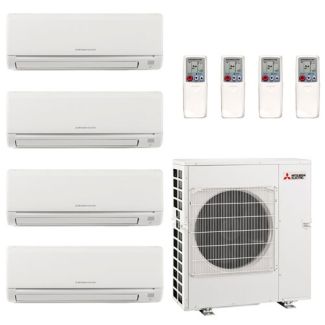
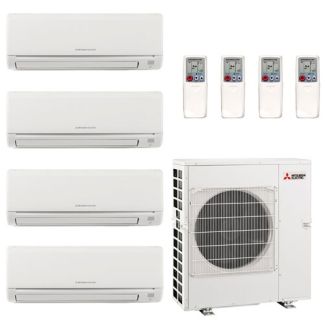
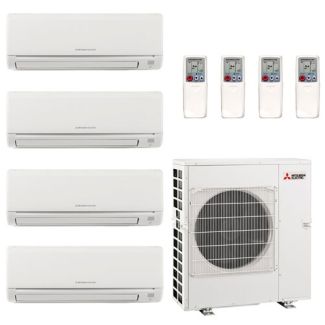
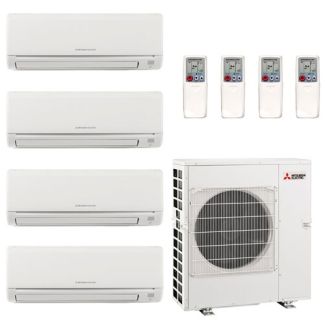
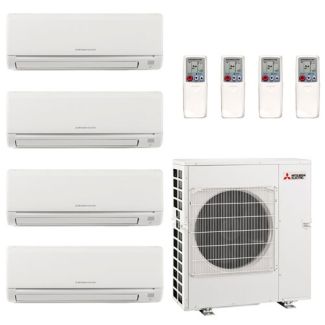
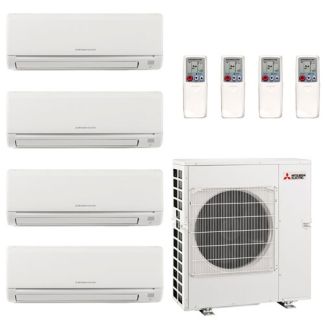
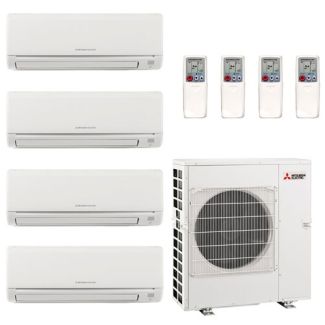
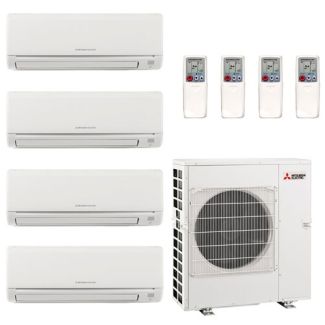
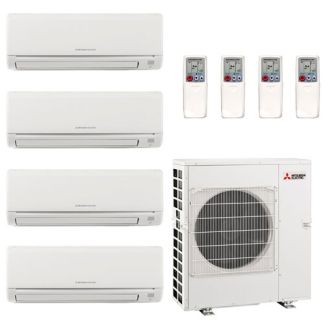
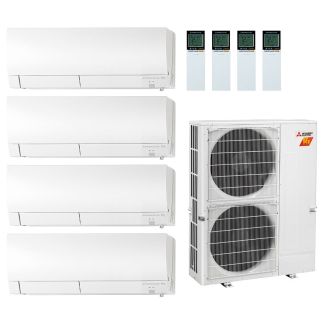
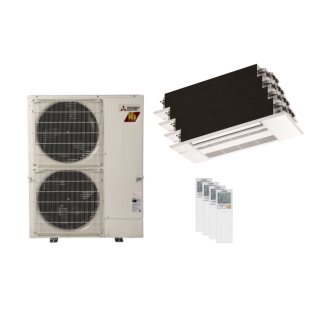
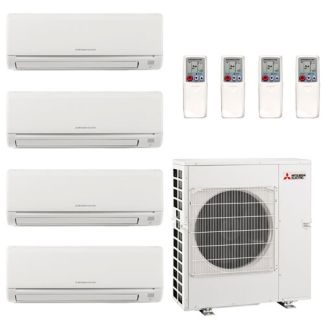



Mitsubishi 4 zone mini split systems are ductless heating and cooling systems that connect one outdoor condenser unit to four independent indoor air handlers, allowing four separate rooms or areas to be conditioned simultaneously with no shared ductwork required.
These systems work by circulating refrigerant between the outdoor unit and all four indoor units, absorbing heat from each zone and releasing it outside during cooling, then reversing that flow to deliver warmth indoors during heating. Mitsubishi's variable-speed inverter technology continuously adjusts the outdoor compressor's speed in response to real-time demand across all four indoor rooms, using only the energy each zone actually requires at any given moment.
Mitsubishi 4 zone mini split systems are typically designed to heat and cool up to 2,700 sq. ft. across four zones in well-insulated residential or light commercial spaces with standard 8- to 9-foot ceilings. They thrive when used in multiple spaces with different comfort needs, varying usage levels, no ductwork, and not connected to any central system you may already have. Here are some typical use cases:
Four-Bedroom Homes or Upper Floors: A home with four bedrooms occupied by people with different temperature preferences is one of the most common uses for a Mitsubishi system. Each occupant controls their own room independently without affecting anyone else, which is a practical solution that a central system with a single thermostat cannot replicate.
Homes with Multiple Additions or Renovations: A house with additions such as a sunroom, in-law suite, garage conversion, and a bonus room above the garage can be tough to heat and cool. The original system often can't reach these new spaces. A 4 zone Mitsubishi mini split conditions each area independently, eliminating the need to extend ductwork through multiple walls and ceiling cavities, which can be costly.
Multi-Level Homes with Four Distinct Areas: Homes with rooms on different levels, such as a main-floor bedroom, an upper-floor office, a below-ground basement, and an attic, often require separate heating and cooling from a system like this one. This is because heat rises, and a single thermostat can't reliably control the temperature across different floors. Having separate zones for each level is more effective and efficient than trying to balance the temperature with one ducted system.
Medium-Sized Older Victorian Homes: Older homes often lack space for bulky ductwork, making a ductless four room Mitsubishi mini split a great solution. These systems allow you to heat and cool the main gathering areas, such as a living room or kitchen, while maintaining individual units in separate bedrooms without compromising the home's original architecture.
Mixed-Use Light Commercial Spaces: Office suites, medical or wellness facilities, and mixed-use commercial buildings with four distinct zones can benefit from individual temperature control for each occupied area. You can also heat and cool spaces such as server rooms, reception areas, private offices, and treatment rooms as well with this Mitsubishi system. Since they all have different heat loads and occupancy patterns, individual zone control is a great energy-efficient solution.
Environmental factors like extreme cold, blocked outdoor airflow from snow or debris, high humidity, and salty coastal air can significantly reduce the heating capacity and operational efficiency of these systems. These issues should be addressed or taken into account when sizing.
These systems come in outdoor unit capacities ranging from 36,000 to 48,000 BTU, covering combined spaces from roughly 1,500 to 2,700 sq. ft. Each of the four individual air handlers covers anywhere from 6,000 to 24,000 BTU, up to about 1,500 sq. ft., with the total combined capacity adding up to close to the outdoor unit’s rating. Here’s what each size is typically used for:
36,000 BTU (1,500 to 2,000 sq. ft.): A mid-range system covering four rooms, typically used for apartments, medium houses, or large combined living areas. Common BTU configurations for the air handlers include 6k+9k+9k+12k, 9k+9k+9k+9k, and 6k+6k+9k+15k, which suit combinations like a living area paired with three bedrooms.
42,000 BTU (1,800 to 2,400 sq. ft.): Usually used for larger family homes or multi-story buildings with a couple of rooms that need a higher BTU capacity paired with a couple of smaller ones. This system can heat and cool rooms, such as sunrooms and basements, paired with new additions, without extending the current ductwork of any existing central system.
48,000 BTU (2,000 to 2,700 sq. ft.): Suited for large homes with multiple substantial living areas, oversized primary suites, or spaces with slightly above-average heat gain from poorer insulation, higher ceilings, or significant glass exposure across all four zones.
You can customize your Mitsubishi four room system with the "Design Your Own System" tool on HVACDirect.com and combine different air handler types and BTU capacities to match your space’s specific needs.
The total cost, including equipment pricing and installation, for a 4 zone Mitsubishi mini split usually ranges from $10,000 to $20,000+, depending on the complexity of the installation and the system's capacity and efficiency. Here is a typical breakdown of the costs:
Equipment Cost: $6,000 to $13,000+, depending on air handler type and BTU capacity. This covers the outdoor condenser, four indoor air handlers, and handheld controllers. Mitsubishi is considered one of the more premium brands for mini splits, so their equipment is often more expensive than others.
Installation and Labor Cost: $3,000 to $6,000+, including licensed pros handling refrigerant lines, licensed electricians setting up electrical connections, and system commissioning. Labor costs will depend heavily on local rates.
Operation and Maintenance Cost: Operating costs average $40 to $100 per month for power, though they depend heavily on your local rates and usage levels. Professional cleaning and maintenance range from $100 to $450+ annually, with higher costs if there are any issues beyond regular cleaning.
For your system setup, don't forget to budget for critical accessories like drain pumps, heavy-duty outdoor mounting pads, line set covers, and Wi-Fi interface modules, which will add $300 to $1,200 to your total cost. Permit costs will add another $100 to $500, depending on your local jurisdiction, the scope of the installation, and whether electrical upgrades are required.
All Mitsubishi systems, including four zone systems, must be installed by a licensed HVAC professional, as these systems are not considered DIY or designed for self-installation. Here are some details on the best path for installing your system:
DIY Installation: Mitsubishi does not offer DIY systems for any of its mini splits, including 4 zone models. These systems must be installed by a licensed professional, preferably a Mitsubishi Diamond Contractor. If you install one of these systems yourself, your warranty will be voided regardless of whether the installation was completed correctly.
Professional Installation: Mitsubishi four room systems must be installed by a licensed contractor to qualify for the warranty. When the system is registered within 90 days of installation, homeowners who choose a Mitsubishi Electric Diamond Contractor can qualify for an extended 12-year parts warranty and 12-year compressor warranty on qualifying residential installations.
A certified electrician must handle all electrical wiring, and your HVAC contractor will typically obtain or help coordinate any required permits for your 4 zone installation. These requirements will vary by city and country.
Mitsubishi four zone mini splits support four different indoor unit types, including wall mounted, ceiling cassette, slim ceiling cassette, and concealed duct. Here are some details on when to use each:
Wall Mounted Air Handler: Mitsubishi's 4 zone lineup includes the most widely available indoor unit style, the wall mount air handler, offered in a broad range of BTU sizes and series. Wall mounted units are installed high on an interior wall and are the most common choice for bedrooms, home offices, and everyday living spaces, available in 4 zone configurations.
Ceiling Cassette Air Handler: Mitsubishi ceiling cassettes mount in the ceiling, distributing air in four directions, making them suitable for open-plan areas and commercial spaces where wall mounted units are visually intrusive. A typical configuration for one of these systems might include one cassette in a great room and three wall mounted units in surrounding bedrooms.
Slim Ceiling Cassette Air Handler: Mitsubishi's EZ FIT ceiling cassette series is specifically designed for homes with limited ceiling cavity depth, fitting between standard 16-inch joist spacing with minimal structural modification. In a 4 zone system, homeowners often use slim cassettes in bedrooms, bonus rooms, or finished basements to achieve a low-profile appearance without sacrificing independent room-by-room temperature control.
Concealed Duct Air Handler: Mitsubishi concealed duct air handlers are hidden above ceilings, inside soffits, or within closets and distribute conditioned air through short duct runs and discreet supply vents. In a 4 zone configuration, homeowners commonly use concealed duct units to serve primary suites, living areas, or connected room groupings while maintaining the appearance of a traditional central HVAC system.
Homeowners might pair a wall mounted MSZ-FX unit in a bedroom, an SLZ ceiling cassette in a great room, an MLZ EZ FIT cassette in a bonus room, and an SVZ concealed duct unit in a primary suite. HVACDirect.com makes it easy to customize these combinations with our “Design Your Own” tool, allowing you to build a four room unit tailored to your home's layout, comfort preferences, and aesthetic goals.
Mitsubishi 4 zone mini split systems typically require a dedicated 208/230V electrical circuit, a 20- to 40-amp double-pole breaker, and 10-gauge power wiring, though exact requirements vary by model and capacity. Always verify the Minimum Circuit Ampacity (MCA) and Maximum Overcurrent Protection (MOP) listed on the outdoor unit's nameplate before any electrical work begins, as these values determine the correct circuit and breaker sizing for your specific system.
Voltage: Most Mitsubishi 4 zone outdoor units require a dedicated 208/230V, single-phase, 60 Hz electrical supply and are designed to operate within an allowable voltage range of approximately 198V to 253V.
Amperage and Breaker Size: Most 30,000 to 36,000 BTU Mitsubishi 4 zone systems require a dedicated 20- to 25-amp double-pole breaker, while 42,000 BTU systems typically require a 25- to 30-amp breaker. Most 48,000 BTU systems require a 30- to 40-amp breaker, but the MCA and MOP printed on the unit's data plate should always be used when sizing the circuit and breaker.
Wiring: Most 4 zone installations use 10/2 or 10/3 AWG copper wire from the electrical panel to the outdoor disconnect box. Communication between the outdoor condenser and each indoor air handler typically uses 14/4 or 16/4 AWG stranded copper communication wire, and communication wiring should be routed separately from high-voltage power wiring to prevent signal interference.
Dedicated Circuit and Disconnect: The outdoor unit must have its own dedicated circuit with no shared electrical loads. A weatherproof disconnect box rated between 30 and 60 amps is typically installed within sight of the outdoor unit to meet electrical code requirements and allow safe servicing.
If you don't follow the electrical requirements for your Mitsubishi 4 zone model, you might end up with problems like nuisance breaker trips and communication errors between indoor and outdoor units. This can lead to poor system performance and equipment damage. You could also face code violations and, in some cases, have portions of the manufacturer's warranty voided.
Mitsubishi 4 zone mini splits are highly energy-efficient, with SEER2 ratings ranging from 18 to 24. Entry-level MXZ-4D Series systems typically deliver around 19 to 21 SEER2, while premium H2i, FX, and GX Series configurations can reach up to 23 SEER2. Mitsubishi's inverter technology continuously adjusts compressor speed to match the combined real-time demand across all four zones. This reduces energy consumption well below that of a fixed-speed system of comparable capacity.
Mitsubishi Electric, a division of the Japanese company Mitsubishi Electric Corporation, makes these systems. Mitsubishi Electric has been producing ductless mini split systems since the 1970s. They sell their heating and cooling products in the US through a joint venture with Trane Technologies, called Mitsubishi Electric Trane HVAC US.
Mitsubishi does not make DIY 4 zone mini split systems, and attempting to install one yourself voids the warranty regardless of whether the work was done correctly. All Mitsubishi multi zone systems must be installed by a licensed professional.
Installations completed by a licensed HVAC contractor typically include a 5-year parts warranty and a 7-year compressor warranty. If your system qualifies and is installed by a Mitsubishi Diamond Contractor, you can receive up to a 12-year parts and 12-year compressor warranty when registered within 90 days of installation. You must have proof of installation to receive this extended coverage, and it is required for all claims. Any self-installations or DIY installation voids the warranty completely.
The majority of Mitsubishi multi zone systems, including those for 4 spaces, are heat pumps and can provide both heating and cooling. Heat pumps work by moving existing heat rather than creating it, allowing them to absorb heat from the outside and move it indoors and, in the summer, reverse this process to act like an air conditioner. Some models even include Hyper Heat (H2i) technology that maintains effective heating output down to outdoor temperatures as low as -13°F. You can set different temperatures in each of the four rooms, though they must all run in the same mode, heat, cool, or fan, at the same time.
Mitsubishi 4 zone systems are durable and reliable, and with regular cleaning, can last 15 to 20 years. Some high-efficiency ones can even last up to 25 years if properly maintained. Other factors that influence a mini split’s lifespan include whether the system was installed correctly, how consistently all four indoor units’ air handlers are cleaned, and whether debris is kept away from the outdoor unit year-round.
Mitsubishi 4 zone outdoor units typically produce 50 to 58 dB of sound, similar to a dishwasher, while indoor units operate between 19 and 45 dB, ranging from a whisper to a quiet room. The indoor unit sound level depends on the fan speed as well as the indoor air handler type, with wall mount indoor units being the quietest. Mitsubishi's quietest indoor units, including the newer FX and GX models, operate as low as 18 to 19 dB on their lowest fan settings.
All Mitsubishi mini splits, including those for four spaces, naturally dehumidify each zone during cooling. Dehumidification occurs during cooling: as warm, humid air passes over the cold indoor coil, moisture condenses and drains out through the condensate line. Most also include a dedicated dry mode that lowers humidity without excessive cooling, which is useful during warm, humid weather.
You should clean all four indoor unit filters every 2 to 4 weeks and more frequently in dusty or heavily used spaces. Most units have washable filters, so all you have to do is remove them, rinse them with water, let them dry, and reinstall them. To strengthen your warranty claim submissions and help extend the life of your system, you should have the outdoor unit and all four indoor units professionally cleaned and checked every year. This is to ensure the refrigerant levels are okay, electrical connections haven’t been damaged, and the coil condition is good.
These 4 zone systems are designed to condition exactly four separate rooms or defined areas, with each zone independently controlled by its own thermostat or remote. If a fifth room needs to be added later, a 5 zone system is usually a better choice than attempting to heat and cool additional spaces with a system designed for four zones. In rare cases, an open-concept layout where two connected areas share natural airflow can be served by a single indoor head within a single zone, freeing the remaining three zones for other enclosed rooms.