Your cookie preferences
We use cookies to remember your preferences and understand how shoppers use our site, helping us improve your shopping experience.
Read our privacy policyShop By Zone
Shop By Brand








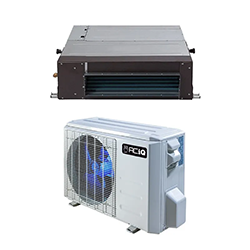
A concealed duct mini split is an indoor air handler tucked behind a wall, above a ceiling, or beneath the floor, delivering heating and cooling through short duct runs to the space it serves. Often referred to as ducted, slim duct, or ceiling concealed units, they house the blower wheel, evaporator coils, and filtration components entirely out of sight, with only small grilles visible in the finished space.
The unit pulls room air in through a return vent, filters it, and passes it across refrigerant coils connected to the outdoor condenser, where it is either heated or cooled before a built-in fan pushes it through the attached ductwork and out through the supply vents. Because the air handler is fully hidden above the ceiling or inside a soffit, with only small grilles visible in the finished space, this style is easily the most discreet indoor unit option in the mini split category.
Features like adjustable static pressure, built-in condensate pumps, and flexible duct configurations can make a real difference in both comfort and installation flexibility. Given the fact that this equipment will be located behind ceilings or inside soffits and, thus, be very hard to reach after installation, it would definitely be wise to spend a bit of time choosing proper features at the outset, especially those that affect airflow and condensate management in particular. The following are some features to look for:
Adjustable Static Pressure: Since concealed models distribute air using ducting systems and not by distributing air directly, it is crucial to have a fan motor that offers adjustable external static pressure. The higher the static pressure capacity, which ranges between 0.6 inches up to 1.0 inch of water column, the more efficiently the air handler will be able to distribute air through long distances or numerous vents.
Built-in Condensate Lift Pump: Since such units are generally installed in confined locations where drainage by gravity is not possible, it is a good idea to have a built-in high-lift condensate pump. Otherwise, there is a need for a separate pump that must be mounted on the outside and this is definitely more troublesome after installation.
Wired Wall Thermostat or Smart-Home App Integration: As the unit is not visible, it is customary for the ductwork to be controlled using a wired wall thermostat rather than a remote. At the time of purchase, you should decide whether you want your unit to work with smart thermostats or use Wi-Fi connectivity via an additional adapter.
Return and Supply Air Flexibility: These systems give installers the freedom to position supply and return ducts in a way that best suits the room layout and available ceiling space. Flexible ducts are significantly easier to install when beams or other barriers are present than rigid metal ducts, especially in cramped spaces like attics, soffits, or areas above ceilings.
Low-Profile Design and Accessibility: Ductless, hidden units like the ACiQ Concealed Duct series are designed to fit into shallow ceiling spaces, soffits, or attics where vertical clearance is limited to as little as 8 to 12 inches. Slim ducted models from Mitsubishi, Daikin, and LG take a similar approach with compact cabinet designs that also incorporate accessible filter panels and service ports, making routine maintenance and future repairs considerably easier and less costly.
Adjustable static pressure, duct flexibility, and compact cabinet design are some of the characteristics that make this system different from wall mounted or ceiling cassette units. These features are significant to enable the quiet and consistent airflow that will allow the system to achieve its intended purpose.
Concealed duct mini splits work well in spaces ranging from about 400 to 3,000 square feet, as long as the ceilings are high enough and the ceiling or soffit is deep enough to fit the air handler and ductwork out of sight. For homeowners who want equipment that stays hidden, runs quietly, and delivers more consistent airflow than a wall mounted or floor unit, this style is often the better fit. Open-concept living areas, historic homes, home theaters, and finished attics are some of the most common places where these systems shine. Here are a few of the top spaces to consider:
Open-Concept Living Areas: These systems are a natural fit for large open-concept living rooms, kitchens and dining areas as air can be distributed through multiple supply vents rather than a single point. They help maintain even temperatures throughout a large area, something wall mounted and floor mounted units often struggle to do in open layouts.
Historic or Architecturally Sensitive Rooms: Wall mounted air handlers can be out of place style-wise in historic homes or custom spaces, or in rooms with exposed beams, detailed trim, stone fireplaces, or high-end finishes. Ducted mini split systems avoid that problem altogether by hiding behind ceilings, walls, or floor cavities with only small supply and return grilles visible in the finished space.
Master Bedrooms, Home Theaters, or Other Sound-Sensitive Spaces: Hidden duct mini splits are a great option for bedrooms, media rooms, and home theaters because the air handler is tucked away in a ceiling cavity, attic, or soffit, putting walls and structure between the unit and the living space. That separation makes a big difference, with airflow and fan noise far less obtrusive than what most visible indoor units produce, which is just what you want in a room intended for sleeping or watching movies.
Custom Sunrooms and Solariums: Sunrooms and glass-heavy spaces are another good match for concealed duct systems, since supply vents can be positioned to direct air right where it is needed most, such as along large windows or sliding glass doors. This helps control the heat gain, condensation, and uneven temperatures common in these spaces without the need for a bulky wall mounted unit that disrupts the open feel of the room.
Finished Attics and Lofts: Attics and loft spaces are difficult to condition because of their sloped ceilings, knee walls and limited vertical wall space, which often preclude the use of wall mounted and ceiling cassette units. Often a concealed air handler can be tucked away in unused eave space or a soffit and you can feed air through low profile grilles for a cleaner look and better coverage throughout the space.
Rooms without a usable ceiling cavity, such as those under a flat roof or concrete slab, are generally not a good fit for concealed duct systems. The same goes for spaces where the ceiling depth is too shallow to accommodate the air handler and condensate components. Rooms with poor insulation, significant air leaks, or notable heat loss around windows and doors can also undermine system performance enough that the higher installation cost becomes difficult to justify.
Installing a concealed duct mini split indoor unit requires enough ceiling or attic space, clear paths for ductwork and refrigerant lines, proper condensate drainage, and a matching outdoor condenser. These units require the most effort to install among mini split indoor units. Therefore, careful planning before installation can improve system performance and prevent costly ceiling repairs down the line. Here is what each requirement involves:
Mounting Location Requirements: Concealed duct mini split air handlers need to be installed in a hidden structural space, such as a ceiling cavity, attic, soffit, or crawl space, with at least 10 to 12 inches of vertical clearance for the unit, refrigerant connections, and condensate components. The framing must be strong enough to support the air handler long term without sagging or damaging the ceiling, and the unit should have 6 inches of clearance on all sides for future maintenance. Duct runs should be reasonably short to help the system maintain proper airflow within its static pressure limits.
Routing Space for Lines and Drain: You need enough space to route refrigerant lines, communication wiring, short duct runs, and a condensate drain from the indoor unit to the outdoor condenser, typically through a 3- to 4-inch wall penetration. The condensate drain is usually a 5/8-inch PVC pipe or a flexible hose that must maintain a continuous downward slope of at least 1/4 inch per foot for proper gravity drainage; if not, the system must include a condensate pump to lift the water to a suitable drain point. Because these components are hidden inside ceilings or walls, concealed duct systems generally require more routing labor and planning than other air handler types.
Outdoor Unit Compatibility: Concealed duct indoor units must be paired with a compatible outdoor condenser from the same manufacturer, using the manufacturer’s approved model-pairing documentation. We recommend purchasing a matched, AHRI-rated mini split system to ensure the voltage, refrigerant type, communication wiring, and BTU capacity are all certified to work together properly. This helps prevent communication faults, refrigerant problems, poor performance, and warranty issues.
DIY or Professional Installation: Concealed duct mini split systems almost always require professional installation because the project involves ceiling modifications, duct design, refrigerant line routing, electrical work, system evacuation, airflow balancing, static pressure calculations, and condensate drainage planning. Ducted installations are significantly more complex than wall mounted mini splits, and most manufacturers require installation by a licensed HVAC contractor to maintain warranty coverage and ensure the system operates as designed.
You need a permit for ceiling mount mini split installations in most jurisdictions because these systems often involve ceiling modifications, condensate drainage, and dedicated circuit work. Checking with your local building department before installation begins can help prevent failed inspections, code violations, or costly rework later in the project.
Hidden duct air handlers are among the most expensive indoor units for mini splits, costing $350 to $3,000+ for the indoor unit alone, depending on the brand, BTU capacity, static pressure rating, and included controls. ACiQ concealed duct units are among the most affordable, usually ranging from $200 to $1,000+, while MRCOOL models in its Olympus concealed duct series commonly range from $800 to $1,500+. Brands like Mitsubishi and Daikin usually cost more, with Mitsubishi concealed duct air handlers typically ranging from $1,300 to $2,000+ and Daikin models commonly ranging from $900 to $2,000+ due to quieter operation, enhanced humidity management, and more advanced airflow control features.
While concealed duct air handlers can be purchased separately, most homeowners are better off purchasing a complete mini split system to ensure the indoor unit, outdoor condenser, controls, and refrigerant capacity are fully compatible. Single-zone concealed duct systems typically range from about $800 to $6,000+, while multi-zone systems commonly range from $1,500 to $12,000+ depending on the number of zones, BTU capacity, efficiency rating, and brand. Purchasing a matched system also helps maintain AHRI-rated performance, warranty coverage, and proper communication between the indoor and outdoor equipment. Because concealed duct units have specific airflow, static pressure, and capacity requirements, buying a complete system helps avoid compatibility issues that can impact performance and efficiency.
Concealed duct installation is consistently the most labor-intensive indoor unit style, with costs averaging $1,500 to $4,000. Installation costs will be on the lower end if you're installing only one air handler and your space layout has an accessible ceiling cavity, a short duct run, and requires little to no framing modifications. Jobs involving custom ceiling framing, longer refrigerant line routing through finished spaces, multiple supply vents, or difficult access for the condensate drain can push total indoor unit labor to the high end. Permit fees for mechanical and electrical work typically range from $100 to $400, depending on your local jurisdiction, and any ceiling patching, drywall repair, or register finish work required after installation is complete will add additional costs you should budget for.
These air handlers are available in anywhere from 9,000 to 60,000 BTU and cover up to 3,000+ square feet. They are more commonly used in multi zone setups than single zone, but are available for both. Some common BTU capacities include:
9,000 to 12,000 BTU (400 to 600 sq. ft.): Small concealed duct units are a great choice for bedrooms, home offices, guest rooms, and small apartments where you want quiet comfort without seeing a wall mounted air handler. They're quiet and won't clutter the space. Homeowners often choose these systems to keep the room looking cleaner and more upscale while still getting even airflow through ceiling or wall vents.
15,000 to 18,000 BTU (500 to 1,000 sq. ft.): Mid-sized concealed duct air handlers are a good choice for larger bedrooms, open living rooms, studio apartments, finished basements, or connected spaces. They work well in these areas because they can handle longer duct runs and provide more airflow. This is useful when you have irregularly shaped rooms that need multiple supply vents to evenly condition them.
24,000 to 30,000 BTU (1,000 to 1,750 sq. ft.): Larger concealed duct units are commonly installed in open-concept living areas, multi-room zones, small commercial offices, or larger home additions with higher occupancy loads and longer ductwork layouts. These systems can support more supply registers and typically offer higher static pressure for improved airflow distribution.
36,000 to 48,000 BTU (1,500 to 2,700 sq. ft.): Higher-capacity concealed duct units are ideal for large open floor plans, custom homes, retail spaces, or large finished basements with several rooms connected. At this size, concealed duct systems often outperform wall mounted units in comfort because they can move more air more evenly throughout the space via multiple supply vents.
54,000 to 60,000 BTU (2,500 to 3,000+ sq. ft.): The largest concealed duct mini split indoor units are often installed in luxury homes, large custom additions, offices, or light commercial buildings where appearance, quiet operation, and whole-area airflow matter. Homeowners usually choose these systems for larger projects when they want a cleaner look and more even comfort, similar to central air, but without installing a full traditional ducted HVAC system.
Concealed duct mini split units are tricky to fix once installed, especially since they're hidden above ceilings or in tight spaces. If sizing or ductwork is off, it can be extremely difficult and expensive to correct. Proper sizing is key to maintaining correct airflow, minimizing static pressure issues, reducing noise, improving humidity control, lowering energy costs, and preventing premature wear caused by oversized systems short-cycling or undersized systems running constantly.
Concealed duct mini split indoor units work with compatible single zone and multi zone mini split condensers from the same manufacturer. However, the system must be approved and AHRI-rated for concealed duct applications. Since concealed duct systems depend on static pressure and ducted airflow instead of direct air delivery into the room, not every mini split condenser is designed to properly support this type of indoor air handler.
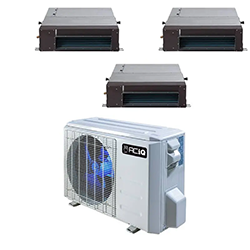
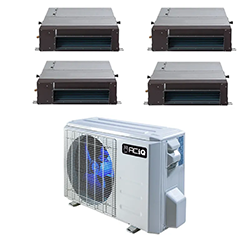
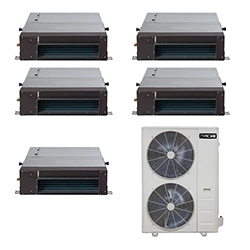
Condenser Zone Type: Concealed duct air handlers can work with single zone condensers or multi zone systems. These systems can also share wall mounted units, ceiling cassettes, or floor mounted units. Homeowners often pick concealed duct systems when they want one hidden air handler to supply multiple vents in different areas. This could include a bedroom suite, an open-concept area, a hallway, or several connected rooms. It keeps indoor units out of sight while still providing the comfort they want.
Condenser Brand Compatibility: You need to get an outdoor condenser from the same manufacturer as your concealed duct indoor unit. Using units from different brands is not allowed, voids warranties, and often leads to problems that are difficult to fix after the concealed unit is installed above a ceiling or inside a soffit. These problems include communication errors, refrigerant issues, airflow problems, and control failures.
Condenser BTU Capacity: Single zone ducted systems come with a condenser and a concealed duct air handler that match in BTU capacity. This setup ensures balanced performance and airflow. For multi zone systems, the outdoor condenser needs to be big enough to handle the total BTU load of all connected indoor units. It must also stay within the manufacturer’s approved zone allocation guidelines.
Condenser Voltage Compatibility: Most concealed duct mini split systems use 208/230V single-phase power. However, some smaller residential models come in 115V options. Before buying any component, make sure the indoor unit, outdoor condenser, and dedicated electrical circuit all match the same voltage specification.
Condenser Refrigerant Type: On any mini split system, including ducted models, the indoor and outdoor units must use the same refrigerant type. Mixing refrigerants will destroy the compressor. Older concealed duct systems commonly used R410A refrigerant, but new R410A HVAC systems can no longer be manufactured for sale in the United States due to federal refrigerant regulations that took effect in 2025. New concealed duct mini split systems now typically use lower-global-warming-potential refrigerants such as R454B or R32, which comply with current environmental requirements and industry standards.
Approved Model Pairing: Check the manufacturer's official compatibility and AHRI certification documents to make sure the indoor and outdoor units work together before buying equipment. An AHRI-rated mini split system makes certain the system provides its promised output and efficiency, keeps warranty coverage, and meets inspection requirements.
If these compatibility requirements are not met, concealed duct mini split systems can face weak airflow, excessive noise, communication failures, poor humidity control, frozen coils, higher energy costs, and early failure of the compressor or blower motor. Since concealed duct air handlers are placed above ceilings or in soffits, correcting a mismatched condenser or a poorly designed system after installation may require opening finished ceilings and replacing major components. This makes mistakes much more expensive than with other types of air handlers, like wall and floor mount.
Yes, concealed duct mini split indoor units are very energy efficient with most standard systems being rated between 16 and 20 SEER2. Many high-efficiency models go above 21 to 24+ SEER2. These units use short insulated duct runs within the conditioned space. This setup helps prevent the 20% to 30% energy losses that typically happen with traditional central HVAC ductwork. However, they need more power to push air through the ducts. As a result, they are slightly less efficient than other types of air handlers, like wall mount units.
Concealed duct mini split systems are typically heat pumps, providing cooling in summer and heating in winter by reversing the refrigerant cycle. In heating mode, the indoor unit sends warm air through ceiling registers, resembling a central forced-air system. This makes the concealed duct style a familiar heating and cooling option for homeowners moving from a traditional ducted system.
One of the bigger advantages of these units is their ability to serve multiple rooms through short, flexible duct runs, typically two to four adjacent spaces from a single air handler. Unlike other indoor unit types, though, you won't get individual temperature control per room, and you'll need a proper return air path when interior doors are closed. Low-static models, rated around 0.10 to 0.20 inches of external static pressure, work best for one to two rooms with short duct runs, while medium-static units rated around 0.30 to 0.60 inches can handle two to three rooms with more complex layouts. Trying to stretch one system across too many rooms is a common mistake that leads to uneven temperatures, increased noise, short-cycling, and a shorter equipment lifespan overall.
Some of the best hidden duct mini split indoor units come from ACiQ, Mitsubishi, and Daikin. Mitsubishi and Daikin concealed duct mini splits offer quiet operation, excellent humidity control, and strong cold-weather performance. ACiQ delivers solid efficiency and reliability at a friendlier price point. The right choice really comes down to your budget, your duct layout, your climate, and what matters most to you in a system.
Most concealed duct mini split systems require professional installation due to the complexity of the project, although a small number of DIY-compatible options are available.
Before choosing either option, verify local permit requirements and manufacturer warranty terms, as some systems require professional installation to maintain full warranty coverage.
Concealed duct mini splits are among the quietest systems available, with indoor sound levels typically ranging from 20 to 35 dB, quieter than a whisper. The low noise is due to the fact that the unit is placed in the ceiling or even above it, where the ceiling wall acts as a sound barrier, leaving just a slight noise coming from the supply vents.
These systems are very safe when properly installed and maintained, but the installation itself does require careful attention to a few key details. The air handler, whether placed above a ceiling, in a closet, or in an attic, needs adequate airflow, drainage, and service clearance to function as intended. Because most concealed duct units are designed for lower-static-pressure duct systems, poorly planned duct runs or restrictive vents can overwork the blower motor, leading to reduced efficiency, frozen coils, or overheating. Proper insulation of the refrigerant lines and a correctly installed condensate drain, whether gravity-fed or pump-assisted, are equally important for preventing water leaks and mold growth hidden inside your ceilings or walls.
Most concealed duct mini split systems last between 10 and 15 years, and with consistent maintenance, some units reach 20 years or more. The air handler itself tends to be quite durable, though if your system includes a condensate pump, that component may need replacement sooner given its additional moving parts. To get the most out of your system, keep the filter clean and schedule annual professional service that covers coil inspection, drain line checks, and refrigerant verification.
Like any HVAC system, your concealed duct mini split needs its filters changed and mechanical components cleaned on a weekly and monthly basis. Filters should be cleaned every two to four weeks, and a professional cleaning of the coils, blower wheel, drain pan, and condensate line should be done every six to twelve months. Neglecting this maintenance can lead to reduced airflow, lower efficiency, mold growth, and even costly water damage to your ceilings and walls.